
Traffic and pedestrian flow, the ways in which people move around, can be more complex than many people think. Much like traffic on highways, individual movements can create patterns of congestion and convergence. For example, the concept of how a disease can spread from person to person on a seemingly random basis can be illuminated when applying the science behind traffic flow— Yi Sun, a mathematics professor and researcher at the University of South Carolina, has developed a method to model human movement, with several potential applications.
Sun’s kinetic Monte Carlo method, a random probability simulation method, allows Sun to simulate many different types of research.
Originally a simulation tool that was created in the late 1940s in the Los Alamos National Lab for the Manhattan Project, the Monte Carlo method was developed to be a random chance simulator in which different factors are evaluated to see what happens. In the original Monte Carlo method, many random “trial moves” are done and subsequently rejected because they turn out to be impossible, making this method less efficient and more costly. Sun applied the kinetic Monte Carlo method to make the computational tool more efficient— Sun’s method only simulates actions and moves that are legitimately plausible, exerting less effort and spending less time on simulations that have no bearing on the research being done.
After joining USC in 2011, Yi Sun used the kinetic Monte Carlo method to simulate artificial organ and artificial tissue dynamics. This computational tool allowed Sun to model, simulate, and mimic how cells within artificial tissue work together with different variables in effect.
A decade later, Sun is now utilizing the same methodology to simulate traffic and pedestrian flow.
Aided by the Advanced Support for Innovative Research Excellence (ASPIRE) grant, Sun utilized his innovative computational method to examine epidemics by taking his model and simulating how people move from place to place, when each individual comes into contact with another, and how a disease transmits accordingly.
I want to apply everything to my method, the kinetic Monte Carlo simulation.
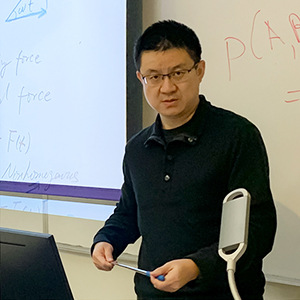
Though Yi Sun is a professor of mathematics, his kinetic Monte Carlo method has broad application in other fields as well.
In 2024, Sun published an article in a top transportation engineering journal: Transportation Research B: Methodological.
“I want to popularize the kinetic Monte Carlo method for engineering researchers,” Sun said. “This is not a mathematician’s journal, it is engineering, so that is why I feel very excited to run into their field. I hope other professors in engineering groups will see this work and I want to have a connection or collaboration with them.”
Collaboration is nothing new to Sun. The artificial organ and artificial tissue research conducted using the kinetic Monte Carlo method in 2011 was done in collaboration with several researchers across South Carolina through SC EPSCoR. In 2023, Sun collaborated with Ph.D. student Nutthavat Tamang with ASPIRE support. The two were able to apply the kinetic Monte Carlo method, named the dynamic Monte Carlo method in this research, to pedestrian evacuation dynamics in order to research how best to evacuate from a room during an emergency.
Sun elaborated, “You know, suppose there’s a group of people inside one room, a conference room or maybe a small room. If there’s an emergency like a fire, how are people running out from the door?”
ASPIRE support has made a world of difference for Yi Sun. The research funding from the Office of the Vice President for Research has allowed Sun to not only further his research, but also aided him in his personal motivation within academia and research.
“It gave me some initiative, some motivation, then with that motivation I can continue extending to a more detailed proposal for the external National Science Foundation or other agencies’ proposals,” Sun explained. “I really appreciate it. It gave me some motivation to think seriously about what I want to do and extend, to move forward into what I want to do for the next research project.”
As for what comes next, Yi Sun hopes that his kinetic Monte Carlo method is able to revolutionize the way that different industries use randomized computational tools. The current widespread usage of the traditional Monte Carlo method revolves around an inefficient and costly process, but the kinetic Monte Carlo method boasts a simulation that stays away from unnecessary computational costs, replacing a time-consuming and expensive process with one that is much more efficient. Moving out from his mathematical roots, Sun hopes to continue expanding into other fields, furthering his research in engineering, transportation, and beyond.