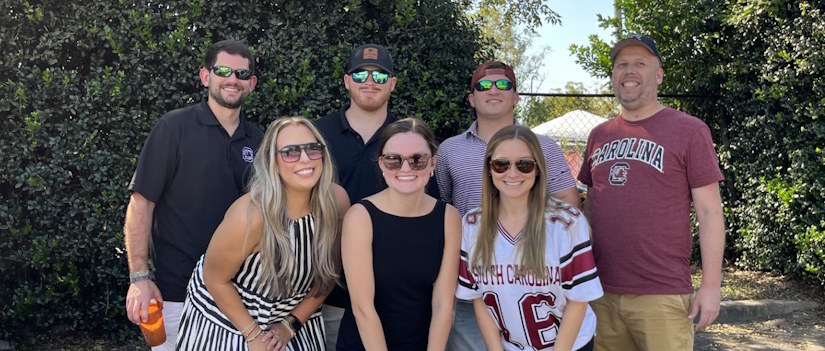
We asked Arnold School alumni why they chose the Arnold School, the mentors who influenced their journeys and how their degrees prepared them for their next steps.
Job Title: Statewide Employee Retention and Wellbeing Program Manager
Employer: SC Hospital Association
Arnold School Degree(s): B.A. in Public Health, 2020; MPH in Health Promotion, Education, and Behavior, 2026
How did you become interested in public health or your area of study? When I started college, all I really knew was that I wanted to help people, but I didn't necessarily want to work in a hospital or provide direct patient care. That led me to explore what other opportunities existed in healthcare, and that's how I discovered public health. I quickly realized that public health gave me the opportunity to help people on a larger scale through prevention, education, and improving the health of communities.
How did you decide to attend USC for your degree? I chose USC because it felt like home. My family are huge Gamecock fans, so I grew up around the university and always pictured myself there. Once I discovered the Arnold School and its public health program, it felt like the perfect combination of staying close to home while studying something I was genuinely interested in. I started with my Bachelor of Public Health and loved the experience enough to return several years later for my MPH in Health Promotion, Education, and Behavior.


Who were your Arnold School mentors, and how did they influence you? Dr. Edena Guimaraes was a particularly meaningful mentor throughout graduate school and encouraged me to think critically about how public health concepts translate into real-world practice. Because I completed my undergraduate degree in about two and a half years, I figured out a lot of my career path through my own experiences, particularly through internships with SC DHEC (now DPH) and SC Thrive. Those experiences, especially working in public health during COVID-19, helped me understand what public health actually looks like in communities and shaped the direction I wanted my career to take.
What were some of the most valuable knowledge, skills or experiences you gained during your program? The Arnold School taught me how to look beyond individual health outcomes and consider the larger systems, environments, and behaviors that influence people's wellbeing. I gained valuable skills in program planning, health education, evaluation, communication, and using data to inform decisions. Just as importantly, my experiences taught me how to build relationships, collaborate with different stakeholders, and turn public health concepts into practical solutions.
How did you get your start in your field? Both of my first full-time roles after college came directly from the internships I completed as an undergraduate, which showed me how valuable hands-on experience can be. I spent several years in the nonprofit space at SC Thrive, working to connect South Carolinians with resources and services that could improve their financial stability and overall wellbeing, and then spent several years at SC DHEC (now DPH) working in the health equity space. I am now grateful to be exploring a new area of public health through my work with the South Carolina Hospital Association, where I focus on workplace wellbeing and the healthcare workforce; an area of expertise I had not previously explored but have become incredibly passionate about.
What do you do in your day-to-day work, and how do you use your degree in your work? As the Statewide Employee Retention and Wellbeing Program Manager with the South Carolina Hospital Association, I lead and support initiatives designed to address the systemic factors contributing to healthcare worker burnout, disengagement, and turnover. My day-to-day work includes supporting the Workforce Experience Survey, coordinating trainings such as Adult Mental Health First Aid and Just Culture, facilitating learning opportunities for hospitals, developing resources, and working with healthcare organizations to identify and share strategies that improve workplace culture and the overall employee experience. My public health and HPEB background is woven into all of this work through program planning, behavior change, evaluation, communication, data-informed decision-making, and a focus on addressing the systems and environments that influence people's wellbeing.
How do you stay connected with other Arnold School alumni? I made some of my closest, lifelong friends through the Arnold School, and those relationships have continued well beyond graduation. I also stay connected through my professional work and involvement with the South Carolina Public Health Association (SCPHA), where I serve on the Board and have made new friendships and professional connections with other public health professionals across the state. One of my goals through that involvement is to help get more students engaged with SCPHA and the public health community early in their careers so they can begin building those relationships while they are still in school.
What advice would you give to students pursuing a similar career path? Don't feel like you have to know exactly what you want your career to look like when you graduate. Take advantage of internships, networking, and opportunities outside of the classroom because those experiences can open doors you didn't even know existed as my internships ultimately led directly to both of my first full-time jobs. Most importantly, stay curious and be willing to explore different areas of public health; my career has taken me from nonprofit work, to health equity, to healthcare workforce wellbeing, and each experience has built on the one before it.