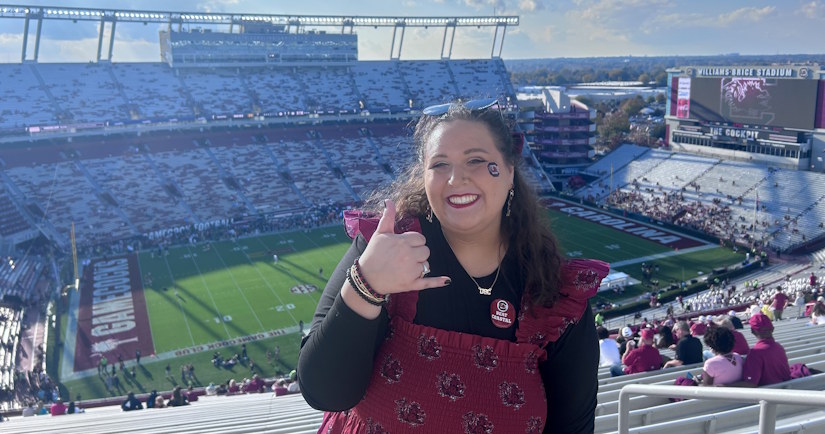
We asked Arnold School alumni why they chose the Arnold School, the mentors who influenced their journeys and how their degrees prepared them for their next steps.
Job Title: Speech Language Pathologist
Employer: Spartanburg Regional Hospital and HealthPro Heritage
Arnold School Degree(s): B.A. in Public Health, 2019; M.S. in Speech-Language Pathology, 2023
How did you become interested in public health or your area of study? I became interested in the field of speech pathology because of my grandparents. My grandmother and granddaddy both lived with neurological disorders: Guillain-Barré syndrome and Parkinson’s disease. As their diseases progressed, I watched as they struggled with everyday tasks such as eating and speaking. Seeing the impact these challenges had on their independence, their joy, and quality of life, inspired me to pursue a career geared towards helping individuals rehabilitate, maintain, and improve independence and confidence in their daily lives.


How did you decide to attend USC for your degree? I decided to pursue my bachelor’s degree in public health at USC because I have been a lifelong Gamecock fan for as long as I can remember and I was drawn to the prestige of the Arnold School of Public Health. My amazing undergraduate experiences reinforced my decision to continue my education at USC by pursuing a graduate degree in Communication Sciences and Disorders (COMD). The program’s reputation, high certification exam pass rates, post-graduation employment outcomes, and diverse clinical settings made it the perfect place for me to develop the skills and knowledge to become a speech language pathologist (SLP).
Who were your Arnold School mentors, and how did they influence you? My mentors at the Arnold School of Public Health include Dr. Neils-Strunjas, Dr. Beth Barnes, and the clinical faculty at the Montgomery Speech-Language-Hearing Clinic. Each of these wonderful individuals provided encouragement, advocated for me, listened when I needed it most, and provided education/resources. Through their guidance, I gained confidence in myself, my knowledge, and my clinical abilities. They taught me how to administer assessments, conduct evaluations, develop treatment plans, as well as provide individualized, compassionate, evidence-based care. Most importantly, they have shown me what it means to be a well-rounded SLP who combines clinical knowledge with empathy, professionalism, and a commitment to lifelong learning.
What were some of the most valuable knowledge, skills or experiences you gained during your program? The most valuable experience I gained during my time in the COMD program came through my clinical placements. Each semester, I had the opportunity to work in a different setting including hospitals, a skilled nursing facility, a public school, and the Montgomery Clinic on campus. These placements allowed me to apply the foundational knowledge I learned in the classroom to real-world situations, how to work with diverse populations, and enhanced my clinical and interpersonal skills.
How did you get your start in your field? My career began during my clinical fellowship in speech pathology in the skilled nursing facility setting in September 2023. Becoming a medical SLP had been my dream and it's surreal that I've accomplished it. Currently, I split my time between 3 skilled nursing facilities and in acute care.
What do you do in your day-to-day work, and how do you use your degree in your work? My day to day looks a little different each day, which is one of the things I love most about being a medical SLP. I conduct evaluations and provide treatments for dysphagia, cognitive communication disorders, aphasia, dysarthria, and dysphonia. I use the knowledge and skills I gained from both my COMD and public health coursework to evaluate and treat individuals from diverse socio-economic and cultural backgrounds. My education has prepared me to provide evidence-based, patient-centered care while considering each patient’s medical, social, and cultural needs to achieve the best possible outcomes.
How do you stay connected with other Arnold School alumni? I stay connected with other Arnold School of Public Health alumni through the life-long friendships I've made and social media. I love being able to collaborate, encourage, and learn from my fellow alumni.
What advice would you give to students pursuing a similar career path? My advice for students interested in pursuing a career in speech pathology is to shadow a speech pathologist. I had the opportunity to do this during undergrad in the acute care setting. My shadowing turned into an internship that gave me valuable insight into the profession while helping me build relationships with practicing SLPs, learn more about the acute care setting, and how to collaborate with the interdisciplinary team. I am so very thankful for the wonderful SLPs who helped and guided me during my internship and shaped me into the SLP I am today.