
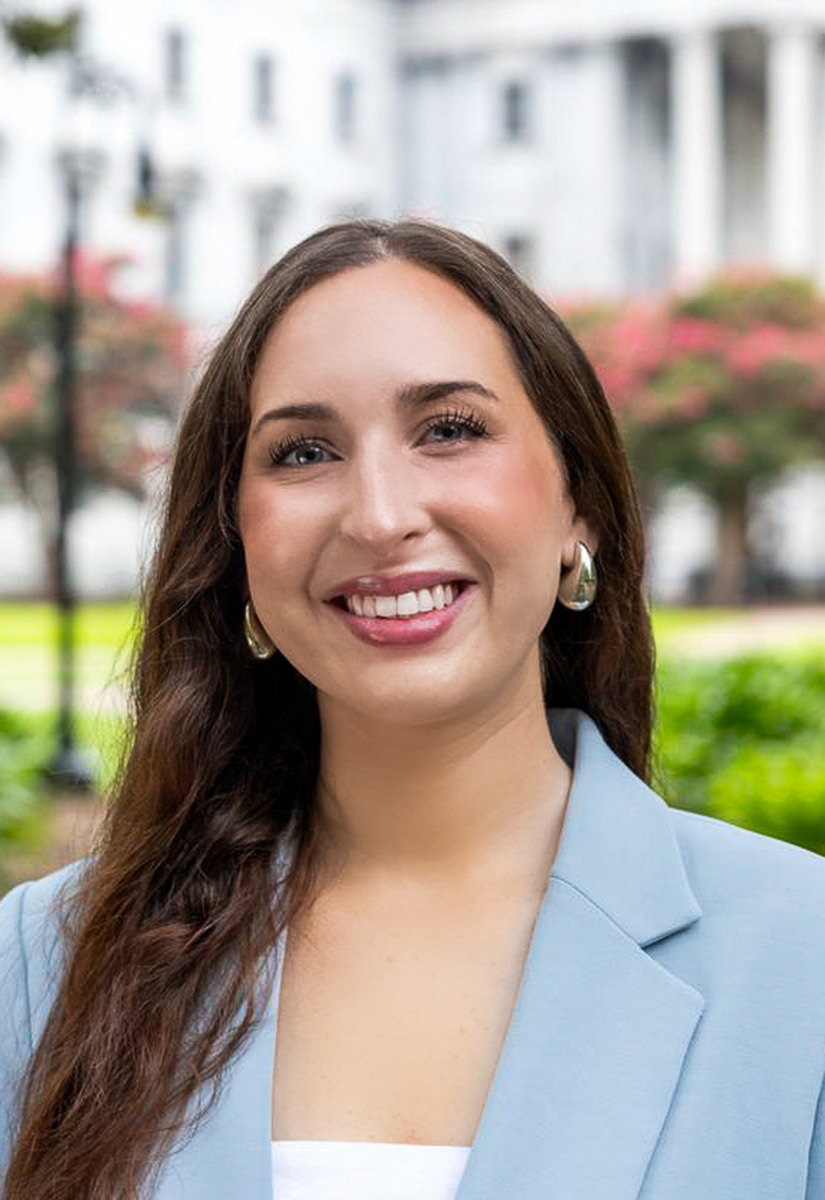
For Taryn Farrell, public health has always started with a question: Why?
That curiosity first brought her to the Arnold School of Public Health for her Master of Public Health in Health Services Policy and Management, and eventually to the South Carolina Institute of Medicine and Public Health (SCIMPH), where she now serves as research and policy manager, supporting policy-informing initiatives, facilitating taskforces, and leading evaluation efforts for the organization. “I was always the ‘why’ child,” she says. “The MPH program not only equipped me with the technical skills and resources to answer a lot of these questions, but also the skills needed to harness that curiosity and translate it into something meaningful.”
From the classroom to public health practice
Farrell first joined the South Carolina Institute of Medicine and Public Health three
years ago as a graduate research assistant while completing her MPH practicum at the
Arnold School. She later became a research associate before moving into her current
role. Her path reflects one of the things she valued most about the MPH program: theory
rarely had the chance to remain theoretical.
Holding both the data and the story
Today, that preparation shapes how Farrell approaches her work. She turns data into
actionable policy insights, translates complex research and policy into plain language
and works to keep people at the center of the process.
“The MPH program taught me how to approach a project or conversation with a systems lens and how to ask questions instead of assuming I had the answer based on what I was taught in theory,” she says.That means learning to hold both the science and the stories behind it. “Public health is where the research meets real lives,” she says.
“A graduate education in public health equips you with the skills and compassion to turn evidence into impact, held accountable to the people at the core of your work, even under real-world constraints.” For Farrell, an MPH did more than deepen her knowledge. “Undergrad equipped me with the skills, vocabulary and theory to understand the science,” she says. “But a graduate education equips you with the fluency to understand and translate the science by holding both the data and the story behind it. Most importantly, it does not just deepen what you know — it changes what you are trusted to do with it.”
People who invest in you
When Farrell reflects on her MPH experience, she thinks first about people in the
program: faculty members who stayed after class to teach her, mentors who challenged
her, classmates who became collaborators and friends, and colleagues she can still
call when she needs to work through a diJicult question. She even met one of her best
friends on the first day of class. Today, that friend and her family have become Farrell’s
family away from home.
“There will be moments where the program will ask more of you than you expect, but it will also give you back more than you expect,” she says. “I look to so many of the incredible faculty and mentors I have had the pleasure of meeting with immense gratitude because they invested in me like my success was personal to them.”
Public health is where the research meets real lives. A graduate education in public health equips you with the skills and compassion to turn evidence into impact, held accountable to the people at the core of your work, even under real-world constraints
That investment also gave her room to make mistakes, encounter rejection and navigate uncertainty. Her mentors encouraged her not simply to move past those moments, but to examine them: What happened? What did you learn? What will you do diJerently next time? That process, she says, helped her develop a resilience she will carry throughout her career.
On how to stay curious
Farrell knows it can be tempting for prospective graduate students to believe they
should already know exactly where they are headed. But she says you shouldn’t wait
for certainty, but just start where you are.
“This journey is your own,” she says. “You do not have to have it all figured out when you start.”
Instead, she encourages students to make room for opportunities, relationships and
even unexpected turns. “Welcome the uncertainty, say yes often, expand your comfort
zone and stay curious,” she says. “The best is yet to come.” Looking back, Farrell
sees her own journey as a patchwork of the people who helped make it possible: her
mentors, parents, brother, colleagues and best friends. “Every accomplishment is as
much theirs as it is mine,” she says. “I will forever be grateful for this experience.”
Prepare to lead. Explore USC's five MPH programs.
Request Information
Connect with us to receive more information about the Master of Public Health programs at USC.