July 31, 2026 | Erin Bluvas, bluvase@sc.edu
Andi Jilling is tackling a threat to the soil that feeds America. The environmental health sciences assistant professor is leading two U.S. Department of Agriculture (USDA)-funded projects (and is co-investigator on two more) focused on identifying threats to healthy soil and protecting it on behalf of farms and consumers across the country.
Today’s farmers face an array of complex challenges, and, as their numbers dwindle, they often face these trials in isolation. The number of U.S. farms has declined by approximately 72% from its peak of 6.8 million in 1935 to 1.88 million in 2024, according to the USDA. Correspondingly, direct employment on farms has dropped from 25% of the population to 1-2%.
Projected shifts in climate change suggest increases in droughts and a general intensification of wet-dry cycling. Our goal is to help identify which agricultural soils are most vulnerable as the climate shifts.
Rising production and distribution costs, labor shortages, shifting trade and policy regulations, pests, climate change, and water availability create an interconnected web of issues. Each of these factors causes its own strain on the industry while collectively exacerbating the depletion of microscopic nutrients in the soil. With expertise in how nutrients move through soil systems, Jilling is the perfect scientist to lead projects aimed at understanding how we can manage soils to support healthy, climate-resilient and productive ecosystems.
One of her USDA projects examines the impacts of climate change (e.g., erratic rainfall, intense storms, increasing drought) on the storage of soil carbon and availability of nitrogen for future crops. Historically, farmers and scientists have counted on soil organic matter as a key reservoir for plant nutrients, even in fertilized systems. The challenge is to measure and manage soil organic matter to optimize the release of nutrients in the right ways and at the right times to benefit plants.
Yet a closer look at soil’s composition, which is made up of two types of organic matter, reveals a more complicated story. Partially broken-down plant matter cycles quickly, is more sensitive to farming methods, and is considered a more active supplier of nutrients. The second type, which makes up the majority of soil organic matter, is tightly bound to minerals such as clay. Once formed, these mineral-bound particles can last for decades to centuries and have therefore long been viewed as less sensitive to farm management (e.g., tillage) as well as external elements.
However, Jilling’s work has discovered that certain moisture conditions can unlock these reservoirs prematurely, risking the release of nutrients into the environment before plants can effectively use them. Using samples of different soil types from Oklahoma, Virginia, South Carolina, and Arkansas, Jilling and her team will be running controlled lab experiments – exposing the samples to different moisture conditions that mimic the unprecedented fluctuations in weather conditions brought on by climate change.
“Projected shifts in climate change suggest increases in droughts and a general intensification of wet-dry cycling,” Jilling says. “Our goal is to help identify which agricultural soils are most vulnerable as the climate shifts.”
The second project puts these two types of organic matter to a more practical test. The Jilling Lab will collect data that could help the USDA's Natural Resources Conservation Service (NRCS) decide whether to start tracking mineral-bound organic matter as an official measure of soil health. Currently, the agency's dynamic soil properties include partially broken-down plant matter, but not its mineral-bound counterpart. However, as Jilling has shown, mineral-bound organic matter can become unstable and lose carbon and nitrogen under certain conditions, suggesting it may be just as dynamic as its rapidly cycling counterpart.
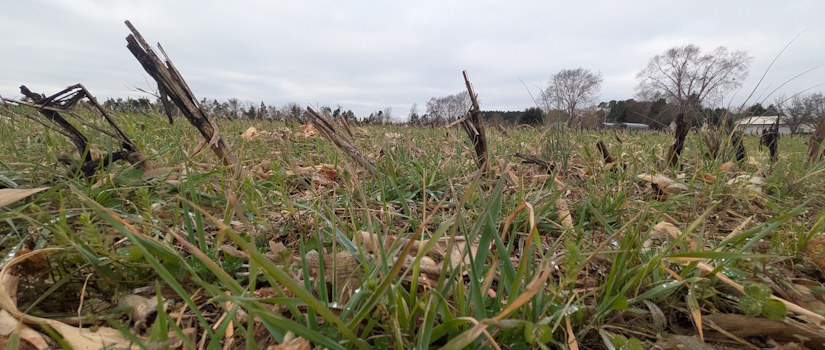
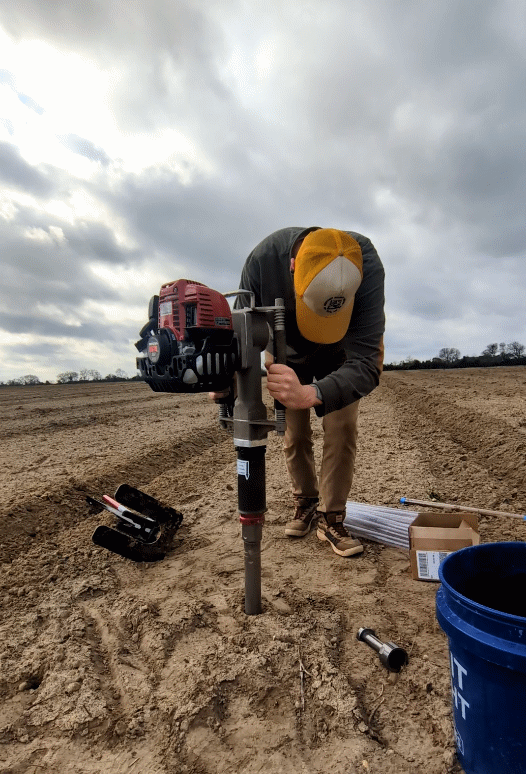
Her team is collecting soil samples from annual and perennial cropland across the diverse regions (and contrasting soil types) of South Carolina – from the clay-rich Piedmont to the sandy Coastal Plain. Their goal is to assess whether mineral-bound organic matter should be included in the USDA’s list of soil health indicators and possibly informing how soil health is measured and reported on farms across the country.
“Our understanding of soil has evolved to include a growing appreciation of factors
such as the reactivity of mineral surfaces and microbe-mineral interactions, making
mineral-bound organic matter much more susceptible to disruption than previously thought,”
Jilling says. “Previous research has shown that mineral-bound organic matter can be
impacted by some types of land use and external elements, and we hope to add to that
knowledge base by studying both the role of moisture in forming mineral-bound reservoirs
and, across both projects, how plant-microbe-mineral interactions can destabilize
them.”