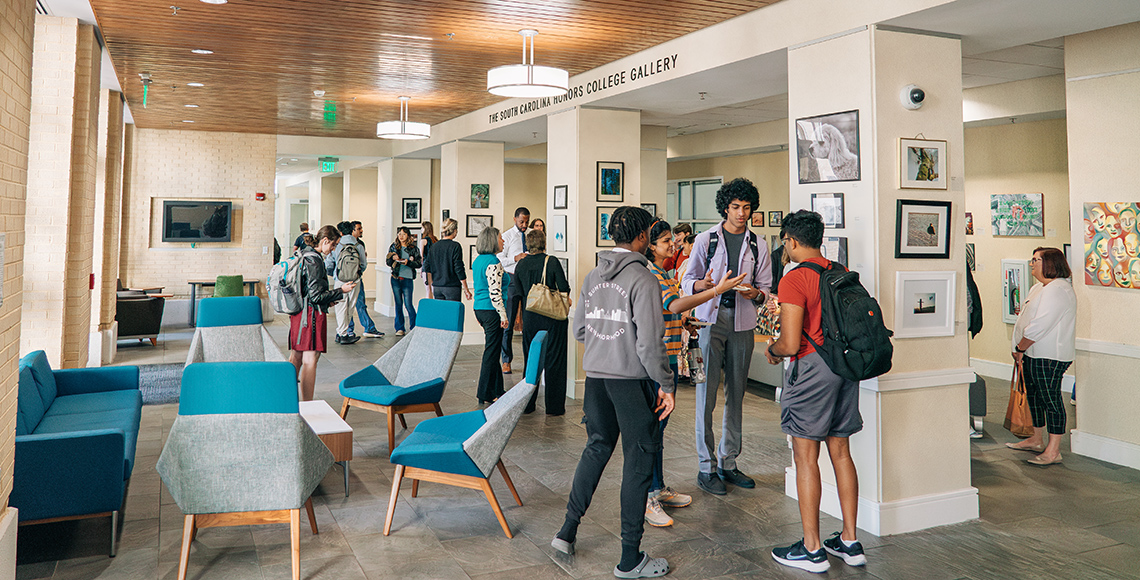
Standing six stories tall at the intersections of Main, Blossom and Sumter Streets, the Honors Residence Hall (HRH) has been welcoming Honors students to the University of South Carolina since 2009. Built to replace the Towers Residence Hall — colloquially known as the Honeycombs — the Honors Residence Hall was one of the first buildings on campus to earn a LEED (Leadership in Energy and Environmental Design) Gold certification.
But that wasn’t the only gold standard set by the building fondly known to students as HRH. State-of-the art living spaces, classrooms, offices, community gathering areas and dining facilities made HRH a standout from the start.
In fall 2026, construction began on a third wing of the Honors Residence Hall, which is set to be completed in 2028. As HRH expands into a new era, we’re looking back on its first 17 years in operation and the generations of Honors students who have called it home.
Forming the lore
Jenni Williams (‘13) walked through the brand-new doors of HRH in fall 2009. Like the rest of her class, the broadcast journalism major from Virginia felt a buzz of excitement about being the inaugural group of students to occupy the space.
“In pop culture, TV, movies and books, college residence halls are portrayed with such lore and history,” she recalls. “We’re like, ‘Okay, this has no history — which is amazing because we get to be the ones who write it.’”
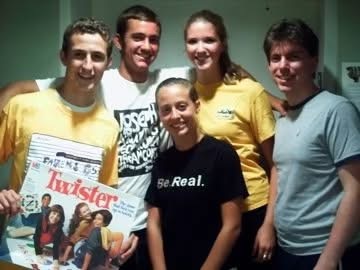
Write it, they did. Williams has fond memories of heading to the Honeycomb Café with her floormates for the can’t-miss monthly crab leg night (yes, you read that correctly) or joining her Resident Mentors (now called Resident Assistants) to carve pumpkins. And whenever she stepped on the elevator, she never knew if she’d be joining a surprise game of Twister as she rode up to her floor.
While she and her hallmates were dedicated to their studies, they also prioritized socializing — something that Williams hadn’t expected. She was initially hesitant to apply to the Honors College because she wanted a “regular college experience,” but upon arriving in HRH, she quickly discovered that residents also sought balance between work and play. “We got our work done, had a fun time doing it, and then would do some fun activity on campus or go shopping,” she says.
As an out-of-state student and a budding journalist, she was particularly grateful for the lifelong friends she made in HRH. “I learned so much about people from different countries, different states across America, different religions, different backgrounds, different experiences,” she says. Williams also met her Honors Senior Thesis partner, Elena Faria Mitchell, a fellow journalism student, in HRH.
“I’m so grateful for the opportunities they provided us there for making friends and providing a wonderful space to develop a friendship,” she says.
Maintaining the community
A few years after Williams and her peers lived in HRH, Andres Soto (‘15) and Ann-Marie (Nunziata) Spanuello (‘16) were assigned to the hall as Resident Mentors. Soto served as an RM in the fall of 2013 and Nunziata in the spring of 2014.
For Soto, an international business major, sharing the value of studying abroad and experiencing new cultures was one of his main priorities for engaging with residents.
“A lot of them were not aware of all of the opportunities there were for studying abroad,” he says. Soto organized an informational meeting for his residents, catering in foods from different restaurants in town to share a multicultural menu and inviting an Education Abroad Office staff member to speak. He recalls a strong turnout, with residents eager to ask questions about where they could go and how they should prepare.
Marketing, management and supply chain student Spanuello encouraged her residents to make connections by designing a quest, challenging teams of residents to run around campus with a stuffed Cocky plushie and photograph different locations.
Strong bonds formed in the residence hall, with RMs and residents supporting one another through challenging classes, busy schedules and pressure that Honors students put on themselves to be high achieving and academically perfect. “If you knew someone who was struggling in a class, you could say, ‘This person’s also a science major,’ or, ‘This person’s looking for this type of resource.’ How can we find other ways, other paths?”
She attests to the friendships formed between Resident Mentors, as well, recalling evening study sessions with a friend spent drawing equations on corner unit windows with neon markers. “We got through stats together!” she says.
Soto also formed lasting connections with other Resident Mentors. He met fellow Honors student John Huth ('15), who is still one of his best friends. Some of his fondest memories are of their evening rounds through the hall, building community with the residents.
“I was just at his daughter’s birthday party,” he says. “I never would have met him, and by extension our group of friends, if I hadn’t chosen to be a Resident Mentor.”
Learning through collaboration
While friendships form in common spaces like the rec room or the Honeycomb Café, classes are in session on the first floor. HRH boasts three classrooms and a conference room, giving residents the opportunity to learn where they live.
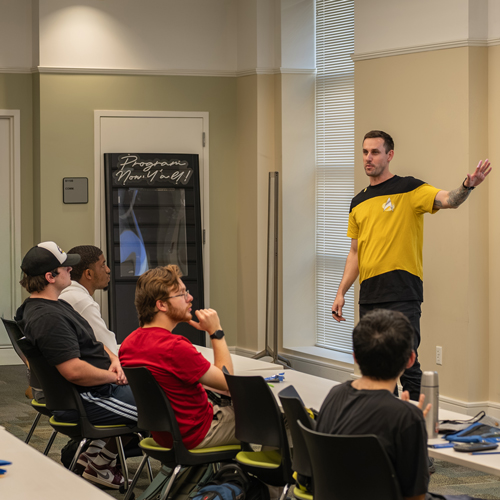
Philip Brookins, associate professor of economics, has taught in one of those classrooms for three fall semesters, introducing Honors students of all majors to two topics he loves: economics and Star Trek. And so The Economics of Star Trek was born. Its mission: to explore modern economic topics, to encourage discussion, to boldly go where no economics class has gone before.
But what can a sixty-year-old sci-fi franchise teach today’s students about economics? Brookins points out that, in the Star Trek universe, economic needs are completely met due to advances in technology, but challenges still emerge.
“Economics is the study of choice under scarcity,” he explains. “Now scarcity is almost gone, but wait, it’s not, because what else is scarce? Your time. All the same principles you would learn in a standard principles of economics class are still in play.”
Classic episodes are staples of Brookins’ course. “The Trouble with Tribbles,” for example, introduces students to the concept of preference and its impact on economic systems. Though Brookins admits that the episode’s premise is silly, Honors students are eager to engage in deeper discussions about how preferences evolve over time and economic concepts like diminishing marginal utility.
“I just kept thinking to myself, man, these Honors kids are sharp,” he says. “I am not the smartest person in this classroom!”
Brookins, who primarily teaches lecture courses at the Darla Moore School of Business, appreciates the opportunity to develop his pedagogical skills as the instructor of a small, discussion-based course. He hopes that students will emerge from the class thinking like the characters they see on the screen and meditating on their roles in society. A basic economic principal, Brookins says, is that incentives matter — but Star Trek characters are more incentivized by the idea of contributing to the public good than most modern citizens on Earth might be.
“We see these wonderful people in the future, and the only way they can get there is if there’s a fundamental change in how we respond to incentives. I want students to really think about that. Everything you do is because you’re incentivized to do it. If some of the things are bad, we’ve got to change that,” he says. “At the end of the day, it’s about doing the right thing even though you have no incentives to do so.”
Increasing access, maintaining friendships
Speaking of incentives: Maya Woodruff, a sophomore political science and marketing major, loves to tell prospective students about her time living in HRH last year because she wants to help them envision their futures as Honors students.
“I appreciated how there were always events going on, whether it’s free food, games, learning dances or movie nights,” says Woodruff, an Honors Ambassador. “Our common room was always full, so when I came home, I felt like I was coming home to my family.”
Alex Bishop, Honors student engagement manager, adds that the residence hall makes community engagement a “frictionless” experience. Instead of having to intentionally seek out events and connections, HRH’s busy programming schedule leads to organic involvement. If, for example, the Honors Welcome Party is happening on the first floor of the residence hall the day before classes begin, chances are high that a student will stop by when they’re passing through the building. Or, when waiting in one of the Honors classroom staging areas before the First-Year Flotilla event, students can pop over to the Honeycomb Café to grab coffee and breakfast with their fellow kayakers.
Often, that’s all the spark that’s needed. “I've heard from students that that's where they met their best friend, or they discovered a really great opportunity,” says Bishop. “I heard one from one student ambassador that she, when she went on Flotilla, was the informal DJ for the Flotilla. She had brought her Bluetooth speaker, and sharing music inspired her to get involved in the WUSC student radio. I love hearing those stories, that these community-building events are their impetus to get involved on campus in a meaningful way.”
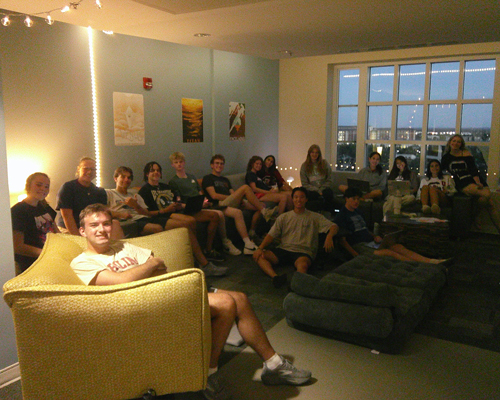
After the renovations conclude, Bishop hopes that students will continue to utilize new common spaces to engage in creative, casual activities, such as musical jam sessions with Dean Steven Lynn or relaxation events led by the Honors Holistic Art of Living student organization. From Woodruff’s experience, students will no doubt be eager to gather wherever they can, sharing in the excitement, challenges and growth that a college experience brings.
HRH might look a bit different during, and after, the renovations, but the supportive community within remains the same.
“Everyone was out and trying to meet new people, so I always was surrounded by people I could be myself around,” says Woodruff. “As an out-of-state student, I was immediately surrounded by social, talented and driven people and met my best friends. We still have family dinners every Sunday!”