A historical fiction mystery novel set in Charleston, South Carolina. Star Wars: The Musical. A comparison of Fitzgerald’s and Hemingway’s flapper girls and the modern Manic Pixie Dream Girl archetype. A fantasy novel inspired by Baba Yaga folklore. Short stories and poems reacting to reproductive rights legislation. A food studies analysis of Quicksand’s protagonist.
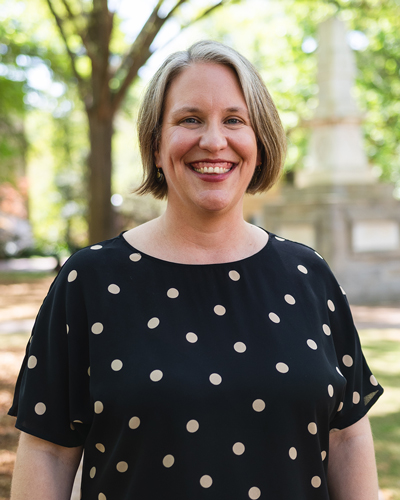
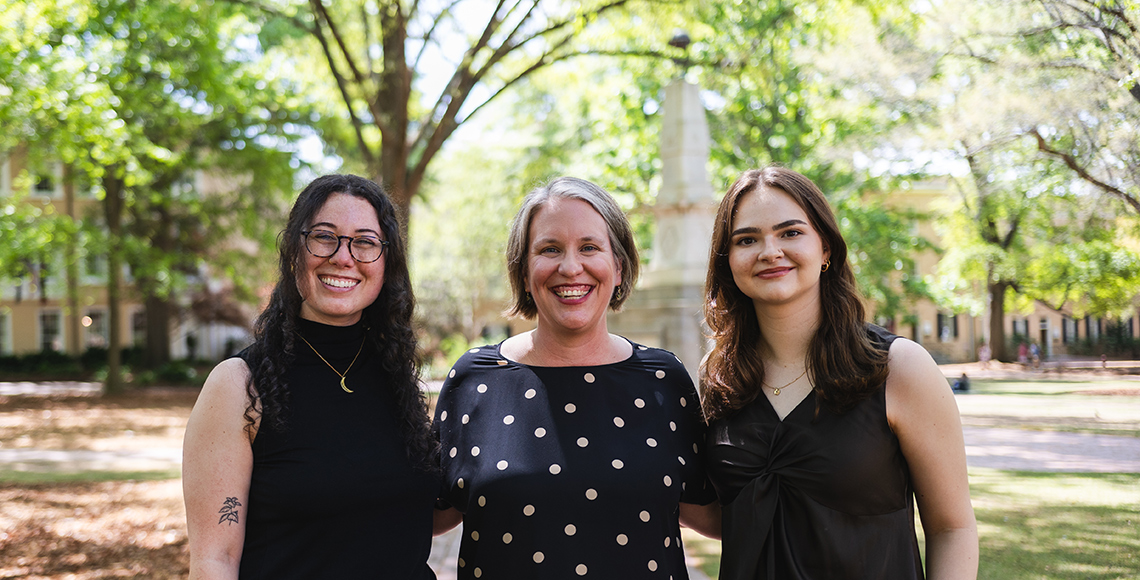
These are just a few of the South Carolina Honors College senior thesis projects that professor Catherine Keyser has directed. When asked about the time and effort that mentorship requires, Keyser, professor of English Language, vows to take on fewer mentees each semester to “protect the students from my own busyness.
Each semester, she makes exceptions. Why? “They are so interesting and creative and passionate about what they’re doing, so I keep getting hooked on their elevator pitches!”
Keyser has lost count of the number of theses she’s directed since she began teaching at the University of South Carolina in 2007. Though her mentees’ topics run the gamut of creative projects and research papers, Keyser’s keen insights, actionable feedback and individualized approach are the hallmarks of her mentorship.
“They’ve taught me to be brave, I think,” Keyser says of her students. “It’s that combination of bravery and dedication that I have learned from them. They remind me that this is why we do the kinds of projects that I do for a living. It’s the idea that if we think critically, if we perform the research, if we ask the right questions, we can say things that matter and we can share those ideas with others.”
The first idea will be broad, and that’s okay.
When reflecting on her years of mentorship, Keyser has three main pieces of advice for students approaching a senior thesis. One is to start with a broad idea; the magic of the process is narrowing the topic.
Keyser’s own mentors, professors Maria DiBattista and Deborah Nord at Princeton University, helped her understand this concept when she was writing her senior thesis on Virginia Woolf’s novel The Years. DiBattista and Nord challenged Keyser to ask better questions. “I would start with a broad question and then they would offer a challenge or an expansion or a nuance.”
This guidance shaped Keyser’s academic journey and helped her grow as a researcher. She continued to refine her interests and now specializes in twentieth century American literature and food studies.
She strives to emulate this approach to mentorship with her own students: guiding questions, challenging them to zoom in on a specific aspect of a broad topic. It's normal, she believes, for the initial project idea to be too broad — and that applies to undergraduates, graduate students and seasoned researchers.
“If at the end you have argued what you thought you were going to argue when you were daydreaming about the project two years before, something’s gone wrong,” says Keyser. “You should make discoveries across the process, and nine out of ten times, one of the discoveries is that one-tenth of the massive project you thought of is actually a rich, valuable, thesis-length project. That’s a neat thing to watch students discover.”
Start early.
A discovery process takes time, so Keyser encourages students to start thinking about their thesis topics well ahead of senior year. But this doesn’t mean drafting a detailed proposal their second semester on campus. She suggests that students start “attending classes with the feelers out,” reflecting on the courses they enjoy and the content that sparks their curiosity.
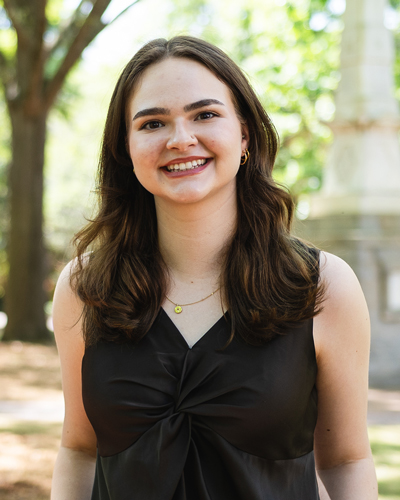
One of Keyser’s mentees, Elliott Catoe-Griffis, a senior public health major, exemplifies this approach. Catoe-Griffis took a literature course with Keyser her first semester, and Keyser’s teaching left a lasting impact.
“I think I chose, in my mind, the director first and maybe the project second, because I really love Dr. Keyser,” Catoe-Griffis attests. “(The class) was feminist retellings of Greek and Roman mythology. It was called Circe Speaks, and it was a fantastic class.”
Catoe-Griffis stayed in contact with Keyser after the course ended. When it was time to select an advisor for her thesis she knew that Keyser would be the ideal mentor. Catoe-Griffis is blending her public health background and legal interests — she’s qualitatively coded bills and floor debates related to reproductive rights in South Carolina — with her personal passion for creative writing to produce a collection of poems and short stories.
“Creating a cohesive project is definitely new for me, and I am not an English major,” says Catoe-Griffis. But she knew that Keyser would be a resourceful guide through this new pursuit, noting Keyser’s skill at facilitating welcoming, thought-provoking discussions in her classes.
Indeed, Keyser is aware of the wholistic impact that a mentor can have throughout the process. “It’s all too easy to think of (a student) as a brain in a vat,” she says. “But a thesis is a project that’s executed over a lot of time and with a great deal of logistical difficulty. It helps if you know that the person who’s directing your project remembers that you also have friends, that you’re also stressed about a test that’s happening next week.”
As Catoe-Griffis completes her thesis, she’s grateful for Keyser’s empathy, insight and actionable feedback. “She’s a person who I feel really believes in my abilities,” Catoe-Griffis reflects.
Implement a writing schedule.
While a thirty-page thesis might be the longest piece of writing that an undergraduate would generate, Keyser attests that breaking the project down can make the process attainable.
“If you can write a one-page paper that cites somebody,” she says, “you can write a thirty-page paper that cites somebody.”
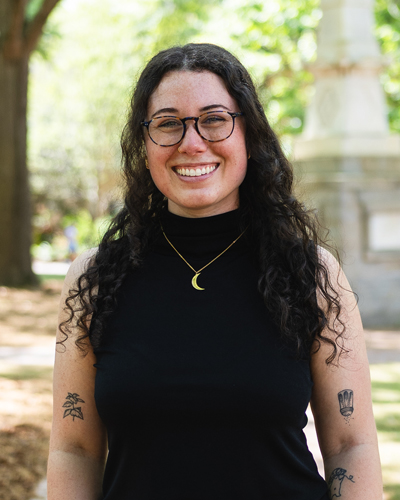
Kati Russ (‘20 English) was no stranger to writing research papers. But Keyser’s advice shaped the way she approached her writing process, which was one of the most impactful takeaways from her thesis experience. Russ wrote a thesis examining female protagonists in Hemingway’s The Sun Also Rises and Fitzgerald’s Tender is the Night through the lens of the modern Manic Pixie Dream Girl archetype.
“Basically, this is a female character who supports a male protagonist as a spiritual guide, life coach, helping him find the whimsy and joy and adventure in life,” says Russ.
While she was passionate about the topic, Russ recalls that the initial stages of the writing process were stifling. She was accustomed to developing a detailed outline before writing a single word and pre-planning every paragraph. But for the thesis, this approach wasn’t effective.
“I was talking to Dr. Keyser about this frustration and how it felt overwhelming, and she said, ‘Well, why don’t you just start writing? Why don’t you just free-write in a way that feels relevant or in a way that allows you to start writing about the things you’re excited about?’” Russ recalls.
That advice unlocked a refreshing approach to writing that propelled Russ into a flurry of productivity. Even as the COVID-19 pandemic closed campus and changed daily life, Russ stayed motivated to write with this new technique. The mentor and mentee worked together to create new project timelines amidst the pandemic’s upheaval and confusion.
The result? A William A. Mould Award-winning thesis. When Russ saw the congratulatory email from Dean Steven Lynn, she couldn’t quite believe it. “I had no clue,” she says about being nominated. “I felt like (Keyser) was continually an advocate for me and really invested in my long-term goals. She even helped me with my graduate school applications.”
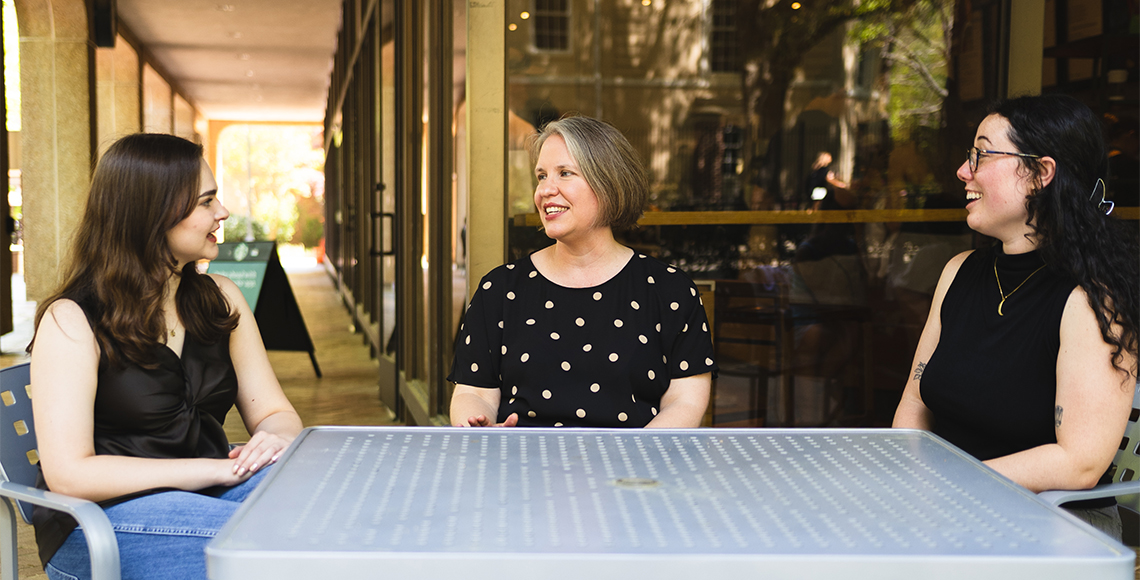
And when she started graduate school at Brandeis University, Russ brought her new approach to writing with her. “Dr. Keyser was the one who supported me in thinking through how I actually wrote and what worked best for my style.”
Russ’s award-winning thesis is one of many positive outcomes for the theses Keyser has directed. Star Wars: The Musical played to sold-out crowds. The analysis of Quicksand became a writing sample that earned the author admission to graduate school. The list goes on — but, as thrilled as she is by her students’ achievements, for Keyser, the value of the thesis lies in the process and the assistance she can provide along the way.
“It’s like, your initial idea is you putting up the frame of the house, but then when you are able to do research and to write a longer piece and to connect with other experts in the field, suddenly you’re laying floors, you put up walls, you even have decorations in there,” Keyser reflects. “And it’s very inspiring as a mentor to look at that house at the end of the day and say, ‘I could never have made that. But because I helped her with the blueprint, she was able to get there.’”