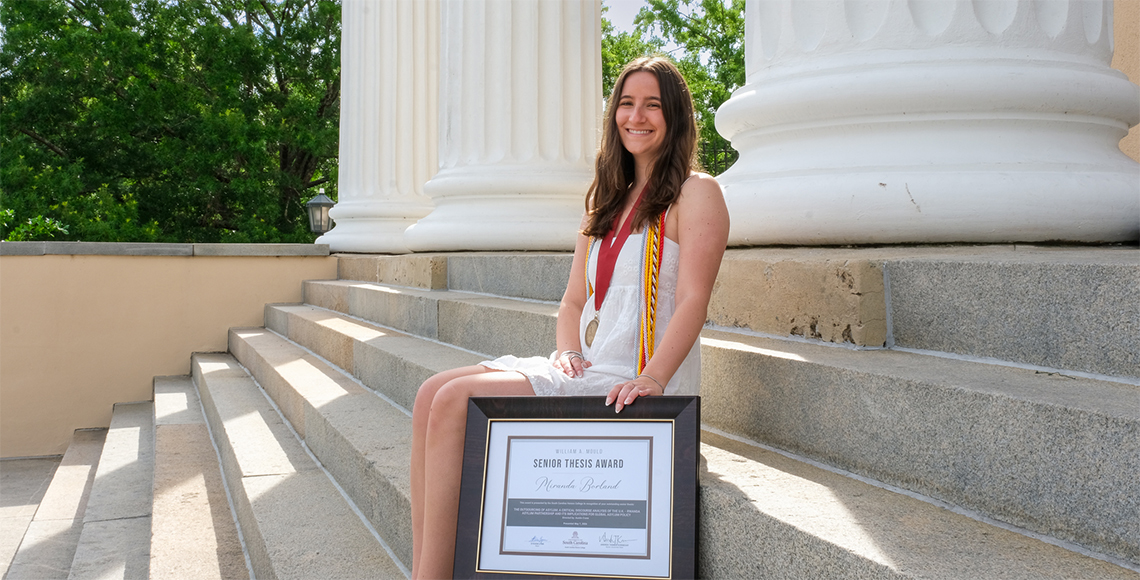
At the May 2026 South Carolina Honors College Revocation Ceremony, Miranda Borland was aware of three important things. First: her research mentor and thesis director, professor Austin Crane, had nominated her for the William A. Mould Senior Thesis Award. The nomination recognized the two years of research, writing and revising that produced “The Outsourcing of Asylum: A Critical Discourse Analysis of the U.K.-Rwanda Asylum Partnership and its Implications for Global Asylum Policy.”
Second: as a nominee, the global studies and Spanish double major from Decatur, Georgia, was in excellent company. Three of her best friends, whom she’d met in the Honors Residence Hall her first year on campus, were also on the list of nominees. “I had attended all three of their thesis defenses as well,” says Borland. “They all had such great, novel ideas and topics.”
And the third: Borland was convinced that her thesis would not be selected as the winner. Though she’d been immersed in the topic of migration for most of her undergraduate career — exploring it through research and coursework, interning with the Al Otro Lado humanitarian aid nonprofit and producing episodes of the Seeking Refuge podcast — she felt that “somebody who did a science experiment that has conclusive results (was) going to win this, versus mine, which was just analyzing words.”
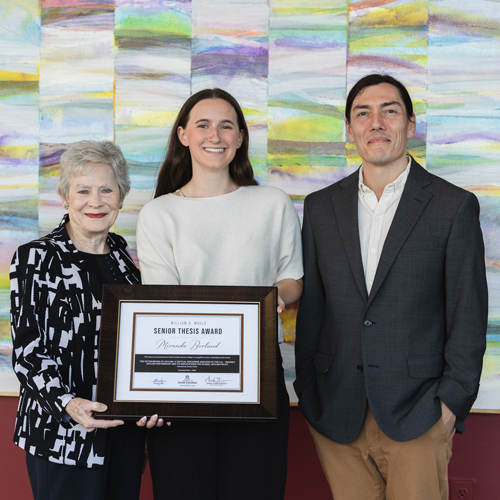
Those words mattered. Borland’s 95-page thesis, an investigation of the parliamentary discourses surrounding a 2022 – 2024 policy proposing that asylum seekers to the United Kingdom would be relocated to Rwanda, was selected as the 2026 winner.
Crane highlighted the project’s depth and impact on the field of migration studies in his nomination letter: “Her thesis makes a timely and important contribution to how we understand this specific migration policy arrangement, and to how the human right to seek asylum is changing today. Significantly, Miranda’s thesis is the first piece of scholarship, to my knowledge, that analyzes the Rwandan government’s perspective on this policy.”
‘A switch flipped in me’
Borland attests that Crane’s mentorship shaped her undergraduate experience. Her first semester was Crane’s first year teaching at the University of South Carolina, and she took his first class. In Global Studies 391: Health and Human Rights, Borland read about migrants displaced by climate-related disasters and the international policies that complicated their pursuit of asylum. “I just remember feeling so defeated about our system, our global system, not even just the U.S., because global warming is a serious issue,” she reflects.
The next day, she voiced her concerns to Crane: What could possibly be done in the face of these global-scale problems?
His response is what has fueled her undergraduate work and future goals. “He said all we can do is what we do in our day-to-day,” she says. “That is where a switch flipped in me ... working with people one-on-one and trying to be that advocate is the way that I can reason with myself that I’m still making a difference, even if I recognize the larger issues that are at hand.”
Borland dedicated herself to research, seeking to understand the complex issue of immigration policy from every angle. She started working for Crane and soon discovered the U.K.-Rwanda Asylum Agreement. Fascinated, she wanted to dive into the discussion surrounding the obligations that countries in the Global North have when it comes to migration and asylum policy, examining the complications between humanitarianism and protecting border security: “All of these different things play together to create a world of borders,” she says.
Crane encouraged Borland to pursue the topic for her thesis, leading to years of reading and coding hundreds of parliamentary transcripts from the U.K. and Rwanda. She was keen to highlight Rwanda’s perspective, and even language barriers wouldn’t stop her: Borland utilized Honors thesis grant funding to pay for an official translation of documents from Kinyarwanda into English.
‘The process is so iterative’
Borland's thesis utilizes a critical discourse analysis to discuss the transcripts. In this three-level approach, Borland analyzed the literal text, the discourse in a larger context such as national news, and the underlying social and international contexts. She concludes that, even though the agreement never went into full effect, “This deal could perhaps set a precedent for the future and how other countries go about their migration management policies and how other countries that are richer might make these similar deals with countries that are poorer.”
In addition to receiving feedback on multiple drafts, the thesis defense process helped Borland nuance her point that Rwanda, rather than being a passive player with nothing to gain, did stand to receive significant financial compensation from the agreement. While Crane and professor Caroline Nagel, Borland’s second reader, had suggestions during the defense, Borland was proud of how she demonstrated her knowledge of the topic — and that so many people, from family to professors to members of her a cappella group, showed up to support her.
“The defense helped me solidify the fact that I am passionate about this and solidify the fact that I did know what I was talking about and helped me get over that last final hump of writing that last section,” she reflects.
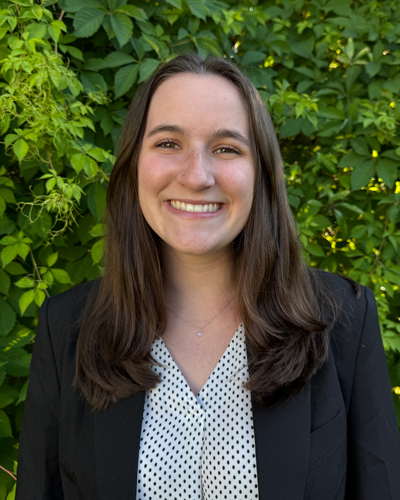
Now a USC alumna, Borland is grateful for the supportive community she encountered at Carolina. From Crane’s mentorship to the thriving research culture amongst Honors students, Borland’s undergraduate experience has prepared her to take bold steps. This fall, she will embark on a NALCAP fellowship to San Sebastián in Spain’s Basque Country, where she plans to improve her language skills and teach English in a primary school for a year. While there, she will apply for law school; she plans to pursue a career in immigration law.
Though she’s leaving South Carolina, the connections she’s made are just as strong as her passion for migration law. She encourages all students to reach out to faculty, especially if they’re interested in research.
“If you establish some kind of rapport with a professor, that’s the reason they’re there — they’re at a teaching institution for a reason,” she says. “They want to have those relationships with you, and they want to be a part of your journey in academics. It never hurts to ask... if I had never sent that e-mail, I probably would never have seen (Crane) again, and I probably would have never had him as my thesis director or be co-writing a publication with him right now.”