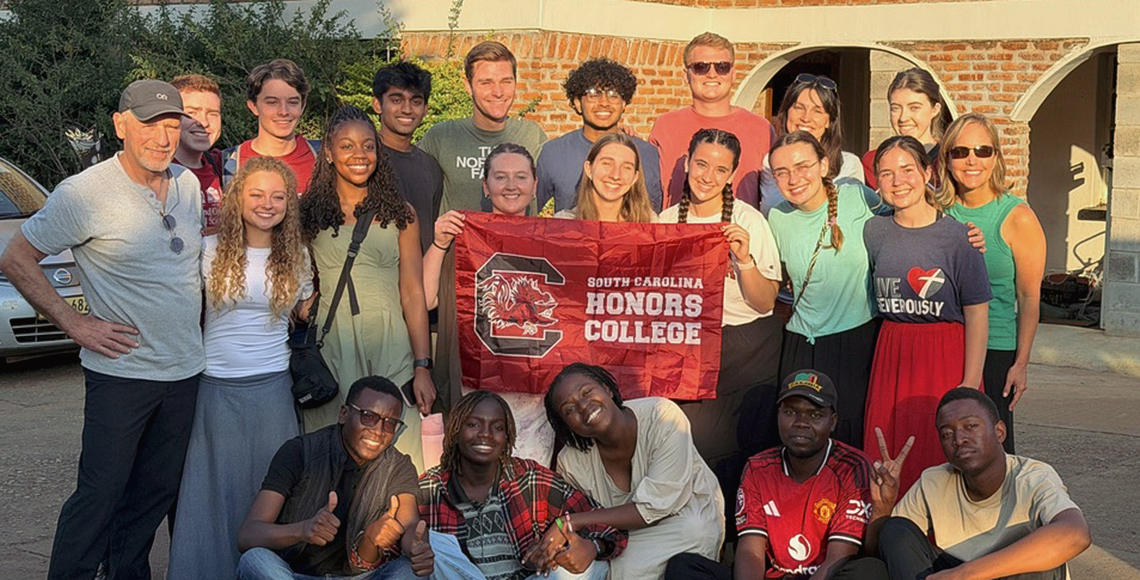
The road from Lilongwe, the capital of Malawi, to rural villages is a long and bumpy one, says Andrea Tanner Kornegay, senior associate dean of the South Carolina Honors College. She, co-instructor professor Van Kornegay, a class of 15 Honors students, and student ambassadors from Malawi’s African Bible College, made these kinds of trips multiple times last summer. Through a partnership with the Ministry of Hope, a Malawian nonprofit, Honors students engaged in a two-week Honors Education Aboard course — Service Learning and Literacy in Malawi, Africa — focused on building connections, learning more about Malawian culture and volunteering in rural villages to provide educational and medical aid.
Sophomore biochemistry and molecular biology major Ryan Ezekiel was motivated to participate in the course by his passion for service and community engagement. “I hoped to learn how to be more effective with my service from this course, and to learn more about the country of Malawi and how we can work to serve their people in the best way possible,” he says.
Before beginning the 20-hour trip to Malawi, students collaborated on lesson plans for kindergarten to fifth-grade students at village schools. Each student’s lesson was inspired by their major at USC.
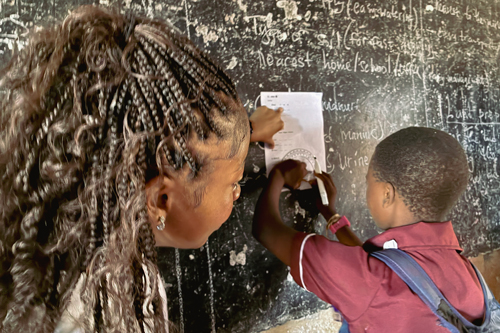
“Education is deeply valued in Malawi, but so many of the children there do not go on to high school because there’s a requirement that they have to take a series of exams and they have to have a certain level of proficiency in English to move forward to high school,” says Tanner Kornegay.
While Ezekiel and his classmates knew that children would be eager to learn, they weren’t prepared for the students’ enthusiasm — or their numbers. “About 600 children had come to see us,” he says. The children ran alongside the van as it approached the school, chanting “azungu, azungu,” a term for “foreigners.”
In the classroom, Aavan Patel, a sophomore exercise science major, taught children about the water cycle through coloring activities. Even though the lesson went well, he realized that his methods weren’t as effective as they could be. He and his peers decided to lead the children in singing “The Itsy-Bitsy Spider” to add a musical element to the lesson.
“The students loved it,” Patel recalls. “It really showed me that to communicate with these students, we needed to match their culture and energy. Malawi is the land of song and dance, and we learned how much chants and songs play a role in their culture.”
Brooklyn Bailey, a sophomore psychology major, also attests to the importance of improvisation. Without electricity or technology in the classroom, she needed to be flexible — but she was encouraged by the students’ excitement. “All the kids were respectful, eager and happy to learn on a Saturday, which is something that I don’t believe I would have seen in a classroom in America,” she says. “We had to work on our feet and adjust to the environment and supplies available. A lot of our plans and lessons had to be improvised, but in the end, the activities became much better because we adjusted to what we had and listened to the suggestions of the kids and staff.”
Other initiatives focused on healthcare. When the class arrived in one village for a mobile medical clinic sponsored by the Ministry of Hope, over 400 Malawians were waiting to be seen by physicians. Students helped triage patients, took vitals, sorted medications and shadowed physicians. The Honors College also donated $1,000 to cover medications.
For Patel, a pre-med student, the experience at the clinic was an eye-opening firsthand encounter with the global health challenges he’d studied in his coursework. Volunteering at the clinic was a reminder that “far more resources and healthcare workers are needed before these communities can receive consistent and adequate care.” He aspires to work in a medical career in which he can assist such communities in a greater capacity.
Students also volunteered at a crisis nursery that was established by the Ministry of Hope at the height of the AIDS epidemic. Though AIDS cases have decreased in Malawi, the nursery still provides support and care for orphaned infants.
“Sometimes, there are 30 babies there, and they need hands,” says Tanner Kornegay. “Those babies need to be held. Our students do that and assist the nursery workers.”
By the end of the service portion of the trip, students have not only connected with villagers, but with interpreters and guides from the African Bible College who accompany each trip. Tanner Kornegay notes that some of her favorite memories of the course are the times spent in the van as SCHC students sing songs and learn chants from the African Bible College students.
“The people of Malawi were some of the kindest people you’ll ever meet, earning their name as ‘the Warm Heart of Africa,’” says Ezekiel.
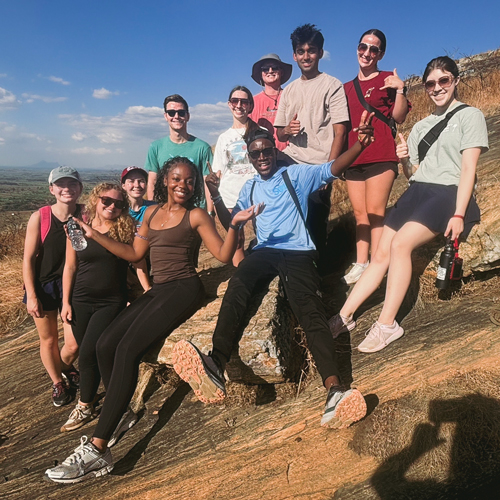
The course culminates in a retreat to a solar-powered campsite on an island in Lake Malawi. Students spend the time reflecting and writing an e-portfolio about their service experiences. They also have the chance to appreciate the natural beauty of Malawi through kayaking, hiking, swimming and stargazing.
Bailey reflects that Malawi was “the experience of a lifetime,” and recommends it to any student who is interested in cultural immersion and service. Patel agrees, adding that he experienced a great deal of personal growth in just two weeks: “I learned more about myself, the reasons I want to serve others and the kind of person I strive to become in the future.”
Tanner Kornegay notes that, if anyone wishes to aid the Ministry of Hope, traveling to Malawi isn’t exactly the most practical or efficient approach. But the Honors College motto is sapere aude, dare to know — and this is an important learning opportunity for students who strive to be informed, global citizens.
“You can stroke a check to one of these organizations, but there is something to be said about actually experiencing another culture and another country,” she says. “That’s what college is about, exploration. That’s what the Honors College is about, being intellectually curious.”