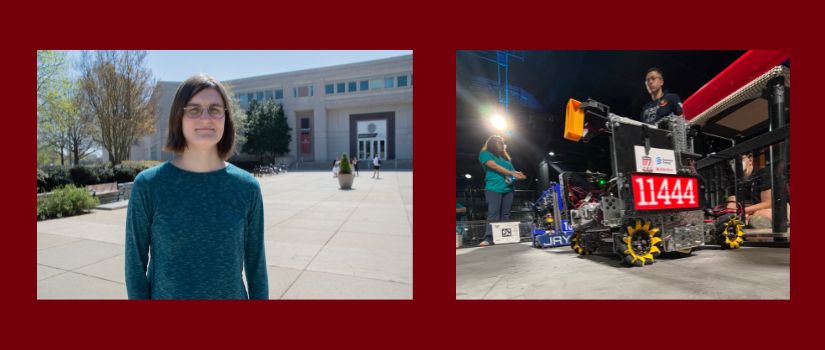
Saws, drill presses and 3D printers line the room, and diagrams and equations fill the whiteboards. It is equal part workshop and classroom, a space where problem-solving and collaboration are constant.
Athena Shier, who earned her undergraduate degree in mechanical engineering this past December, was once at the center of this creative space. Now, she can look back and utilize the lessons she learned moving forward.
Early involvement shapes direction
Arriving at the University of South Carolina in 2020, Shier was already familiar with the campus environment. As a homeschooled high school student, she spent four years working alongside USC student mentors through FIRST Tech Challenge (FTC) Garnet Squadron 11444. FTC is a robotics program for students in grades seven to 12 who work in teams designing, building and programing robots for competition. USC students mentor participants through the process.
Shier’s high school FTC experience introduced her to engineering concepts and evolving technology that she says influenced her decision to pursue mechanical engineering.
“By the time I finished high school, 3D printers were becoming more common, and people were CADing the entire robot,” Shier says. “Everything had changed so much over those four years, which pushed my interests further.”
Due in part to her previous experiences in high school, Shier became president of FTC 11444 Gamecock FIRSTers only three months into her freshman year. She oversaw both the university group and the high school team, balancing administrative responsibilities with hands-on mentorship. Shier led older peers while coaching students she once worked alongside.
Program interruption and restart
Shier returned for her second year as president during the 2022-2023 academic year. While she implemented new ideas to motivate and improve the organization, the team’s ambition led to burnout, and they made the difficult decision to shut down. However, feedback from high school students and program leaders changed their minds just two weeks later.
“Some of the leaders of FIRST South Carolina came to us and said, ‘Are y’all really going defunct? You’ve been such an important team for so long.’” Shier says. “They showed us how distraught the students were because they all showed up and really wanted to keep running it.”
Shier led the effort to restart the team mid-season, coordinating registrations, recruiting mentors and reestablishing regular practices to bring back the community.
State title and world competition
The team marked a milestone during the 2025 season. Squadron 11444 won its first state championship and advanced to the FIRST Tech Challenge World Championship in Houston, Texas.
But to travel to Houston, the team had approximately one month to raise $23,000 and organize travel for 12 students, 10 parents, three mentors and around 1,000 pounds of equipment. Shier organized fundraising efforts, developed sponsorship materials, helped establish nonprofit status and guided students to advocate for sponsorships.
“It was a feeling of pride and joy that I was able to deliver this once in a lifetime experience to these kids,” Shier says.
She also coordinated transportation, lodging and communication with the team’s industry advisor. Despite a short time frame, the money was raised, travel plans were arranged and the team was off to Houston. At the competition, Shier managed team operations while addressing unexpected issues, including missing equipment. The team finished in the top 2% of more than 8,000 teams.
“World's stressed to me the extreme value of soft skills in STEM,” Shier says. “I did more than just teach STEM that month.”
Forming community through mentorship
Shier helped create an environment where students learn by doing. Three-hour FTC practices are held twice weekly, with additional meetings as competitions approach. Mentors teach students to use tools while introducing advanced concepts in physics, CAD and engineering design. The program also includes academic support.
“For several years now, we have had a math homework space where they can come and ask questions about physics, math and programming,” Shier says. “FTC 11444 operates completely freely, and we’ve sent students all over the country to learn at no cost to the university.”
Recognition and responsibility
Integrated Information Technology Professor Dezhi Wu, helps the FTC team and says Shier played a central role in its development. She also described the organization as distinct from other student groups for its community and the commitment required to maintain the program.
“It’s very impressive because this is the first time the team actually went to the world championship,” Wu says. “She basically served as the major student mentor. For this level of volunteer work, it’s so intense, and Athena has been doing that for many years.”
The high school students recognized Shier’s dedication at the 2025 FTC state competition by secretly nominating her for the Compass Award for outstanding mentorship. Since Shier was a volunteer emcee at the event, she first saw her name as the winner in the script during the ceremony.
“I’m looking at the line below and trying not to cry,” Shier says. “Then they play the video, and I see all my students talking about what this meant to them. It felt like everything was worth it."
Looking ahead
Shier graduated magna cum laude in December and is currently evaluating opportunities between graduate school and the workforce.
“I credit my organization experience through FTC with landing me several interviews and graduate school acceptances,” Shier says.