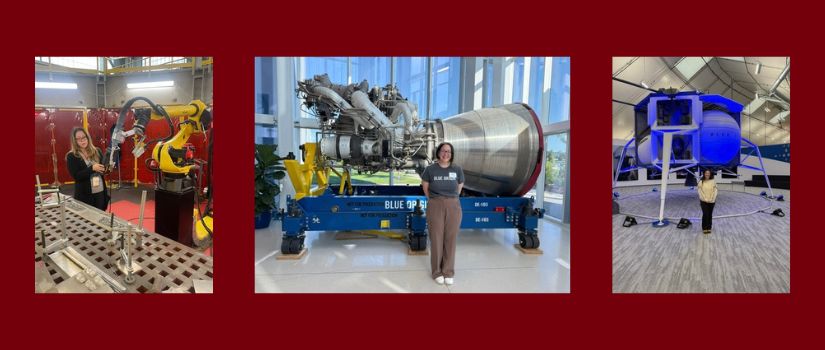
A conversation with mechanical engineering alumna Ilana Lu, BS ’17, MS ’19
Ilana Lu’s journey to NASA and Blue Origin started at the University of South Carolina. She earned both her bachelor’s and master’s degrees in mechanical engineering at the Molinaroli College of Engineering and Computing, where research, hands-on learning and a co-op at Oak Ridge National Laboratory helped turn her interest in welding and additive manufacturing into a career in the space industry.
Today, Lu is a materials and process engineer with Blue Origin Engines, supporting production welding and helping develop large-scale additive manufacturing for spaceflight hardware. Her path is a pretty exciting reminder for current students and young alumni: The work you take on at Molinaroli College can lead to places you may not yet be able to imagine – including NASA’s Marshall Space Flight Center.
Q: What does your work at Blue Origin look like today?
Currently, I am a materials and process engineer supporting production welding for Blue Origin Engines, as well as leading development of large-scale additive manufacturing for spaceflight hardware. Day to day, which means a mix of emergent production issues that require quick root-cause analysis, intuition, and the technical backing to make immediate resolutions. I also support design decisions and internal customers. The other half of my role involves business development and strategy surrounding large-scale additive manufacturing and the road maps and activities that turn ideas into physical hardware.
The research, courses, co-op, and other work experience directly solidified my technical career, which led me to work at NASA’s Marshall Space Flight Center before my current role. My mechanical engineering degrees were broad enough to enable flexibility in career choices, and I do feel they have benefited my skills and career path.
Q: What advice would you give to future engineers and recent graduates?
I am mid-career now and in the near future, I need to decide whether I want to continue to deepen my technical skills, pursue management or pursue program management. The advice I can give to new graduates and prospective students is: “Stay humble, stay hungry.” Stay grounded while still reaching for technical excellence.
I have found that intuition goes a long way, so trust your instincts, which are guided by your experiences in your programs and internships. Also, find good mentors at every point in your career.
Q: Was a master’s degree in mechanical engineering worth it?
Yes. I believe a master’s degree in mechanical engineering is worth it because it is flexible enough to benefit many different career paths while also giving you extra technical depth that a bachelor’s program does not provide. It is the sweet spot between the breadth of an undergraduate program and the depth associated with a doctoral program.
Q: How did you navigate the challenges of the program?
I found the courses challenging, but I was able to find success by studying both solo and in groups and by attending office hours. The biggest impact on my success was continuing to humbly ask questions when things were unclear and pushing myself to understand the material at a fundamental level.
The other students in the program were my biggest support system. We were able to collaborate on each other’s research based on our programs and skill sets, offer guidance for classes and provide general camaraderie.
Q: What do you see in the job market for mechanical engineering?
I personally think the job market is quite strong for those in mechanical engineering, especially in the United States. When I have talked to recruiters or prospective employers in the past, it has never been a disadvantage.