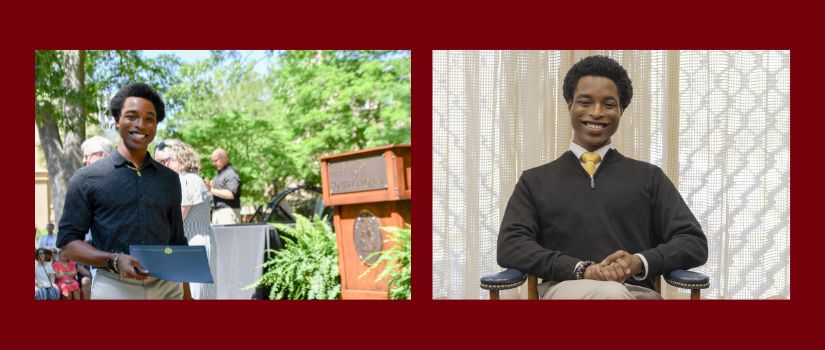
Khufu Holly dove into research immediately upon arriving at the University of South Carolina in 2023.
Three years later, the junior biomedical engineering major in the South Carolina Honors College is one of five USC students named as a Barry Goldwater Scholar. The national award recognizes sophomores and juniors pursuing research careers in STEM. A total of 452 scholarships were awarded this year from the 1,485 nominees by 482 institutions.
Holly says they planned to pursue research before even starting at USC. The university’s high research activity and the Honors College’s emphasis on research drew them to the university.
The road to Goldwater
Holly first learned about the Goldwater Scholarship during their freshman year after watching fellow biomedical engineering student and lab mate Caroline Rucker open an acceptance letter. They applied the following year but did not receive a university nomination, a required step in the process.
Despite the initial setback, Holly says the application process strengthened their research writing and clarified their goals. After meeting with the university’s Goldwater Committee for feedback, Holly was encouraged to reapply.
“It gave me a lot of confidence,” Holly says. “It showed me I had the ability to get this award, so I should try again.”
Melissa Moss, senior associate dean for academic affairs at the Molinaroli College of Engineering and Computing, serves on the USC Goldwater Committee.
“It's a serious competition,” Moss says. “Students who are selected as Goldwater Scholars are part of this nation's future in terms of research careers.”
The committee evaluates and nominates students on their research experience, potential and commitment to a research-focused career. Holly earned a nomination on their second attempt in 2025, and faculty mentors helped refine the final application submitted to the Barry Goldwater Scholarship and Excellence in Education Foundation. Holly learned they were selected as a Goldwater Scholar on March 27.
“Khufu is an outstanding student,” Moss says. “They’ve reinvigorated the undergraduate research journal on campus, which is a huge task and something that they didn't have to do.”
The scholarship provides up to $7,500 and access to a national network of scholars, including conferences and mentorship opportunities. Moss says the recognition also strengthens the university’s research environment.
“It creates that culture among our students,” Moss says. “It's something that they can aspire to. They can encourage each other to get involved in research and consider how they might fit within these national awards.”
A research focus
On Holly’s first day of freshman classes, they searched USC’s research database to find a lab. They began working with Biomedical Engineering Associate Professor Michael Gower on materials engineered to actively guide specific immune responses.
Holly remained in Gower’s lab for two years and expanded their experience through summer research programs. After their freshman year, Holly participated in the Cancer-focused Summer Undergraduate Research Program, working at the Cleveland Clinic Foundation. Last year, they joined the Vanderbilt Medical Scientist Training Program, where Holly explored the physician-scientist and pediatric infectious diseases career paths.
Since the spring of 2025, Holly has conducted research in the Cardiovascular Translational Research Center at the USC School of Medicine under Clinton Webb, the center’s director. The lab examines how hypertension affects cells, triggers inflammation and contributes to vascular dysfunction — a topic Holly presented in their Goldwater application.
Holly says their experiences have shaped a clear future research focus: studying bacterial pathogens and their interactions with the immune system to develop new treatments with biomedical engineering.
Future goals
The biomedical engineering field helped Holly find their career path.
“The promise of biomedical engineering is that you can innovate the field of medicine,” Holly says. “You're supposed to be able to make a large impact on a group of people, and that's what I want to do.”
After graduation, Holly plans to pursue an MD-Ph.D. and ultimately become a pediatric infectious disease specialist.
“It's great that we've been able to recruit that caliber of student here to USC,” Moss says. “We are able to help those students, like Khufu, become successful researchers in the next stage of their career.”