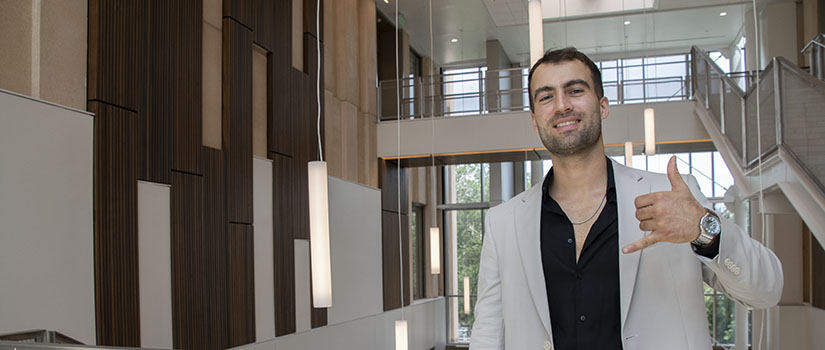
In 2016, Computer Science Ph.D. candidate Alireza Bagheri first realized that artificial intelligence would change the world.
Two years after receiving his bachelor’s degree in electrical and electronics engineering from Guilan University in Iran, Bagheri began studying for his master’s degree at the University of Akron in Ohio. While there, he co-founded tech startup G-Angel to develop an AI-powered device which could automatically place a catheter into a patient’s blood vessel.
“G-Angel was born from a desire to improve healthcare,” Bagheri says. “Today, I’m continuing in the same direction, designing AI to analyze the vascular system.”
Bagheri’s research is driven by his goal to use AI to enhance the healthcare system, since it can be useful for detecting subtle abnormalities which are often invisible to the human eye. His vascular analysis model works by extracting vascular structures from CT scans and using machine learning to identify conditions like occlusions or aneurysms. This technology can speed up the diagnostic process while also increasing the accuracy of a diagnosis.
“The aim is to streamline diagnostics and improve patient outcomes,” Bagheri says. “We can now use AI to automate what is traditionally a very time-consuming manual process.”
When he established G-Angel in 2019, Bagheri received a $50,000 grant from the National Science Foundation. However, a condition of the award was that Bagheri had to interview 100 potential stakeholders in only seven weeks. According to Bagheri, it was one of the greatest challenges he has faced so far in his career.
“I only managed to interview five people in the first week, and I was almost kicked out of the program. Luckily, they gave me another chance,” Bagheri says. “I worked so hard on my social skills, and I was meeting nearly 20 people a week towards the end of the seven weeks. That experience fundamentally changed me, and I am so grateful for it.”
The experience inspired Bagheri to create a second AI-driven company, FriendsO. The app helps users connect with potential friends based on shared interests.
“I noticed that the way people connect isn’t very efficient,” he says. “I found that introductions made through a mutual connection have a far higher success rate.”
FriendsO was created to be a middleman and it is currently available on the Apple App Store for all University of South Carolina students.
“I’ve spent most of my adult life in the U.S., and I’ve loved it. It’s the land of opportunity for those with an entrepreneurial mindset,” Bagheri says. “And I’m fortunate to love what I’m doing.”
Since starting at USC in 2021, Bagheri has found himself enjoying Columbia’s warm weather and social opportunities. But most of all, he enjoys his work. Describing his passion for his work with AI models, Bagheri compares them to the human brain.
“They react based on patterns learned from their training data,” Bagheri says. “Debugging them sometimes feels like introspection: tracing outputs back to their source, much like the way we reflect on our own thoughts and actions.”