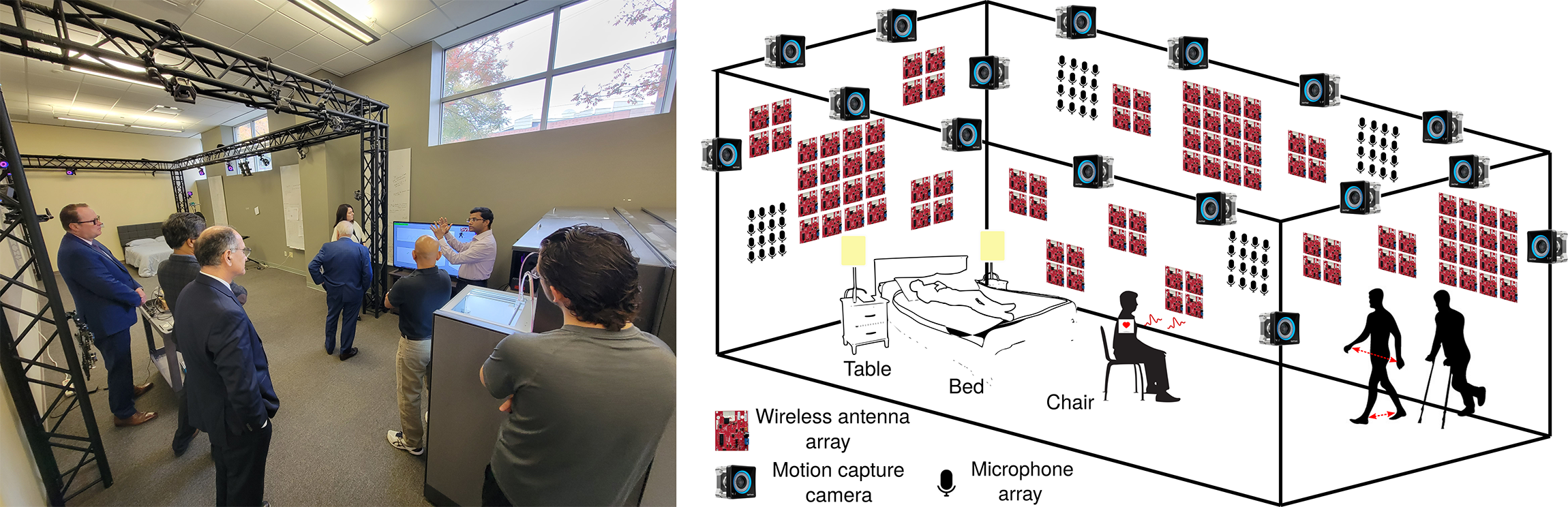
Ground truth is verified and factual information typically obtained through direct observation and measurement. It is important in research for several reasons, including trustworthiness and confidence, validating models and correcting errors.
But obtaining ground truth in research, particularly projects involving volunteer participants, can sometimes be difficult due to privacy, costs, and other issues.
Ground truth collection through contactless sensors was one of the motivations for a device housed at the Molinaroli College of Engineering and Computing (MCEC) that has broad applications and is being utilized by University of South Carolina researchers.
Computing Science and Engineering Professor Srihari Nelakuditi led a five-year project to develop an Omnipercipient (OmniC) Chamber to collect ground truth and enable research on smart and connected things. The project began in January 2020, and despite delays related to the COVID-19 pandemic, was completed this past September and supported by nearly $800,000 from the National Science Foundation. Co-principal investigators included Sanjib Sur (computer science and engineering), Guoan Wang (electrical engineering), Nikolaos Vitzilaios (mechanical engineering) and Stacy Fritz from the USC Arnold School of Public Health.
The OmniC was constructed in the Horizon I building with cameras and sensors mounted on all sides. The facility enables different areas of research such as wireless networking and therapeutic and rehabilitation care by capturing minute details with high precision across the frequency spectrum. The OmniC is currently in the process of being moved to its new location in the college’s Storey Innovation Center and operations are expected to restart by the end of this year.
“When we develop any smart systems for sensing and communication, we always want to understand the true events and capture them using electromagnetic, mechanical, and other contactless sensing methods. This equipment enables all this research,” Sur says.
Serving the needs of researchers across the USC campus, the OmniC reduces costs and time, improves speed and accuracy, and expands interdisciplinary collaborations because it is a centralized system where multiple activities are monitored along with sensing modalities and views. The first demonstrations occurred in 2023, and the first two years of operation have led to several projects focused on contactless gait tracking, sleep monitoring, stroke severity detection, children’s activity monitoring, and fall detection.
“You can do research in bits and pieces separately, but it will be costly compared to having this facility where it's time synchronized and you're capturing the same activity through multiple sensing domains,” Nelakuditi says.
Nelakuditi added that contactless systems are better because cameras may cause privacy issues and wearables need users’ active engagement. Thus, it captures the right amount of information needed for precise tracking.
Once ground truth is established and correlated, it can be examined in different sensing domains and used to train machine learning systems. According to Nelakuditi, the system can be generalized to anything, even just a gesture.
“The need for ground truth is broad in terms of applicability. Once you understand it, you can develop a system to capture, train, and validate it,” Nelakuditi says.
“OmniC provided this multidimensional, highly accurate, millimeter scale, microsecond level data for us to build a new smart sensing modality for human health and well-being research,” Sur says.
Since no ground truth and sensing system was readily available for purchase, assembly of the OmniC began in 2020, and the equipment was pieced together to capture different movements simultaneously.
“For example, whenever an activity or gesture is happening, how is it ‘seen’ by the camera, electromagnetic, audio, and vibration sensors? They must be perfectly synchronized,” Nelakuditi says.
In its first two years, Sur has already developed and tested sensors and systems in the OmniC that have now been installed at the Prisma Health Richland and Prisma Health Laurens County hospitals in South Carolina. For Prisma Health Richland, Sur, in collaboration with vascular neurologist Dr. Souvik Sen, brought stroke patients into the chamber to understand their walking pattern and develop sensor systems to observe their asymmetric (semi-paralyzed) gait automatically in a contactless manner. The systems have already been deployed at the hospital’s inpatient rooms.
In addition, Sur’s contactless sensor can measure vital signs like heart and breathing rates for detecting sleep apnea of stroke patients instead of placing sensors on the body using a chest strap system. His contactless sensors are currently being tested in the hospital.
At Prisma Laurens County Hospital, Sur’s sensors are currently being tested for monitoring elderly patients’ activity for preventing falls. The sensors were developed in the OmniC using ground truth data.”
“Our contactless system is helping us understand if we can detect the motion of bed transition before that happens and give an early alert to the caregivers to go to the room and assist the patient with their mobility,” Sur says.
Nelakuditi considers the OmniC an enabler, creating the seed to cultivate ideas and experiments. Other researchers on campus have utilized the idea of the OmniC for their own projects, such as Jessica Bradshaw from the Department of Psychology for her research with autism and early social development.
“She came up with the idea of bringing the lab to children and families who volunteer for her research projects,” Sur says. “I’m working with her on creating a customized bus where we’re placing sensors and replicating some of the things we already have in OmniC. It’s essentially a mobile OmniC to bring those ideas that we have employed to this moving chamber.”
Both Nelakuditi and Sur agree that the OmniC is a living research project that will be expanded and improved. This includes simple improvements, such as adding a private space for volunteer research participants to provide written consent for HIPPA compliancy. “We are continuously thinking about how to do further collaboration and to make the chamber useful for other researchers,” Sur says.
Nelakuditi says the OmniC has already met its goals, and in some ways, even better than expected.
“From successful contactless monitoring, collecting ground truth and collaborations with public health and medicine, it has worked out exactly as we anticipated. It’s also been great for training students,” Nelakuditi says.
“This is a long-term vision, not just a single footprint that we created,” Sur says. “Smart technology will not stop it, so we will continually ask how we can upgrade this and create more precise, powerful versions. It is just the start.”