A catastrophic implosion of a Titan submersible killed five people while on a deep-sea voyage to the Titanic wreckage in June 2023. The submersible’s pressure hull, a space that maintains ambient pressure for occupants, was made of carbon composites. According to the U.S. Coast Guard’s report of its Marine Board of Investigation into the implosion, while the composites offer high strength and significantly reduce weight, they are susceptible to fatigue and damage due to changes in pressure and temperature.
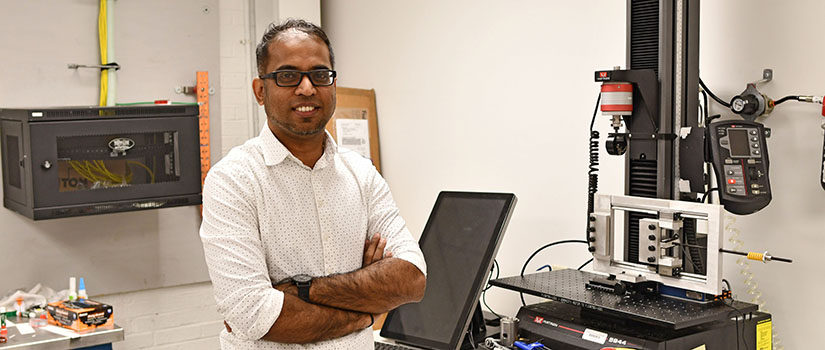
Composite components are subject to damage that affects strength, fatigue resistance and durability. But Mechanical Engineering Associate Professor Subramani Sockalingam’s current research project aims to use a novel approach to address challenges and better understand damage development in carbon composite materials.
Sockalingam’s four-year, $600,000 research project is funded by the National Science Foundation and began this past July with Mechanical Engineering Distinguished Professor Michael Sutton as a co-principal investigator.
Sockalingam’s expertise is in all aspects of fiber reinforced carbon composites, which combine the strength and stiffness of carbon fibers with the durability of a polymer matrix. But when composites are damaged, they degrade in strength and be resistant to further loading, which could lead to catastrophic failure like the Titan submersible.
“Composites are attractive because they are lightweight and often used in aerospace and military applications. But they can be damaged due to impact loading, and it’s difficult to detect this damage,” Sockalingam says. “If we can better understand how the damage develops, initiates, and progresses, it can help guide us in developing predictive damage models.”
Sockalingam aims to develop a new discontinuous finite element formulation to characterize damage, which can be challenging due to the complexity of multiple damage modes and mechanisms. He will address the issue as an inverse problem by combining digital image correlation (DIC) and discontinuous finite element methods.
DIC, which was invented by Sutton, is a noncontact optical technique that measures and captures the shape, motion, and deformation of solid objects. Sockalingam will utilize this technique to capture images of composites subjected to loading to inversely determine and reconstruct the damage parameters. DIC will be combined with the finite element method, a numerical technique used for solving structural mechanics problems in which a large system is broken down into smaller part.
“For example, with the traditional finite element method, if you have a structural design, you apply a load to understand how the structure will deform or move,” Sockalingam says. “You know everything ahead of time, such as what the material is made of, and the load applied to the structure to see how it will deform.”
By combining DIC and discontinuous finite element method, Sockalingam will inversely reconstruct the damage initiation and evolution in composite materials.
“With DIC, we know how the structure is deforming because images are captured. We’ll use that as input to the new discontinuous finite element method and then back calculate the material damage parameters,” Sockalingam says. “In the forward problem, material parameters are known and the structural deformation is unknown. But we’re doing the opposite: structural deformation is known and the material parameters are unknown.”
Over the project’s four years, several sub-tasks are necessary to accomplish the goals of developing the inverse problem and reconstructing the damage initiation and evolution. This includes formulating and verifying Sockalingam and Sutton’s discontinuous finite element method with other known solutions generated using the traditional finite element method. Another important task will be studying the effect of noise on experimental measurements and how it affects damage reconstruction calculations. Finally, an experimental validation will be completed on the method that is developed. In addition, machine learning will be used to leverage the advances and incorporate it to characterize damage from images captured using DIC.
There are currently homogeneous (consistent composition) and heterogeneous (different properties) composites. While some knowledge exists with homogeneous composites since the damage is uniformly distributed, heterogeneous composites have distinct regions with different properties.
“There are some novel materials that we’ll explore with heterogeneous composites,” Sockalingam says. “We need to understand how the damage will initiate and evolve in a more complex heterogeneous composite. We’re trying to improve on current methods and making it applicable to a broad range of complex materials.”
By the end of the project in 2027, Sockalingam hopes his methods help advance the field of mechanics for design and rapid characterization of composite materials.
“The development of this novel inverse method is mechanics-based in the sense that it’s based on how the material is deforming because we’re measuring it using DIC images,” Sockalingam says. “By combing DIC and the finite element method, we’re advancing mechanics because the traditional damage characterization from DIC measurements is time intensive.”
According to Sockalingam, the success of the project depends on more than just developing, verifying and validating an inverse methodology.
“Our success will be through knowledge and capability,” Sockalingam says. “The knowledge is the advancements in understanding of damage development in complex composites, while the capability is this inverse methodology for reconstructing damage parameters.”