According to the Environmental Protection Agency’s Leaking Underground Storage Tank Cost Cleanup Study, it cost an average of $135,636 to clean up a petroleum oil spill site in South Carolina between 1973 and 2021.
The average cleanup cost varies between states, but across the board, these costs can be overwhelming for small businesses which handle petroleum. As a result, many businesses in the past have failed to report leaks and spills.
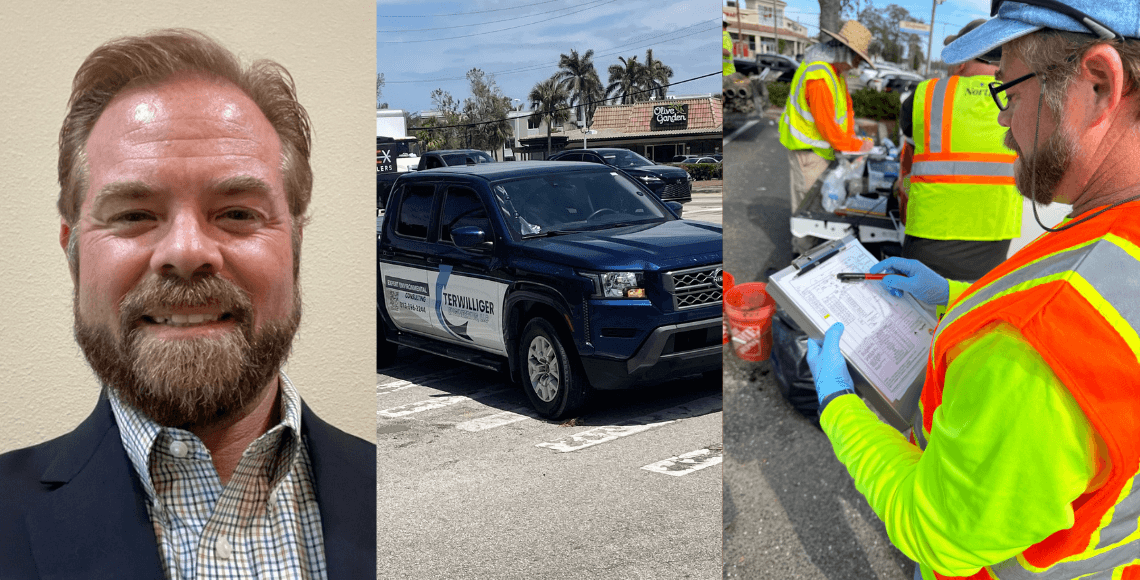
To help this problem, Florida established the Petroleum Cleanup Participation Program (PCPP) in 1995, which encourages businesses to report petroleum leaks and spills by covering costs for those businesses. Alum Tim Terwilliger ’96, Chemical Engineering, has been part of this cleanup for over two decades.
“When that program first started, there were 20,000 known or suspected leaks. Today, there are 4,000,” Terwilliger says.
As an undergraduate student, Terwilliger became involved in the University of South Carolina’s Filtration Research Engineering Demonstration. The demonstration performed engineering-scale tests to determine crossflow filter performance with a sodium solution containing varying concentrations of sludge and monosodium titanate, which is an inorganic adsorbent. Terwilliger’s participation in the research helped him realize what he wanted to do: environmental cleanup.
“At USC, I met a lot of great people, colleagues, friends and classmates,” Terwilliger says. “I was impressed by how established the college was. The professors were knowledgeable and helpful and had real-world skills.”
Terwilliger moved to Florida after graduating, where he earned his master’s in environmental engineering from the University of South Florida. After working in environmental consulting for 16 years (with a short break in between to work as an insurance agent), Terwilliger established his own petroleum cleanup firm: Terwilliger Engineering.
Working with the State of Florida as a vendor for cleanup under the PCPP program, Terwilliger Engineering uses the air sparging process to remove petroleum from the groundwater and soil. Air is first pumped into the groundwater to force hydrocarbon compounds to volatilize and turn into vapors. Then, a soil vapor extraction system removes the remaining petroleum contamination.
While some may only associate chemical engineers and their work with negative environmental impacts such as air and water pollution, Terwilliger says his chemical engineering studies applies to many aspects of his work in addressing today’s environmental challenges.
“For example, I had to take organic chemistry twice, but that knowledge has been very helpful,” he says. “It applies to the work I do every day.”
While PCPP has not completely eliminated the statewide number of petroleum spills and leaks, it has helped to greatly reduce the amount of petroleum in the environment. The removal of soil contaminants helps the environment in several ways, including protecting wildlife, maintaining soil health and restoring biodiversity.
Terwilliger’s important work continues to protect the natural environment and the health of those living nearby.