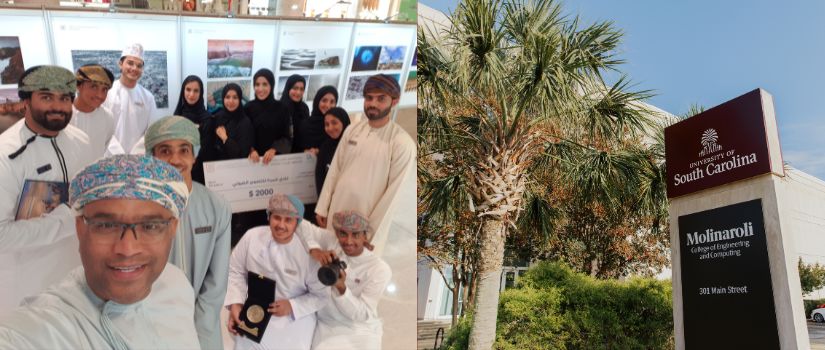
Since 2022, a partnership between the University of South Carolina and the National University of Science and Technology (NUST) in Oman has fostered a cross-cultural engineering community.
The Molinaroli College of Engineering and Computing (MCEC) advises the NUST College of Engineering by overseeing degree quality and helping develop ABET (formerly known as the Accreditation Board for Engineering and Technology)-compliant programs.
“Degrees endorsed by USC increase the marketability and international recognition of our graduates, opening doors to global careers and higher education opportunities,” says Dean Ahmed Hassan Al Bulushi of the NUST College of Engineering.
The partnership encourages students from Oman to pursue graduate studies, research or teaching at USC.
“We can provide some of the elements that might be missing for them, and in the process, they bring talent to us,” says MCEC Dean Hossein Haj-Hariri.
Haj-Hariri attended the NUST College of Engineering's graduation ceremony this past February. He learned about the campus, programs, Omani culture and the opportunity for future visits.
“You have to go there to get a feel for how good these students are. The faculty are dedicated, and the facilities are excellent,” says Haj-Hariri.
NUST administrators visited USC in October 2024 to explore the campus and Columbia community as well as discuss exchange programs, and possible partnerships with the university's College of Pharmacy and College of Education.
According to Samuel Todd, USC vice provost and associate vice president of global affairs, the partnership plays a scientific, research, educational and cultural role at both institutions. In addition, both schools’ programs share learning expectations, technical content, research-driven learning, real-world applications and industry-integrated education.
“This collaboration serves as a benchmarking platform that helps us continually refine and improve our academic and operational standards in line with global best practices,” says Al Bulushi.
The MCEC has approximately 3,400 undergraduate students, which comprises around 9% of the university’s population. Meanwhile, NUST’s College of Engineering has over 3,000 students and is approximately 63% of its university’s population. While the MCEC has seven departments with more than 40 programs, NUST’s engineering school has five departments with 20 programs.
USC has more general education requirements, while NUST focuses on technical specialization. Each has research funding for students and promotes community through activities, service, and professional and cultural organizations, like the USC Omani Student Association.
“The scale and size of our institutions result in differences in administrative processes and resource allocation, but these differences complement our shared commitment to quality and innovation,” says Al Bulushi.
The USC Career Center offers job fairs, mentorships, incentivized research and internship course options. Similarly, NUST has the Tahsin Program for career preparation, required senior internships and the NU Incubation Centre pods for students’ entrepreneurial innovation.
The NUST College of Engineering also has an entrepreneurial focus. Entrepreneurship learning began in 2007, and in 2013, the college received the highest National Award for its entrepreneurial education initiatives. Oman is also an important hub in global trade, particularly oil cargo and finished goods, and requires engineering for shipping ports. The supply chain priorities in Oman can connect NUST and the USC Darla Moore School of Business.
“They work with the students to elevate their ideas, get funding and turn it into a company, which I thought was wonderfully well done. They took me there and [students] pitched their company to me,” says Haj-Hariri.
Conversations to start the partnership began around a decade ago. The Caledonian College of Engineering, now the NUST College of Engineering, wanted to switch to ABET-aligned curriculum with the help of a U.S. partner.
“The decision was driven by shared values, academic alignment and a mutual vision for innovation and excellence,” says Al Bulushi.
When Michael Amiridis became USC president in 2022, he visited Oman to solidify the relationship. This summer, around 30 students from NUST will visit USC for a month. They will visit labs, learn more about research, work on projects and visit local sites.
“We are eager to expand the scope of this collaboration by increasing the frequency and scale of student and faculty exchanges,” says Al Bulushi.
Students and officials can also visit other colleges at USC to consider partnership expansions.
“We want to continue this flow of students,” Haj-Hariri says. “Hopefully some of their faculty will come here and some of ours will go there to teach courses.”