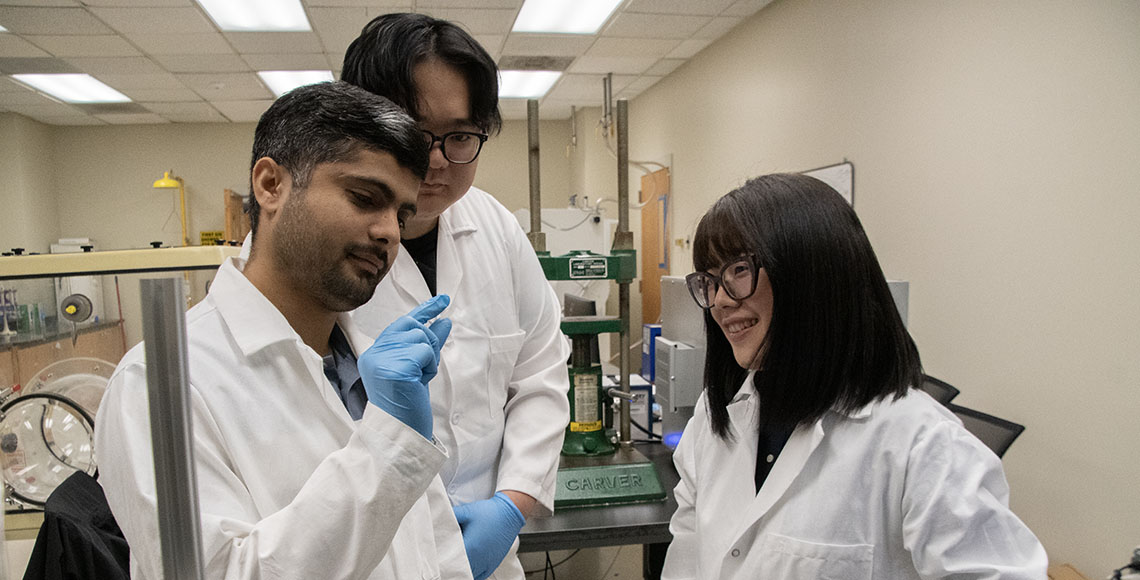
For Chemical Engineering Assistant Professor Hui Yang, materials science is more than studying structure and properties to power everyday technology. It’s reimagining how they can work better.
Today, Yang is one of the team members of the Molinaroli College of Engineering and Computing’s Carolina Institute for Battery Innovation, where her research focuses on solid-state lithium and beyond lithium batteries. Unlike traditional batteries, which use flammable liquid electrolyte systems, next-generation solid-state batteries utilize solid-state electrolytes that can improve safety, increase energy density, and enable a fast charge.
“During my graduate studies, I was trained in organic, inorganic and hybrid material science and designed two-dimensional function materials,” she says. “This paved a solid background on material design at molecular scale. My postdoctoral research emphasized fundamental studies on charge transfer and electrochemistry in battery field.”
Yang’s current research focuses on understanding, predicting, and ultimately controlling matter and energy at the electronic, atomic, and molecular levels to provide the foundations on new material design for new energy technologies. One of the biggest challenges in solid-state batteries is the sluggish charge transport in the solid-state electrolytes. Yang’s work aims to better understand how that process works and to develop new materials that can improve battery performance.
"Hui is really smart and tenacious, says William Mustain," chemical engineering professor and director of the Carolina Institute for Battery Innovation. “She is constantly developing new ideas, engaging with program managers and finding the right places for her work."
Yang began her research at the college last August, bringing a wealth of private sector battery industry experience. She worked at Ensurge, a battery start-up company in Silicon Valley, as a senior staff battery process integration engineer. She led and contributed to breakthroughs in interface engineering and roll-to-roll technologies, which advanced the company’s solid-state microbattery technology.
“These efforts supported safer, higher-performing batteries for wearables, hearables and industrial connectivity, while enabling greater form-factor freedom,” Yang says.
With her first year at the college complete, Yang continues collaborating with colleagues and graduate students to push her research forward.
“My goal is to bridge the gap between fundamental science and real-world technology,” Yang says. “As a chemist, I am driven by the opportunity to design new materials at the molecular level and translate that discovery into advanced battery technologies that offer improved safety, performance and reliability.”