In 1993, Jim Clyburn was first elected as U.S. representative for South Carolina’s 6th congressional district, and University of South Carolina athletics was only in its second year as a member of the Southeastern Conference.
That same year, Carolina Distinguished Professor Jim Ritter began his career at USC as an assistant professor.
Ritter’s contributions to the Department of Chemical Engineering are many, as evidenced by his lasting relationships with students, more than 170 peer-reviewed journal articles and eight U.S. patents. The Syracuse, New York native earned his bachelors, master’s and doctorate degrees from the State University of New York (SUNY) at Buffalo, though he now calls Columbia home.
Ritter was hired by Distinguished Scientist Professor Ralph White, who also joined USC in 1993 as a professor and chair of the Department of Chemical Engineering. However, according to White, he placed Ritter in the “do not interview” pile because he earned all of his degrees from the same university. But Professor Vincent Van Brunt told White that Ritter was an outstanding employee at the Savannah River National Laboratory, where he was a senior engineer at the time.
“We interviewed and found him to be an excellent candidate and offered him the job as an assistant professor without tenure,” White says. “During his interview he presented a long list of his novel ideas for funding and ways to improve our curriculum, which he has obviously carried out over the years.”
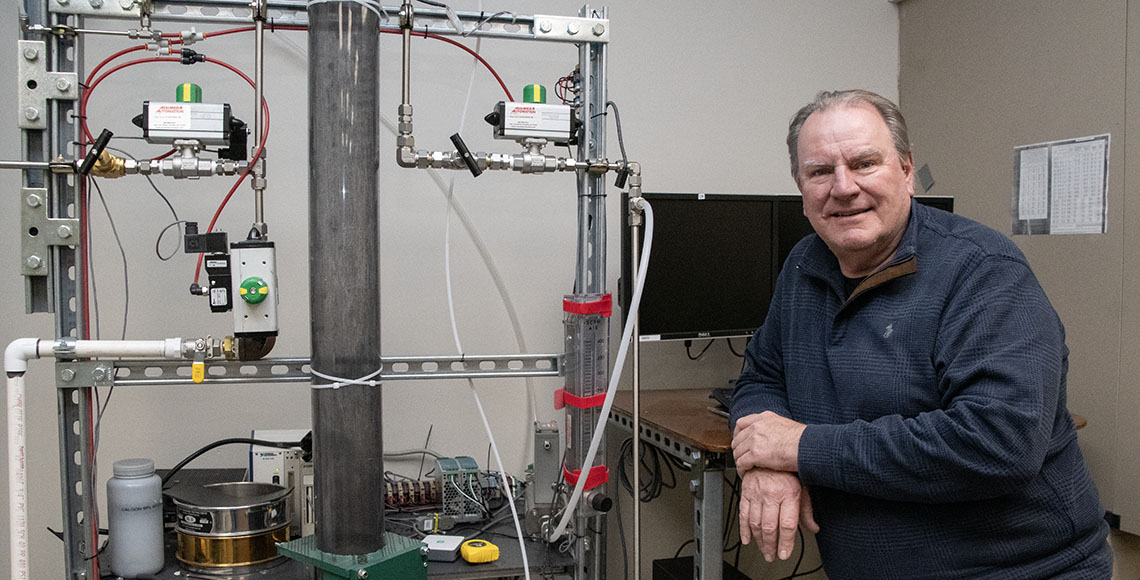
Upon his arrival, Ritter was tasked with rebuilding and teaching the two-course undergraduate Unit Operations Laboratory (ECHE 460 and 461), which he calls one of the greatest highlights of his career. He modeled the course after the unit operations lab at SUNY Buffalo and consulted with Vice Dean of Engineering and Computing Michael Matthews on logistics. The rebuilt course gives practical application to lecture courses in real systems and real data, emphasizing analysis, presentation and writing, and has earned high marks through five Accreditation Board for Engineering and Technology review processes.
“Most people in chemical engineering consider this course a kiss of death because you have to focus on research and it’s a huge time commitment,” Ritter says. “But it has been a pride and joy of mine since taking it over in the spring of 1994.”
In recognition of his success with the undergraduate lab, Ritter was awarded the Dr. Joseph and Geneva Gibbons Distinguished Teaching Award last April. The prestigious performance-based award is a three-year endowment that includes an annual $5,000 honorarium.
“We are all extremely pleased with Jim’s building, managing and running our Unit Operations Laboratory for our undergraduates. I often use one of his lab experiments in my graduate courses,” White says.
Ritter’s research group focuses on cyclic adsorption processes, with his team spanning 4,200 square feet across eight laboratories. His eight patents involve gas separation and purification and hydrogen storage processes and materials, including a process for carbon dioxide capture from flue gas, funded by grants from the Office of Naval Research and Department of Energy as well as several university centers and private companies.
“Because of his significant contributions in adsorption, Dr. Ritter is the editor-in-chief of Adsorption, Journal of the International Adsorption Society, which is the most important worldwide journal on the subject of adsorption,” says Research Professor and former Ph.D. student Armin Ebner. “He also co-authored the Adsorption and Ion Exchange chapter in the ninth edition of Perry’s Chemical Engineers’ Handbook, which is perhaps the most important reference book used in the field of chemical engineering.”
Ritter has served as a research consultant for more than 40 companies, government agencies and national laboratories. A recent highlight involves his work for ColdStream Energy, a technology developer for the oil and gas industry. Ritter’s lab developed a recently commercialized pressure swing adsorption (PSA) process for natural gas conditioning. This PSA unit conditions raw natural gas supplied to internal combustion engines that spin natural gas pipeline compressors; otherwise, the use of raw natural gas in these engines would potentially result in excessively high temperatures causing damage to them.
“I came here in 1993 knowing that I would be required to excel in research, run a large research group and bring in enough money to support it,” Ritter says. “I was like a kid in a candy store because Ralph White was still building the department, and labs were available in Swearingen that no one was using.”
Ritter has mentored 26 Ph.D. and 14 master’s degree students at USC, some of whom continue to work alongside him in the research lab. These include senior researchers Ebner, who has made significant contributions in cyclic adsorption processes; Chuck Holland, who retired as director of the undergraduate lab but continues to build and maintain all his lab equipment; and Marjorie Nicholson, a fixture in the lab for more than 19 years and current director of the undergraduate lab.
“I am proud to be part of Jim’s research group, which I joined as a Ph.D. student in January 1996 and have continued to work with him ever since,” Ebner says. “He has been significant in my own career and life, who with his natural ability to trust and care for others has provided me with the essential tools that allowed me to become who I am today in this field of separations.”
“You are blessed if you get really good students, and my team is like my family,” Ritter adds. “My group would not be what it is without them.”
In addition to his students and research group, the Department of Chemical Engineering and Molinaroli College of Engineering and Computing overall have experienced a significant evolution in the last 30 years. One of the most obvious metrics of growth is national rankings, in which each department continues to rise, resulting in greater recognition and a growing student population from across the country.
“I’ve been impressed with how we’ve evolved both as a department and college,” Ritter says. “When I first got here, people who grew up in South Carolina didn’t even know we had an engineering program. Today, we have a competitive program, and parents want to send their children here.”