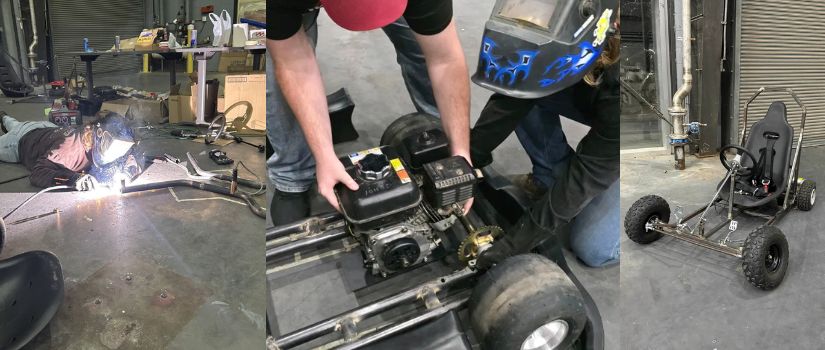
The University of South Carolina chapter of the Society of Automotive Engineers (SAE) is gearing up for the 2027 SAE Formula Competition, a hands-on experience designed to prepare aspiring automotive engineers for careers in the industry. Participating students are in preliminary stages of building a combustion formula car with the goal of competing in the spring of 2027 at Michigan International Speedway.
The SAE Formula Competition provides a platform for students to apply classroom concepts to solve real-world engineering challenges. It requires performance demonstration of their vehicles in a series of events, both off and on track, with each vehicle evaluated against other competing designs to determine the vehicle that best meets the design goals.
USC’s team is composed of seven sub-teams focused on aerodynamics, chassis, electrical, powertrain, suspension, wheel hub/axle and business. The team is converting electrical formula car designs produced during a previous year to fit an internal combustion engine format.
First-year mechanical engineering graduate student Trent Miller is serving as a project advisor. He established the business team alongside junior mechanical engineering student Jacob Kestenbaum to coordinate marketing, outreach and fundraising efforts.
“This project offers valuable skills in designing, building and working as a team, and bridges the gap between theoretical knowledge and application,” Miller says. “I personally enjoy the business side of engineering, which I think is often overlooked. My main goal is to advise the business team on its corporate sponsorship strategy.”
Kestenbaum, treasurer of USC’s SAE chapter and business team lead, has a lifelong interest in race cars. His father raced and Kestenbaum began racing himself after receiving his driver’s license. In his personal time, Kestenbaum is transforming a road car into a race car, and he sees the formula competition as an opportunity to hone his skills and prepare for a racing career.
“This program provides opportunities to make industry connections and apply classroom material,” Kestenbaum says. “It demonstrates that you were given a problem, worked on it, and were able to produce a deliverable and show how you got there.”
Mechanical Engineering Professor and SAE faculty advisor David Rocheleau supports the team’s efforts.
“This program makes a big impact on how students sharpen their skills as engineers, because in addition to hands-on experience, it serves as motivation to focus on the academic work required and succeed academically,” he says. “Students begin to understand their purpose and the meaning behind it, and it’s reflected in their academic record.”
In order to ensure that their car adheres to the safety and performance standards required in automotive engineering, students are seeking support from alumni and industry sponsors for high quality components and materials. Financial support as well as donations of steel, tires, software and other materials is needed.
“We hope to use these materials to maximize the performance and reliability of our car and to foster lasting relationships with our sponsors,” Kestenbaum says. “Sponsor donations will set our team up for success in Formula SAE competitions for years to come.”
Regardless of the monetary amount or type of materials, all sponsors will receive a quarterly newsletter detailing the team’s progress to follow their journey and the impact of their support. Other sponsor benefits vary depending on donation level and include placement of company logo or stickers on the car and promotional materials.
“This project is more than just building a car; it is an invaluable hands-on experience that shapes the next generation of engineers, leaders and innovators,” Miller says. “Your support is a direct investment in our education and provides the critical resources needed to turn our designs into a competitive reality.”
To explore sponsorship opportunities or donate specific physical parts: Please email trentcm@email.sc.edu or kestenbj@email.sc.edu.