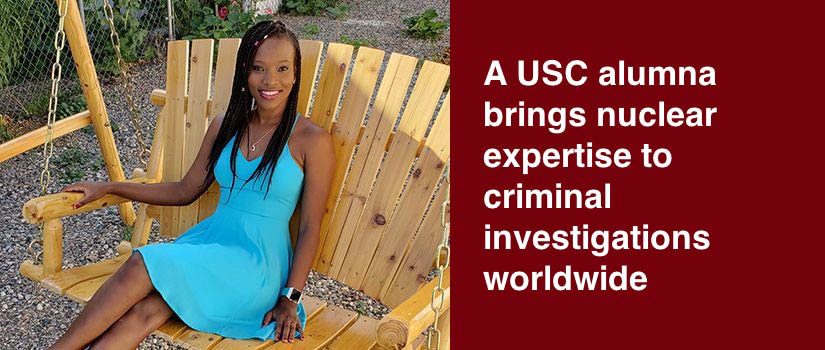
You’ve heard of homicide detectives and crime scene investigators. But a nuclear detective?
University of South Carolina alumna Tashiema Ulrich helps countries develop the skills to trace radioactive material found where it shouldn’t be and investigate whether it’s connected to a crime.
Ulrich, the first Black woman to earn a nuclear engineering doctorate from USC in 2019, serves as an associate nuclear security officer at the International Atomic Energy Agency (IAEA) in Vienna, Austria. Her work focuses on nuclear forensics, a specialized field that uses scientific techniques to identify nuclear and other radioactive materials and help determine their origins and potential connections to illicit activities.
As countries expand their use of nuclear technology, protecting radioactive materials and ensuring they do not fall into the wrong hands is increasingly important. Ulrich helps IAEA member states strengthen their ability to investigate incidents involving radioactive materials found outside regulatory control, including theft, smuggling or trafficking.
“When explain what I do, I say I don’t do science anymore,” Ulrich says. “Instead, I help other countries develop their nuclear forensics capabilities. If radioactive material is found, we need to know where it came from. In many cases someone needs to go to jail. We help build the capacity for conducting those types of investigations.”
Investigating the origins of radioactive materials
Much like traditional forensic scientists examine fingerprints or DNA, nuclear forensics specialists analyze the physical and chemical characteristics of radioactive materials to help determine their origins, history and potential use.
But identifying the material is only part of an investigation. Evidence must also be safely collected, documented and preserved so it can be analyzed and potentially used in criminal proceedings.
Since joining the IAEA in 2025, Ulrich has helped countries develop their nuclear forensics capabilities through training and technical assistance. Her work bridges the gap between the crime scene and the laboratory, helping law enforcement and scientific personnel respond when radioactive material is discovered.
Training varies depending on each country’s resources and experience, ranging from basic nuclear forensics to advanced techniques for managing crime scenes involving radioactive materials. Ulrich and her colleagues also help countries use existing equipment, establish national response plans and develop procedures for handling and preserving evidence.
Her work has taken her to Sri Lanka, Malaysia and Indonesia, as well as locations throughout Europe and South America.
The need for these capabilities extends beyond countries operating nuclear power plants. Radioactive materials are also used in medicine, manufacturing, agriculture and scientific research. When these materials are lost, stolen or improperly controlled, they can create public safety and security concerns.
From 1999 to 2025, IAEA member states reported 3,600 incidents involving nuclear and other radioactive materials outside regulatory control. While not all involved criminal activity, some were associated with smuggling, trafficking and other unauthorized activities.
Ulrich’s goal is to help countries prepare before an incident occurs.
“We want to make sure any radioactive material is accounted for,” Ulrich says. “We don’t want to wait until an accident happens before member states have the capacity to handle investigations of such material.”
Ulrich's career demonstrates how nuclear engineering expertise extends beyond the design, research and operation of nuclear power plants.
And Ulrich is no stranger to forging her own path. Originally from Jamaica, she immigrated to the United States in 2009 at age 15 and become the first member of her family to attend college. She earned a bachelor's degree in chemistry from the University of West Florida in 2015 before pursuing her doctorate at USC.
Her doctoral research focused on nuclear fuel materials under her Ph.D. advisor, Smart State Chair Ted Besmann, who recalls her determination and willingness to tackle challenging scientific questions.
“I have been consistently impressed with Ulrich’s great enthusiasm for the work, the enormous energy she brings to her efforts, and her drive to comprehensively address a question,” Besmann says. “I would rank her in the top five percent of the graduate students with whom I have been generally associated.”
After graduating, Ulrich worked at Los Alamos National Laboratory and spent four years at Oak Ridge National Laboratory, researching advanced nuclear fuels, including how they are manufactured and perform after exposure to radiation.
That scientific background provided a foundation for her transition to nuclear security, where understanding radioactive materials is essential to investigating their origins.
According to Travis Knight, Chair of the Department of Mechanical Engineering and director of the nuclear engineering graduate program, Ulrich's career highlights the range of opportunities available to graduates in a field often associated primarily with energy production.
“Tashiema's career is a wonderful example of how far our nuclear engineering graduates can go, both geographically and in their impact on the world,” Knight says. “Through her work at the IAEA, she is contributing to an organization whose mission is central to advancing the safe, secure, and peaceful use of nuclear technology worldwide.”
Finding purpose in a new career and country
Ulrich's transition from research to international nuclear security required more than a career change. It also meant moving her husband and five-year-old daughter to Austria and adjusting to a new culture and language.
Having experienced a similar transition when she immigrated to the U.S., Ulrich understood the challenges of starting over in an unfamiliar country.
“Moving to Austria was a fear I had to overcome,” Ulrich says. “I wasn’t just moving myself, but my family as well. It’s scary when your child is growing up different, and I fear that my daughter feels different because she doesn’t speak German yet. I know what that feels like.”
Nearly a year after joining the IAEA, Ulrich has embraced the opportunity. She enjoys working alongside colleagues from around the world at the United Nations office complex in Vienna and helping countries strengthen their nuclear security capabilities. She hopes to extend her two-year contract when it comes up for renewal.
Although her career has taken her away from the research laboratory, Ulrich has discovered that her nuclear engineering education can make a difference in ways she never imagined.
“The old Tash is all gone now,” she jokes. “There is a lot more out there that this education can be translated to, and I love helping other countries develop their capabilities and make more out of less. That’s what drives me.”