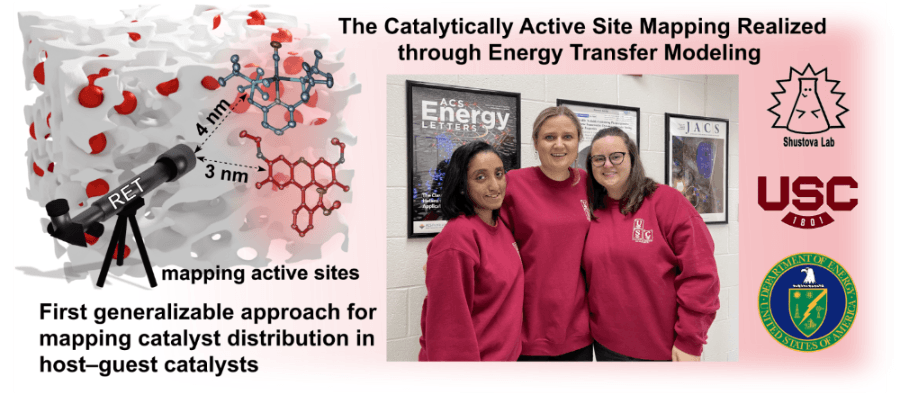
Leading by the senior graduate student Buddhima Maldeni, the Shustova group in collaboration with the Boston College team introduced a novel concept for catalyst mapping, aimed at understanding the distribution of active sites in heterogeneous host-guest catalysts within porous matrices: “Catalytically Active Site Mapping Realized through Energy Transfer Modeling” (Angew. Chem. Int. Ed. 2025, 64, e202416695). These studies present the first transformative approach for mapping molecular-level guest distribution in heterogeneous host-guest catalytic systems. It provides a foundation for predicting and optimizing catalyst performance within various porous supports, paving the way for developing next-generation heterogeneous catalysts, including platforms for highly efficient cascade or tandem catalytic processes.
In particular, we demonstrate the application of resonance energy transfer (RET) as a method for mapping catalytically active sites and tracking their migration in host-guest catalyst systems exposed to industrially relevant reaction conditions. This represents the first implementation of RET for this purpose. As a result, the RET analysis revealed a core-shell distribution of guest molecules within the MOFs, while spectroscopic studies provided insights into the migration of active sites under catalytic conditions used for carbon dioxide reduction and ring-closing metathesis reactions. To complement the quantitative assessment of guest distribution by RET studies, we used confocal fluorescence microscopy imaging to obtain visual insights into the catalyst distribution pattern, supporting the hypothesized core–shell arrangement. By correlating the evolution of active sites with catalytic performance in these transformations, our findings indicate that encapsulated guest molecules predominantly distribute near the MOF surface, enhancing host–guest catalysis by mitigating mass transport limitations. The fundamental knowledge gained through this study is broadly applicable to other porous matrices, enabling the rational design of hybrid systems with improved catalytic activity. Furthermore, this approach opens new avenues for spatial distribution studies using fluorescently labeled catalysts, paving the way for advanced catalyst mapping strategies in heterogeneous catalysis.
Maldeni Kankanamalage, B. K. P.; Thompson, W. J.; Thaggard, G. C.; Park, K. C.; Martin, C. R.; Niu, J.; Byers, J.A.; Shustova, N. B.* “Catalytically Active Site Mapping Realized through Energy Transfer Modeling” Angew. Chem. Int. Ed.2024, e202416695.