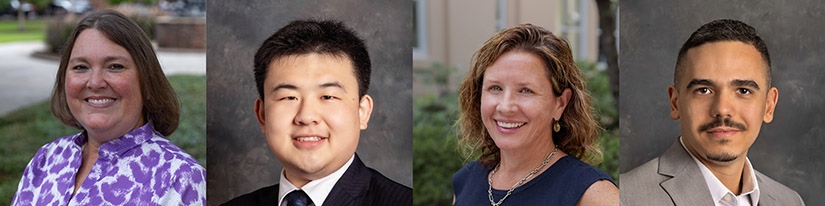
The University of South Carolina College of Education is pleased to announce a total of more than $4 million in funding from the National Science Foundation (NSF) ahead of the 2026-2027 academic year. Four projects were funded across disciplines in the College of Education, setting a college record for NSF awards being awarded within a few days of each other. The projects span developing STEM teacher leaders in rural communities, assessing engineering student’s ethical AI literacy, supporting educators’ integrated algebraic and computational thinking, and expanding authentic learning experiences outdoors. Individual project teams and goals are outlined below.
STEM Teacher Leadership through Action Research in Rural Communities
Primary Investigator: Jan Yow, Teacher Education
Co-PIs: Sean Yee, Mathematics; Ashley Gess, Teacher Education; Christine Lotter, Teacher
Education; George Roy; Teacher Education
Key Personnel: Angie Starrett, Educational and Developmental Studies; Jennifer Crooks-Monastra,
REM Center
Total Project Amount: $2,999,999
This project will offer professional development in STEM for rural educators in Bamberg, Calhoun, Lee, Lexington 1 and Richland 1 counties and provides a model for development of STEM teachers leaders through a five-year professional development program. This program will include a three-year STEM Ed.D. program and a two-year Action Research Implementation program with infused support throughout. A second component of the project will focus on 16 Master Teacher Fellows (MTFs) across partnership school districts to empower instructional leaders, particularly rural districts that lack specialists.
Building an Assessment Framework for Engineering Students’ Ethical AI Literacy
Primary Investigator: Hengtao Tang, Leadership, Learning Design, and Inquiry
Co-PIs: Yingxiao Qian, Leadership Learning Design, and Inquiry; Yi Wang, Mechanical Engineering
Total Project Amount: $499,958
This project will establish research methods for AI literacy by developing grounded, operationalized and measurable constructs for educational research. The research team will use student-generated causal maps to reveal how students organize, connect and apply ethics to authentic AI dilemmas. The project will generate foundational knowledge about ethical AI literacy, advance assessment methodology and produce openly available resources to support future research, curriculum development and faculty practice on ethical AI learning and development across engineering and related STEM disciplines.
Bridging Classrooms and Nature: South Carolina Outdoors for Understanding the Teaching of Science (SCOUTS)
Co-PI: Brooke Whitworth, Teacher Education, (Primary Investigator: Steph Dean, Clemson University)
USC Project Amount: ~$150,000, total award $749,000
This Noyce Research Experiences in STEM Settings (RESS) project aims to serve the national need of developing highly effective science teachers who can engage students in authentic scientific practices using real-world data and local outdoor environments. Additionally, this project will support 24 pre-service and in-service science teachers by providing an immersive two-year freshwater ecology research experience that includes citizen science investigations, mentoring from professional scientists, professional learning workshops and opportunities to design and implement classroom-based citizen science projects. The proposed project components will enable participating teachers to develop expertise in outdoor science instruction, freshwater ecology research, data collection and analysis and the design of standards-aligned science learning experiences that engage students in authentic scientific inquiry and strengthen the future STEM workforce through high-quality science education.
Scaffolds for Integrated Computational and Algebraic Thinking
Primary Investigator: Lucas Vasconcelos, Leadership, Learning Design, and Inquiry
Co-PIs: Matt Irvin, Educational and Developmental Science; Ismahan Arslan-Ari, Leadership,
Learning Design, and Inquiry; Elif Karsli Calamak, Teacher Education
Total Project Amount: $399,650
This project will develop strong foundations for early learners in computational thinking and mathematics. Pre-service educators will be prepared in using learner-center scaffolds, or temporary support structures that assist students in engaging with new information. The research team will study how these support structures contribute to early educators’ experiences in designing and teaching integrated lessons that support both areas.
The study will follow two cohorts of pre-service teachers beginning in their senior year of an early childhood teacher education program, through their teaching internships and into their first year as in-service teachers in South Carolina schools. This partnership between educator preparation in the College of Education, SC CATER and area schools will allow participants to engage in a semester-long instruction featuring robotics activities, learner-centered instructional supports, integrated computational and algebraic thinking tasks and scaffold-supported lesson design. The findings will advance mathematics education for early learners throughout the state and beyond.