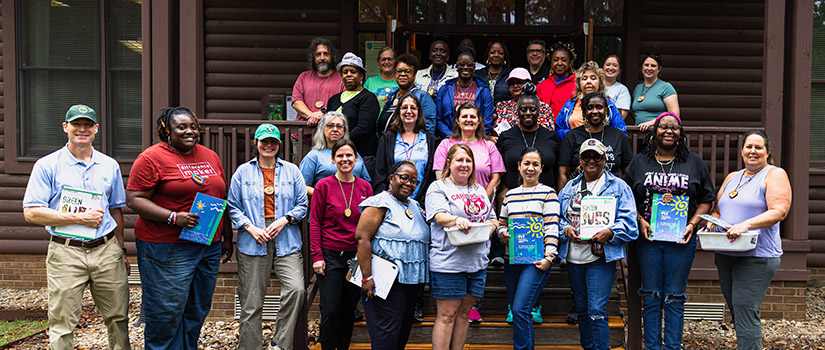
In its final cohort, AWAKE STEM continues to make a meaningful difference among educators across the state. Funded by the National Science Foundation, AWAKE stands for Advancement of the Workforce and Knowledge Economy. More simply, AWAKE STEM is bridging the gap between STEM careers and the classrooms of South Carolina. The grant provides education in project-based learning to middle level educators and school counselors in rural communities throughout South Carolina. In addition to their graduate coursework, these school leaders are introduced to a variety of careers and opportunities as well as technology enhancements for their instruction. By working across disciplines, these teams of counselors and educators infuse career development expertise into exciting classroom lessons.
During year one of the cohort, educators and counselors participate in graduate coursework while developing and implementing two project-based units with their students. Previous participants, Ashley Bennett, Selena Turnipseed and Emily Wireman from Woodruff Middle School, created a farmer’s market within her classroom to introduce their students to agricultural careers and innovations. During the summer the teams meet for a three-day workshop featuring instruction from College of Education faculty and community partners. Dodie Limberg (primary investigator), Christine Lotter, George Roy (co-primary investigators), Matt Irvin and Bryndle Bottoms (educational researchers) collaborate to meet program goals. They take field trips and learn how to use innovative technology including robots and virtual reality headsets to enhance their teaching time. During year two, these educators refine their units and plan for ways to expand their teaching or better their approach. Their guidance from the College of Education continues asynchronously and they meet to exchange ideas. At the close of each cohort, all of the project-based learning units are added to a lesson plan library that is available online for sharing.
Each year participants learn about a wide variety of career possibilities for students who attend college and those entering the workforce after high school. The workshop empowers rural middle school teachers and counselors to work collaboratively to link their interdisciplinary content standards to authentic STEM community and career connections through project-based learning units. Highlights from this year’s workshop included hands-on preparation at Harbison State Forest, learning about careers in forestry as well as soil testing and biology. Matt Schnabel, environmental educator from the S.C. Forestry Commission, helped expand skills and instruction at the state forest using Project Learning Tree’s curriculum. Schnabel was just one of the community partners involved. Mary Margaret Mendenhall from Take Action SC, an initiative from the S.C. Department of Environmental Science, taught a lesson on composting in a bottle. Take Action SC is a free resource for S.C. educators. These lessons showcased the power of community and industry partners, so students hear firsthand from individuals in a variety of careers.
Three educators who participated in this year’s workshop shared the following sentiments:
Tamara Tucker, school counselor, Carvers Bay Middle STEAM Academy
Tamara Tucker serves as the school counselor at Carvers Bay Middle STEAM Academy in Hemingway, S.C. For Tucker, this experience has helped her gain insight into how she can contribute to classroom settings and build connections between her work and her fellow educators.
Her team initiated two projects at their school: building a greenhouse and designing a “Georgetown of the Future.” For the greenhouse unit, students learned about sustainability, growing plants and vegetables and working in groups. Tucker helped the students grow in soft skills and collaboration. For the city planning unit, students learned about the city’s history and various careers that keep cities strong like engineers, historians, recycling and waste management and city planning and development. Tucker’s many connections with community partners were invaluable during this unit because she was able to bring in a wide variety of professionals that expanded student understanding.
“I helped the students expand their collaborative skills,” says Tucker. “We want to make sure we are communicating effectively, allowing everyone to have a role, and holding our partners accountable. These are all important for their future success.”
During the city planning unit, Tucker was surprised to see how the students connected to their town in new ways. The students realized they did not know as much as they thought about their town’s history.
“Not only did it expand their research skills, but for them to build a better Georgetown, they needed to know about Georgetown’s past and present,” says Tucker. “Not just the lens of what they can see in front of them, but how far Georgetown has come and where it can still grow in the future.”
Tucker asked various types of engineers to visit the students so they could see more than one career path in the same field. From blueprinting to utilities and even NASA, the students had access to many professionals. Tucker knows year two will be even better because they will expand on role clarification and streamline their own teaching styles.
“Students have enjoyed participating,” says Tucker. “They’ve felt pride in their work and involved their families. They are growing in public speaking, character and leadership. Our teaching team has grown in leadership too! We are able to show the rest of our school what project-based learning can do.”
Sissy Smith, media specialist, Carvers Bay Middle STEAM Academy
Sissy Smith serves as the media specialist at Carvers Bay Middle STEAM Academy. Smith led the research component of the project-based learning units. Her favorite part of participating in AWAKE STEM has been the ability to learn and do simultaneously. By building units in real time, she can learn from College of Education faculty and immediately implement that understanding. She also enjoyed having a mentorship component with a coach and faculty to rely on including participants from previous cohorts.
As the media specialist, Smith serves as the lead on making sure the units align with South Carolina educational standards. She helps integrate standards into the units across subjects.
For both the greenhouse and city planning units, Smith helped students develop research questions and access sites for answers. Using the South Carolina Department of Education and South Carolina State Library sites, she guided students on effective research methods. As artificial intelligence expands, it is more important than ever that students build solid research foundations and learn how to separate fact from fiction.
“As you know when you use Google, an AI summary is the first thing you see,” says Smith. “We were able to take a look at that information and then explore further to see what a more accurate source might be.”
Smith shared that both units opened up new ideas to the students. Their community is very rural, so it was easy to see how different growing solutions might benefit area farmers. The city planning unit allowed the students to see their community with fresh eyes. The teaching team is using that same approach as they implement these units in year two.
“We are expanding our tasks that coordinate with each project milestone,” says Smith. “This will give our students more structure, but also more choice in how they approach each project. I am also working on making sure stick my facilitator role and let students discover and explore.”
Mark Thompson, 7th grade social studies, Blenheim Middle School of Discovery
Mark Thompson teaches seventh grade social studies at Blenheim Middle School of Discovery in Blenheim, S.C. After a year teaching STEM, he is excited to return to his favorite subject: social studies and world geography. For Thompson, year one was characterized by trepidation at first, but he gained confidence throughout the process. His biggest challenge has been moving from instructor to facilitator.
Thompson and his team led units on plastic pollution and building tiny homes. For the pollution unit, students researched and created posters and arguments for recycling, even touching on relevant topics such as the prevalence of microplastics.
“The students were shocked to learn that a person might have as much as a credit card’s worth of plastic inside their bodies,” says Thompson. “That was a great way to kick off our discussion.”
The tiny home unit allowed students to explore the environmental impact of houses and understanding how one’s home impacts their life. They built models and discussed how a tiny home might solve various societal problems including affordable housing, lowering energy costs and reducing the housing crisis. Students had to grapple with what adjustments might be necessary for someone considering a tiny home. Some students had never seen a tiny home, but they really got engaged in the model making process. Many of the students made furniture and more to personalize their model homes. Their materials were popsicle sticks, paper and cardboard. Thompson was delighted to see the creativity and imagination they used to approach this project.
Thompson is ready to tackle year two. He hopes to change their focus on the pollution unit to how they can tackle pollution surrounding their school including recycling and litter reduction. He is also excited to add more geography concepts into the instruction.
“Marlboro County does not offer curbside recycling collection,” says Thompson. “It will be fun to explore with the students what are new ways we can reduce pollution in our communities and in our school.”
For more information about AWAKE STEM visit, sc.edu/ired.