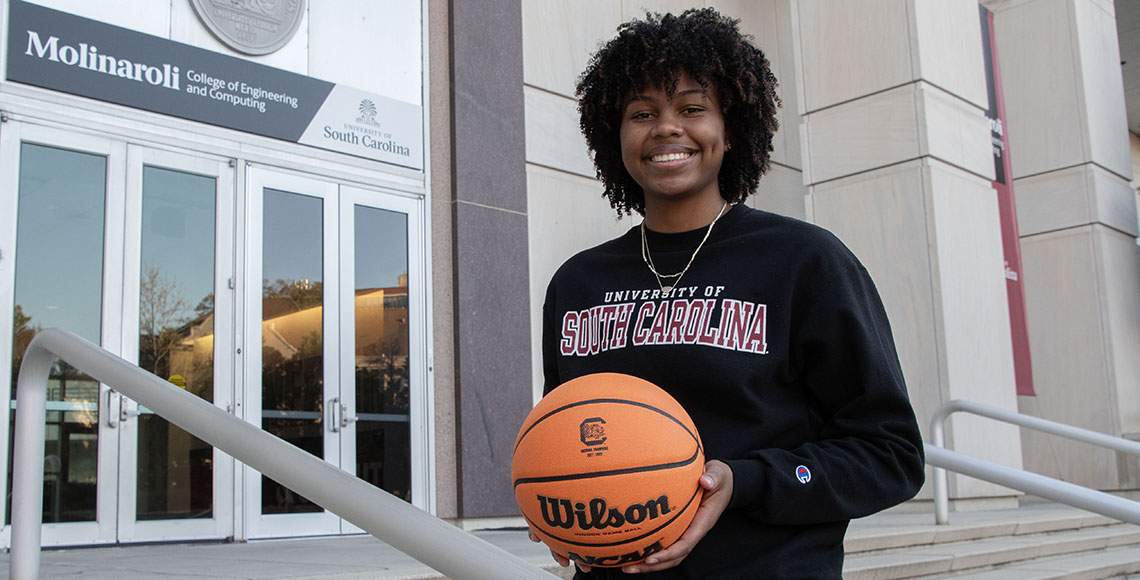
“She wants to take the world by storm.” – USC Women’s Basketball Head Coach Dawn Staley
Freshman women’s basketball guard Ayla McDowell does not separate basketball from academics, or creativity from discipline, or ambition from uncertainty.
Instead, the mechanical engineering major sees everything from chemistry homework and scouting reports to defensive reads and early morning workouts as part of a larger, interconnected challenge.
“To me, everything is like a puzzle,” McDowell says. “On the court you’re reading the defense, solving what’s going to happen next. It’s the same thing in school. I have to solve things and figure them out.”
Only months into her first year at the University of South Carolina, McDowell is already proving she is more than capable of putting the pieces together.
For many collegiate student-athletes, the idea of pairing sports with one of the most demanding majors might feel overwhelming. While the challenge is not easy for McDowell, it is not impossible either.
“I thought managing everything would be so hard,” she explains. “But the biggest transition for me has just been the pace. College is fast, in basketball and in school.”
McDowell’s days start as early as 7:30 a.m. on lift days and do not slow down until well into the evening. Her schedule includes morning classes, midday practice until 2 or 3 p.m., afternoon tutoring, labs, and often one more class before she gets home around 8 p.m.
According to McDowell, the hardest part is not the long hours, travel, or the constant balancing act between academics and athletics.
“Studying for multiple exams at once,” she says. “Switching my brain between calculus and chemistry is so difficult. That's what makes it hard.”
McDowell is still adjusting and credits the support system around her, which includes advisors who find tutoring sessions whenever she needs one; coaches who check in on her academics daily; and teammates who understand the grind.
“My advisors play a huge role,” she says. “If I need help, they get it for me. And my coaches are always on top of our academics.”
Before she became a college athlete and STEM major, McDowell was a creative child with a pile of cardboard and an active imagination.
“My mom would buy me toys, and I wouldn’t even play with them. I’d start creating things out of the cardboard and paper,” she says. “I’ve just always loved building things.”
Growing up in the Houston metropolitan area, McDowell’s creativity remained with her as she moved through school, which led her toward classes such as middle school manufacturing, robotics, welding, and yearly engineering electives in high school, with hands-on projects becoming the best part of her day.
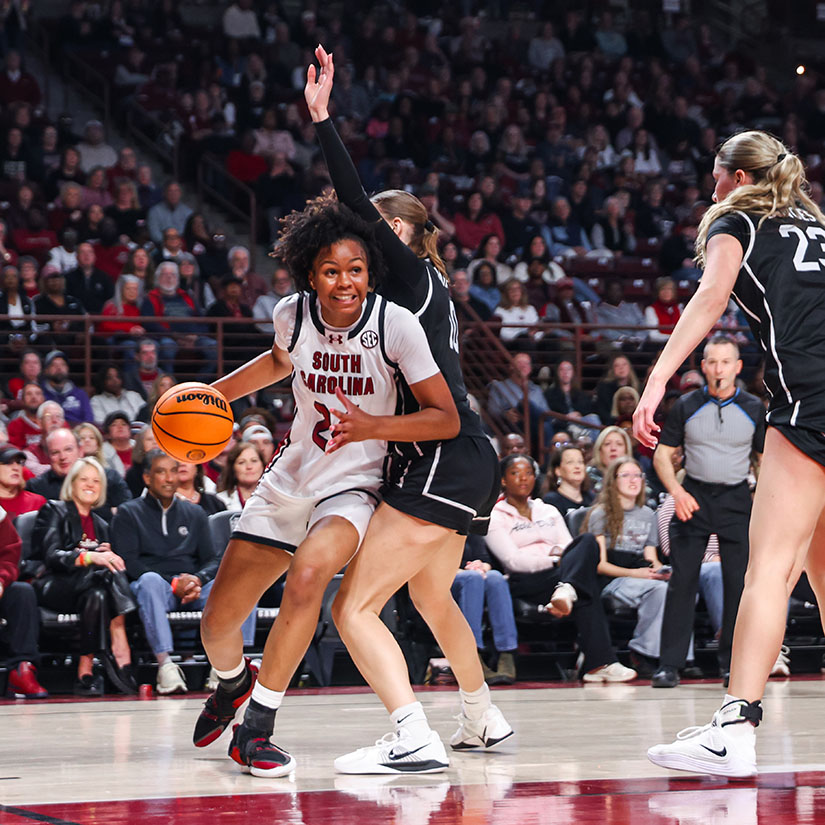
No one pushed her towards engineering – not her teachers or parents - it was just who she was.
“I’m independent and like to do things on my own,” she explains. “When I was choosing a major, I wanted something I really cared about and something that wasn’t easy.”
Mechanical engineering was a perfect fit.
While McDowell was also interested in civil engineering, advice from one of the Molinaroli College of Engineering and Computing student ambassadors during her tour stuck with her: “A mechanical engineer can do what a civil engineer does, but not always the other way around.”
While basketball remains her dream, engineering is a true plan B, and, as McDowell says, perhaps a “plan-A-and-a-half.”
“I want to create things that can help people,” she says. “I love helping people on the court, and I want to help those in the engineering world too. I don’t know what I’ll make yet, but I know I want it to matter.”
Something clicked when McDowell arrived in Columbia on her visit, and academically South Carolina’s engineering program sealed the deal.
“It was the family environment,” she says. “I didn’t want to go somewhere and feel homesick, and I felt comfortable here right away.”
McDowell arrived on campus without specific expectations, but the transition has been smoother than she imagined.
“People kept telling me that engineering is so hard. And it is hard, but I haven’t hit that adversity yet even though I know it’s coming,” she says.
Looking ahead, McDowell hopes to grow both as a basketball guard and as an engineer, even finishing her degree in three years if her incoming credits and course load allow it.
“I expect to grow tremendously as a player and student,” she says. “I want to graduate and reach my best self.”
For McDowell, success is not about points or grades, but about perseverance.
“There’s that image of a guy digging through a wall looking for diamonds,” she explains. “One guy gives up before he reaches them. The other keeps going. I think about that image all the time.”
McDowell’s definition of success is simple: “Keep going, no matter what. Don’t let one bad moment define you.”
“I want to leave an inspiring legacy,” she says. “One that shows you can do whatever you put your mind to.”
On the court, McDowell does not need to be the star player to make an impact. Off the court, she hopes her example inspires future generations of student-athletes who also want to build, create and solve.