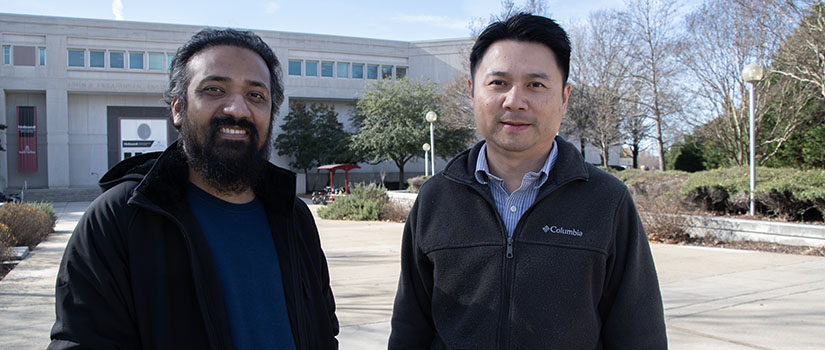
Pictured: Graduate student MD Mahabubur Rohoman (left) and Associate Professor Caizhi Zhou (right)
For centuries, the "paradox of strength and ductility" has challenged material scientists: making a metal stronger typically makes it brittle and prone to fracture.
A promising solution lies in a new class of engineered materials known as heterogeneous lamella-structured (HLS) metals. These materials feature alternating microscopic layers of soft, coarse-grained metal and hard, ultra-fine-grained metal, creating a unique architecture that can defy the traditional trade-off.
With a new two-year, nearly $300,000 National Science Foundation Established Program to Stimulate Competitive Research award, Mechanical Engineering Associate Professor Caizhi Zhou is leading a project to decode the fundamental physics that gives these metals their exceptional properties. The goal is to create a blueprint for designing the next generation of high-performance metals.
“We have seen that these heterogeneous structures can provide both strength and ductility, but we don’t fully understand why,” Zhou says. “Our project aims to discover the basic deformation mechanisms at play. This knowledge will allow us to intentionally design microstructures for tailored properties, moving from accidental discovery to precise engineering.”
HLS metals have shown potential for applications demanding both lightness and durability, such as in automotive, aerospace, biomedical implants and protective systems. However, the involvement of multiple, interacting length scales makes their behavior complex and difficult to predict or optimize.
Zhou’s research is built on a core premise: the key to the enhanced properties lies at the interfaces between the soft and hard layers. Large strain gradients near these interfaces are believed to generate significant back-stress, which simultaneously strengthens the metal and promotes high work hardening, thereby improving ductility.
The project will employ an integrated approach combining cutting-edge experimentation and multiscale computer modeling. Zhou and his graduate student, MD Mahabubur Rohoman, will develop a novel, experimentally validated multiscale crystal plasticity finite element model at the University of South Carolina.
“This model is unique because it explicitly accounts for the discrete nature of dislocation slip in the nano-grained regions, which is crucial for accuracy,” Rohoman explains. “Tuning architectural features like layer thickness and grain size in our simulations will guide us to design advanced metals with optimized performance.”
The computational work will be tightly coupled with physical experiments conducted at the Center for Integrated Nanotechnologies at Los Alamos National Laboratory (LANL) in New Mexico. There, Zhou and Rohoman will collaborate with Nan Li, a thrust leader with over 15 years of expertise in micro and nanomechanical testing.
Li’s team will fabricate clean HLS samples of copper (a face-centered cubic metal) and iron (a body-centered cubic metal) with precise control over layer thickness and grain size. They will then perform pillar compression tests and use advanced characterization techniques like transmission electron microscopy to observe dislocation pile-ups and strain gradients in real-time.
“This collaboration is essential,” Li says. “It brings together complementary strengths that neither experimental work nor modeling alone could achieve. This close integration of advanced experiments with physically grounded multiscale modeling allows us to directly link observed dislocation structures, strain gradients, and back-stress effects to predictive simulations, providing rigorous validation and deeper mechanistic understanding.”
The experimental data will validate and refine the computational model. The model will then be used to explore how variables like interface spacing, grain size, and crystallographic orientation affect mechanical properties, ultimately predicting optimal HLS designs for fabrication and final testing.
Beyond the research, the project will strengthen a valuable partnership between USC and LANL. Zhou plans to have Li visit the Molinaroli College of Engineering and Computing to give a presentation on the material characterization and advanced material experiments at Los Alamos, inspiring students and fostering interdisciplinary collaboration.
“We are building a lasting collaborative relationship in materials engineering,” Zhou says. “This knowledge transfer will enhance USC’s research and teaching capabilities and better equip our students for careers in advanced manufacturing industries vital to South Carolina and the nation.”
By bridging the gap between microscopic deformation physics and macroscopic material performance, Zhou’s project promises not only to advance fundamental science but also to provide the design rules needed to usher in a new era of strong, tough, and lightweight metallic materials.