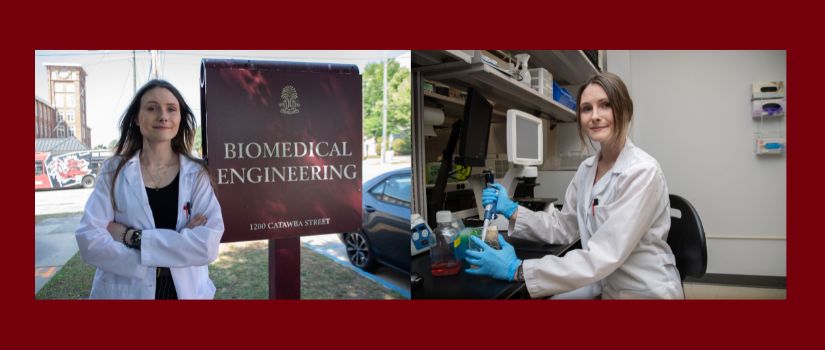
I want to be able to approach problems from both sides - research and clinical practice - and bring those perspectives together.
- Sarah Deloach
For biomedical engineering Ph.D. candidate Sarah Deloach, her academic and research pursuits were not linear but driven by a clear and persistent curiosity about human health.
“I’ve always had an interest in medicine and human disease, and biology felt like the most straightforward path at first” Deloach says.
After earning her bachelor’s degree in biological sciences from the University of South Carolina in 2020, Deloach initially considered pursuing a master’s degree in the same discipline. But a pivotal moment occurred when she sat in on a biomedical engineering lecture and later visited a research lab that opened her eyes to a new way of thinking.
That moment led Deloach to choose the USC biomedical engineering master’s program, which she completed in 2024. She immediately continued into her current Ph.D. program, where she is expected to graduate in 2027.
Today, Deloach’s research focuses on developing new treatments for heart disease, an area she believes is both extremely important and often overlooked. Her work studies a small molecule in the body that helps control blood pressure. By testing how it works in different disease conditions, she hopes to find ways to use it earlier to prevent serious heart problems.
“Cardiovascular disease is often treated reactively,” Deloach explains. “By the time intervention happens, it’s usually at the point of no return.”
Unlike some tissues in the body, the heart has limited ability to regenerate, which makes early intervention especially critical. Deloach is seeking to interrupt disease progression before irreversible damage occurs, an approach that could reshape how cardiovascular conditions are treated. This includes exploring how the immune system interacts with heart disease, as well as how biological differences, such as women being underrepresented in cardiovascular research, affect disease outcomes.
Beyond the lab, Deloach is deeply focused on how her research can translate to real-world applications. Her goal is to contribute to therapies that reach clinical trials and eventually patients.
“Ideally, what we’re working on would become a cardiovascular intervention for heart failure,” Deloach explains.
Her broader perspective on translational research has been shaped by her experience in both pharmaceutical and medical laboratory settings while she was an undergrad. Through those roles, she gained insight into patient care, drug accessibility, and the regulatory processes required to bring treatments to market availability.
“In an academic lab, you can make something work,” Deloach says. “But when you move to a clinical or pharmaceutical setting, you have to think about whether it can be scaled and realistically used.”
Faculty mentors have played a key role in shaping Deloach’s experiences. Early inspiration came from Biomedical Engineering Associate Professor Guerin Wang. Meanwhile, her current advisor Professor Jay Potts from the USC School of Medicine has supported her growth as an independent researcher.
“She has a drive and passion for research and is relentless in finding ways to answer questions that she is investigating,” Potts says. “She is easy to work with and very trainable, and in turn is an excellent mentor to those she works with and for.”
Deloach’s work has already earned recognition, including support from the SCbio Foundation. Aside from financial assistance, the support enabled her to present her research at a conference, an important milestone in her academic career.
Deloach plans to attend medical school after earning her Ph.D., with the long-term goal of combining clinical practice and research. She hopes to become a leader in women’s cardiovascular health; an area she believes deserves greater attention. Deloach envisions a career that spans patient care, academic research, and teaching, continuing to push the field forward while mentoring the next generation of scientists.
“I want to be able to approach problems from both sides - research and clinical practice - and bring those perspectives together,” Deloach says.
Deloach’s goal is simple: to make a meaningful impact on patient lives through science. And with her research already pushing toward earlier, more effective interventions in cardiovascular disease, that impact may be closer than ever.