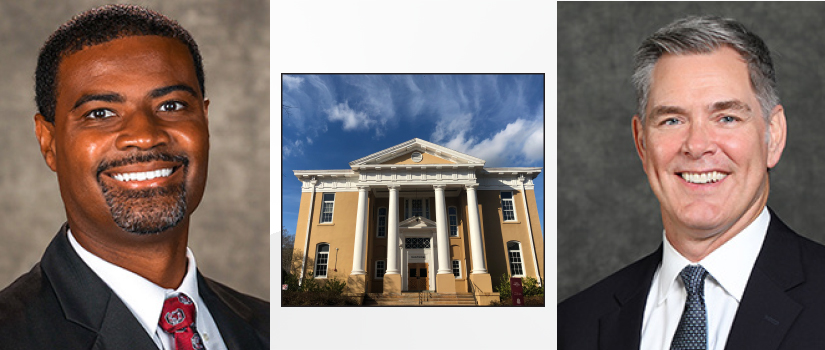
Top photo: Damion Waymer, director of SJMC, and Tom Reichert, dean of CIC
The College of Information and Communications has officially launched a Bachelor of Arts in Communication, filling a long-recognized gap in the university’s academic programs. Though communication is one of the most common undergraduate majors across higher education, USC had never offered a dedicated program until now.
“For a university over 220 years old, it’s hard to believe we didn’t have one,” says Dean Tom Reichert. “We’re filling in a much-needed gap, and if there was to be a communication degree, it should be in a college that has communication in it’s title.”
The new program is housed within the Information and Communications Study Unit, creating space for a degree that bridges disciplines. “It sits in the College of Information and Communications as part of our broader program of study,” explains Damion Waymer, director of the SJMC. “This unit houses programs that don’t fit neatly into journalism or information science, programs that cross both areas — like our master’s in data and communication. The B.A., in Communication fits right alongside them.”
Waymer says the idea for the degree program originated when it was clear there was a void within the college’s communication offerings.
To communicate is the essence of being human.
-- Damion Waymer, director of the School of Journalism and Mass Communications
“We’ve done very well with mass communication — advertising, sports media, journalism — but we weren’t teaching enough of the skills related to interpersonal and organizational communication,” he says. “How do you manage conflict? How do you lead a team or negotiate with colleagues? Those are foundational communication skills students need in any profession.”
Both Reichert and Waymer emphasized that communication is far more than just public speaking or writing; it’s about developing the essential “people skills” that make organizations thrive. “Communication is an essential, high-powered, human-centered skill,” says Reichert. “If people are equipped with communication skills, they can lead teams, persuade colleagues and clearly express their ideas.”
Waymer added that the program is designed to help students strengthen those exact abilities. “We want students to leave with refined interpersonal, mediation, negotiation and team development skills,” he says. “These are the kinds of competencies that will help them in leadership, management and even conflict resolution.”
As artificial intelligence continues to reshape the workplace, Reichert says communication programs are more important than ever.
“AI may automate some technical skills, but it can’t replace critical thinking, empathy or communication. Those human-centered abilities will only become more valuable.”
The program’s development was a collaborative process, shaped by input from faculty across the college who have backgrounds in both human communication and mass communication.
“Many of our faculty studied communication themselves and had long advocated for this program,” says Reichert. “They understood that human communication is different from mass communication, and they helped design a curriculum that reflects that.”