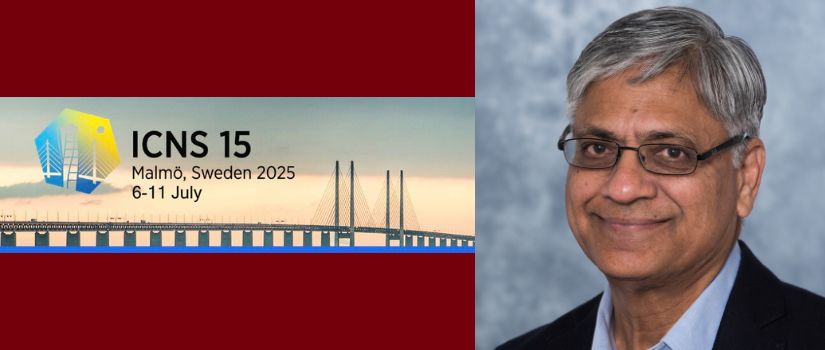
Asif Khan, Carolina Distinguished Professor in Electrical Engineering and director of the Molinaroli College of Engineering and Computing Institute for Extreme Semiconductor Chips, was recently named the first recipient of the Isamu Akasaki Memorial Award by the International Conference on Nitride Semiconductors (ICNS). The award will be presented during the conference in Malmo, Sweden from July 6-11 in recognition of his pioneering contributions in III-nitrides.
III-nitrides are a group of compound semiconductors characterized by a wide bandgap, high saturated drift velocity, high breakdown voltage and thermal conductivity. This makes them excellent for applications in high-power, high-frequency electronics and ultraviolet light emitting diodes (LEDs). In 1993, Khan’s research group was the first to demonstrate III-nitride high electron mobility transistors (HEMTs), which launched the field of gallium nitride (GaN)-based electronics.
Khan’s technology offers significant advantages over traditional silicon-based electronics in radio frequency and high-power applications due to the unique properties of III-nitride semiconductors. This technology is the basis of numerous proposals that he has successfully marketed to the U.S. Department of Defense and is being commercialized by major industries for electric vehicles, electronic chargers and air-water purification applications.
“In any electronic circuit, one of the basic building blocks is a transistor,” Khan says. “If the transistor is made of silicon, the circuit cannot function at temperatures higher than about 100 degrees Celsius. If you want the application to handle more power, or function at a higher temp, you must modify the building block material. We pioneered the use of III-nitride semiconductors instead of silicon for the transistors.”
Khan’s research group at University of South Carolina was also the first to demonstrate high-power aluminum gallium nitride (AlGaN)-based deep ultraviolet light emitting diodes. These lightweight UVC LEDs, which operate at low voltages, are an ideal replacement for mercury lamps which are larger and require high voltages for operation.
Moreover, the use of mercury is now being banned due to its health hazards. The USC-pioneered UVC LED lamps have revolutionized systems for air and water purification, germicidal cleaning, polymer curing and bio-medical applications. Khan-pioneered high-voltage transistor chips and UVC LEDs are also ideal for military applications because they provide increased power and can be operated at high temperatures in a high-radiation environment. This technology is being commercialized by SETi and Nitek Inc., two small Columbia businesses co-founded by Khan.
“Professor Khan’s contributions come with significant advantages over standard silicon technologies, such as high-power and high-temperature operation within a very compact form factor,” says Mohammod Ali, Chair of the Department of Electrical Engineering. “He, his students and research associates have worked to creatively and diligently harness those advantages by addressing the technological barriers that hinder their development for successful technology transition. His receipt of the award for recognition of lifelong pioneering contributions in III-nitrides is well-deserved.”
The Isamu Akasaki Memorial Award was created this year to mark the 30th anniversary of the ICNS. The award’s namesake, Japanese engineer and physicist Isamu Akasaki, shared the 2014 Nobel Prize in Physics with Hiroshi Amano and Shuji Nakamura for their invention of efficient blue LEDs, which led to the development of energy-saving white light sources. Khan will receive the award during a special ceremony and present an honorary lecture reflecting his lifetime achievements to inspire future generations of scientists and educators.
“For any scientist, it is very pleasing to see their technology or innovation eventually lead to a commercial application,” Khan says. “In my case, it’s very satisfying to see that two of them, namely the III-nitride transistor and the AlGaN UVC LEDs, did this. These basic building blocks were created in 1993 and 2002 and have led to billion-dollar industries using chips exactly as we made them. Because of them, there is great energy savings and reduction of environmental contamination, providing tremendous benefits for humanity.”
Khan earned his bachelor’s and master’s degrees from the University of Karachi in Pakistan and his Ph.D. from the Massachusetts Institute of Technology. Prior to joining USC in 1997, he worked at Honeywell Research Center, Minnesota Manufacturing and Mining Company (3M) and APA Optics. He has published more than 420 research papers, holds over 50 U.S. and international patents, and has secured over 70 grants and contracts totaling more than $40 million.