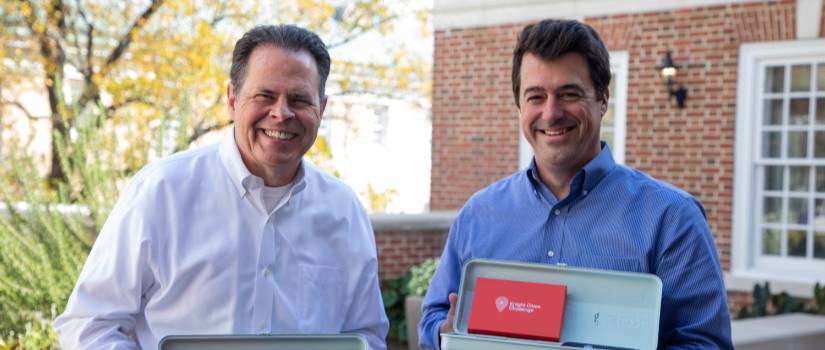
Photo Caption: Clay Owen (left) and Scott Parrott pose with the toolboxes they received from The Knight Foundation for winning the grant. Their past reporting experiences have guided their use of the award resources to solve problems journalists experience today.
A $200,000 Knight Cities Challenge grant will help a College of Information and Communications team test whether artificial intelligence can give journalists more time to investigate the local government decisions shaping their communities.
The project will pilot tools that transcribe government meetings, flag votes and decisions and help reporters find potential stories. Beginning with newsrooms serving Columbia and Myrtle Beach, the team hopes to strengthen coverage across South Carolina.
The college is one of 29 recipients of the 2026 Knight Cities Challenge, which supports projects designed to create lasting local change.
The team applied for funding in spring 2026 and learned of the award in October. Its initial partnerships involve two newsrooms, with plans to expand participation.
For Clay Owen, a professor of practice in the college, helping lead the project, the challenge is familiar. His first job after college involved covering city council meetings for The Times and Democrat in Orangeburg.
Lengthy meetings, crowded agendas and complicated budgets can stretch a reporter’s time and expertise. As newsrooms shrink, publishing cycles implement quicker deadlines and various platforms require posts, journalists may struggle to keep up with growing demands and modern developments. The project aims to make that workload more manageable while preserving the reporting needed to explain what government actions mean for residents.
“This is not to replace the role of a journalist,” Owen says. “This is to augment that, right? So the journalist still has to go in, do the interviews, ask the hard questions, do the research.”
The platform automatically transcribes meeting videos and highlights potentially newsworthy material. Reporters can click a transcript passage to jump to the corresponding video, making it easier to review discussions, check details and extract clips for social media.
That could help journalists monitor school boards, county commissions and committees when competing assignments prevent them from attending every meeting. It could also free time for interviews and deeper reporting on decisions involving public money and services.
“You still have to verify these things,” Owen says. “You still have to use human judgment, but for filtering through large sources of information very quickly, it's hard to beat.”
Owen conducts the project alongside USC professor and researcher Scott Parrott and WIS News 10 Vice President and General Manager Robby Thomas. Thomas identified the grant opportunity and encouraged the team to apply. School of Information Science professor Ehsan Mohammadi contributes AI expertise, while associate professor Eric Robinson contributes First Amendment research.
Parrott will examine how journalists respond to the technology, whether it fits their daily routines and how effectively it supports their work. The team will monitor the pilot and gather feedback before pursuing broader use.
“The point is that we can get this in the hands of journalists across South Carolina and understand what will make it most useful,” Parrott says.
The researchers want to learn whether the tools lead to more government coverage and better stories. Their outreach extends beyond Columbia to communities including Lexington, Orangeburg, Blythewood, Saluda and Myrtle Beach, with the goal of understanding different local reporting needs.
Students will also help evaluate the technology. Parrott says the team expects to work with about 125 students and hire three additional students to assist. Owen says the training will prepare them to use emerging tools in their reporting.
The project’s benefits could extend directly to residents. The team plans to launch a web hub in spring 2027 that would help journalists and the public access government documents and meeting transcripts.
By making those records easier to navigate, the team hopes to connect more South Carolinians with decisions affecting their daily lives.
“It's incredibly time- and labor-consuming, but it's incredibly important,” Parrott says. “Like it's taxpayer dollars being spent, important decisions that can affect their day-to-day lives being made. And so people need to know.”