Finding a New Path, and a New Purpose, Through Library Science
After his first career as a photographer, Ron Stafford pivoted to library science, a choice he says changed the course of his life. He discusses the profound impact of the iSchool in the interview below.
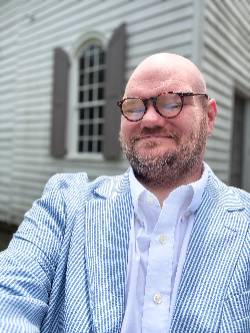
1. Tell us about your career journey.
I worked as a photographer for many years and – like Dante – I came to the midpoint of my life and realized I need a new path with steady pay and insurance. I had been told often I should be a librarian, and so I applied for and was accepted to the iSchool, and it changed the course of my life. I thought I wanted to work in archives – but the community college in my hometown needed a library director and I accepted the job. I thought I would be in the position for a few years, but I stayed for seven years.
2. How did your USC degree prepare you for your career? Were there faculty members who influenced you? Or were there specific lessons or advice that still resonate with you today?
The iSchool prepared me for my career in varied ways. I was involved in organizations on campus and was the President of CALM for a few semesters. I learned a love of helping and serving from USC. Since I left USC, I often volunteer and help the iSchool in any way I can. USC opened the doors to a world that is collaborative and accepting. I learned a love of libraries and service from Dr. Sam and Dr. Lewis. However, Dr. Rathbun-Grubb was the greatest influence on my career. Her gentle yet strong guidance helped me to find my path in the world of libraries. She opened new doors to me with metadata and electronic libraries, and she helped me to succeed as an academic librarian by using Metadata to find OERs for my students.
3. What is one of the most valuable things you have learned working in your field?
Equity. Working in a rural community college, I quickly realized not all students have access to Wi-Fi and this severely derails their education. I earned my Doctor of Education from Brenau University, and my dissertation titled “No Signal, No Success? The Internet Divide and Rural Technical College Persistence” focused on the disparity of Wi-Fi and how it severely affects student persistence.
4. What has been your biggest challenge since entering the workforce?
The most difficult thing for me – and I hope no one else faces this – is when I lost my left leg. I developed an ulcer on my left foot that became infected. The infection led to septic shock and amputation. However, my medical setback did not slow me down. The night before my amputation, I was doing course work in my hospital bed. I never stopped working on my doctorate or working in general. I tried to keep my life as normal as possible. When it was time to defend my dissertation, I was back in the hospital fighting an ulcer on my right foot, which has since healed. Though I faced medical setbacks, I did not stop.
5. What is the most interesting or significant thing you have done since graduating?
This would have to be losing a leg and still getting my doctorate. This experience taught me that I could do most anything – if I had a good support system. During this time, Dean Reichert called and checked in on me as well as Dr. Sam and Dr. Rathbun-Grubb. I knew I had many people in my corner who were pushing me forward and supporting me. Even working toward my doctorate at Brenau, I had Dr. Brock-Simmons and Dr. Skelton who supported me along the way. I knew neither one of these women would let me fail and I knew that if I tried to quit, Dr. Brock-Simmons would probably show up at my house. From this experience, I realized how supportive and collaborative the academic world is, and this has led me to want to fight and help students. So, the next chapter of my life will focus on finding solution to closing the Wi-Fi gap.