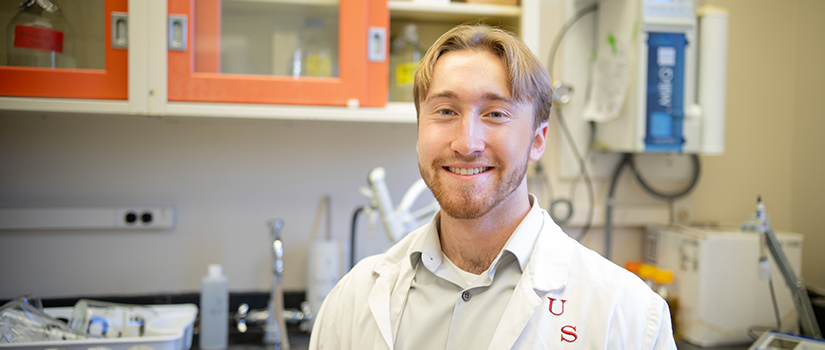
Michael Pitre, a fourth-year student in the Accelerated Undergraduate to M.D. program, was recently awarded the NIH OxCam Scholarship. This prestigious award, valued at nearly $500,000, will fund a portion of Pitre’s medical school tuition at the University of South Carolina Kay and C. Edward Floyd, M.D., School of Medicine. It will also fund a Ph.D. at the University of Cambridge and at the National Institute of Environmental Health Sciences in Durham, North Carolina.
It will allow Pitre, a South Carolina Honors College student and McNair Scholar from West Sayville, New York, to engage in cutting-edge neuroscience and stem cell research. It will open doors to mentorship, international collaboration and a career in neurosurgery. It will also place Pitre in the company of the nation’s top M.D.-Ph.D. students.
He is aware of the magnitude of this award — in fact, he has been working toward this opportunity since his first semester at USC. But that’s not all that Pitre is reflecting on as a newly minted NIH OxCam Scholar. He’s also thinking about the moments of reflection and redirection that paved the path to this milestone.
The process
In the 2025 – 2026 academic year, Pitre applied for the Marshall Scholarship and the Churchill Scholarship. He was a finalist for the Marshall, which would have funded two years of graduate study at any university in the United Kingdom. Though he interviewed in Atlanta, Georgia, last fall and earned alternate status, he was ultimately not selected.
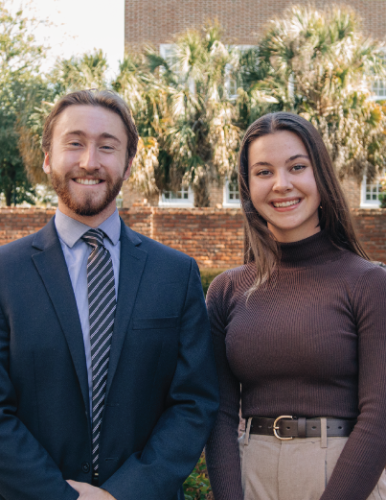
He also wasn’t selected for the Churchill Scholarship, which would have supported STEM graduate study in the U.K. For Pitre, a Goldwater Scholar who has packed his three years of undergrad with as much STEM research and medical service activities as possible—when he’s not in the lab or the classroom, he works 12-hour EMT shifts on weekends—these were not the results he was hoping for.
But the application processes? Invaluable. Through drafting essays, receiving feedback from mentors and practice interviews with a panel that included the Vice President for System Affairs and Community Engagement, Julian Williams, and McCausland College of Arts and Sciences Senior Associate Dean Claudia Benitez-Nelson, Pitre’s goals sharpened.
“I’ve been interested in neurosurgery for quite a while, but these applications really forced me to refine my exact interests,” he reflects. “I realized that I’m particularly fascinated by the electrical circuitry of the nervous system, how it’s degraded by diseases like Parkinson’s and Alzheimer’s, and how it can be restored to its normal function. This realization significantly helped me communicate my passion for science and medicine, both in written applications and interviews.”
Though Pitre was awarded the NIH OxCam Scholarship, he was initially waitlisted. This news, combined with the Marshall and Churchill results, was initially disappointing—until he decided to make the most of the waiting. If a fellowship opportunity couldn’t enrich his educational experience, Pitre decided that he would find another way to stand out amongst his peers.
“After receiving the waitlist notification from OxCam, I began reaching out to neurosurgery faculty across the country, trying to establish connections wherever I could. I secured research opportunities and neurosurgical mentors at both USC and UC San Francisco, which is one of the top programs in the country,” he says. “I was eventually accepted into OxCam, but in a way I’m glad I was initially waitlisted. Had I not felt the sting of rejection from these fellowships, I might not have been pushed to make the important connections that I recently made.”
The passion for research
The theme of patience will continue to define Pitre’s path. He will earn his Ph.D. from Cambridge in 2032 and his M.D. from the Floyd School of Medicine two years later. In that time, however, Pitre will be engaging in his area of fascination: medical research.
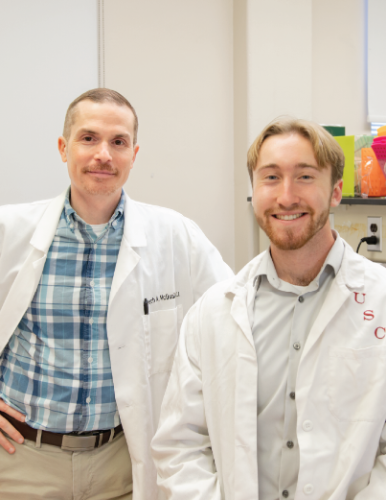
This passion, which started with a take-home assignment during the COVID-19 pandemic that challenged him to build a working mechanical arm, developed throughout Pitre’s time at USC. He conducted neurobiology research with Dr. Joseph McQuail at the Floyd School of Medicine to investigate memory loss with aging and Alzheimer’s. At the Arnold School of Public Health, he worked with professor Mark Sarzynski to research the effects of exercise on atherosclerotic cardiovascular disease. And when he wasn’t researching medical treatments, he was helping his fellow students learn how to provide medical care through the Gamecock Emergency Medical Students organization.
Whatever time Pitre has on his hands, he fills it intentionally. With eight more years of education and research at his disposal, his aspirations have only grown.
“My current plan is to attend Cambridge for the first half of my four-year Ph.D. working on a stem cell graft expressing DREADDs ((Designer Receptors Exclusively Activated by Designer Drugs) that can be used to fine-tune dopamine production,” he says. “Then, I’ll travel to the NIH for the second half to test the product in a rat model of Parkinson’s disease, demonstrating its efficacy before it can be moved to clinical trials. Finally, I’ll return to USC for the clinical years of medical school.”
And then, after nearly a decade of applying, studying and researching, the next phase will begin: Upon completing his M.D.-Ph.D., Pitre aims to become an academic neurosurgeon. He wants to develop and implement treatments for diseases and injuries affecting the nervous system.