Behind many of the most impactful medical advances are mathematical savants – behind-the-scenes
superheroes who are working with vast stores of data to improve public health. Ph.D. in Biostatistics candidate Zichun "Liela" Meng has been developing her skills in this area for nearly a decade – ever since she
realized her statistical prowess could be applied to improve human health.
“One of the things that excites me most about this field is the opportunity to translate
statistical methods into real-world health impact,” Meng says. “Biostatisticians play
an important role in designing studies, analyzing evidence, understanding disease
risk, evaluating treatments and helping ensure that medical decisions are supported
by rigorous data. Being part of that process – contributing to research that may ultimately
improve health – is something I find very meaningful.”
USC has been a place where I’ve been able to grow academically while also building
meaningful friendships and experiences outside the classroom.
Leila Meng
Meng’s journey began with a bachelor’s degree in statistics at Yangzhou University
in China. She then moved to the United States to earn a master’s degree in biostatistics
at the University of California, Davis, where she gained research experience analyzing
diabetes and kidney disease screening. Meng chose USC for her doctoral program because
the Arnold School’s Department of Epidemiology and Biostatistics offered both rigorous methodological training and opportunities to collaborate on
applied health studies.
“What really drew me to USC, though, was the sense of community in the department.
I remember reading posts on student forums from current and former students describing
how the program is relatively small, which allows students and faculty to interact
closely,” Meng says. “People mentioned that during holidays, students often gather
for meals, and that professors would invite students to their homes for dinners. That
kind of supportive and close-knit environment was something I really valued.”
Four years into her program, Meng reports that the department is indeed characterized
by inclusiveness, flexibility, openness and support. She has truly enjoyed the sense
of community among students, including the frequent gatherings outside of class. The
relaxed and friendly atmosphere offered by Columbia – a capital city that she still
finds to be very accessible – has also been a perk. Free public tennis courts and
easy-to-explore parks, neighborhoods and restaurants help foster a healthy lifestyle
and social connections.
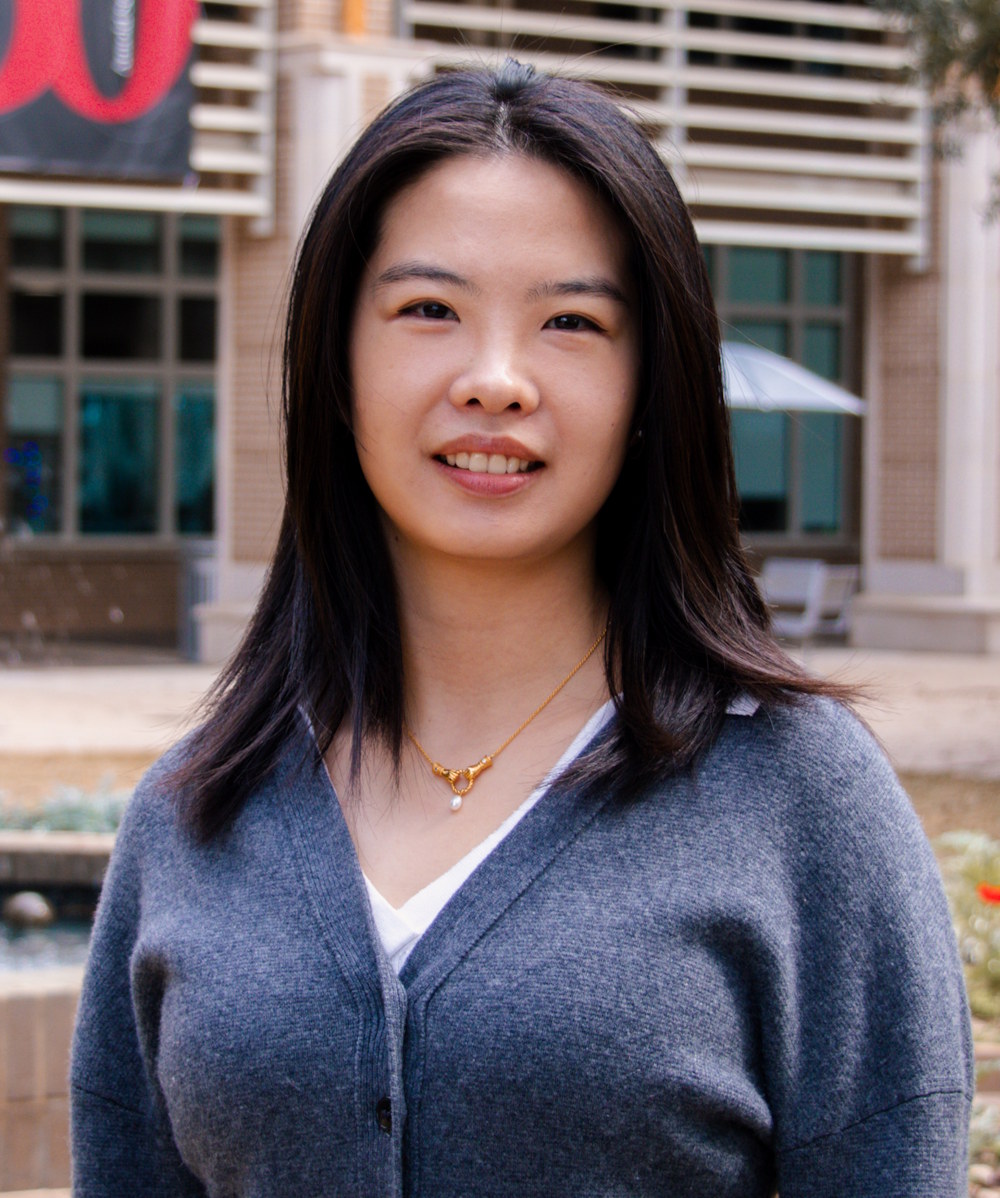
Leila Meng is a biostatistics doctoral candidate in the Department of Epidemiology
and Biostatistics.
“USC has been a place where I’ve been able to grow academically while also building
meaningful friendships and experiences outside the classroom,” Meng says.
The promise of applied health collaborations has also been fulfilled. Meng has worked
with a number of faculty on varied projects focused on survival analysis, dietary
patterns, and Medicaid datasets while amassing additional experience over the summers
through internships with Inari Medical.
Her primary dissertation project, under the supervision of biostatistics professor
Alexander McLain, involves developing statistical methods that improve our ability to learn from complex
data. Because modern biomedical studies often yield high-dimensional datasets, she
aims to support researchers by identifying which variables truly matter while also
solving real-world public health problems.
Through her graduate assistantship, Meng linked Medicaid data and school records to
examine the connection between stimulant medication adherence among adolescents with
ADHD to school absenteeism and educational outcomes. The balance between the deep
concentration on theory – which is required to develop new statistical methodology
– and her commitment to applied public health projects has been both challenging and
rewarding. Together, these dual aims enable Meng to use her statistical talents to
directly inform clinical research and population health decisions.
“This experience has helped me grow from thinking purely as a statistics student to
thinking more broadly as a public health researcher,” she says.
Underlying this evolution has been the steady support of both McLain and Songyuan
Deng, a research associate at the SC Center for Rural and Primary Healthcare, where
Meng has worked as a graduate research assistant since her arrival at USC in 2021.
“One thing I really appreciate about Dr. McLain’s mentorship is that he adapts his
mentoring style to where I am in the program – always providing encouragement and
perspective. What has influenced me the most is his attitude toward research – maintaining
a sincere curiosity and a genuine passion for discovery,” Meng says. “Dr. Deng’s background
as a physician and his Ph.D. training in Health Services Policy and Management at the Arnold School have given me valuable exposure to perspectives beyond statistics.
Working with him has helped me better understand how statistical analysis fits into
broader questions about health care systems, policy and patient outcomes.”
Beyond the curriculum, the mentorship environment and the relationships among students
and faculty can make a big difference in your graduate school experience.
Leila Meng
This broader understanding has been enhanced by Meng’s moves from China to the U.S.
and from California to South Carolina. Working within different health systems has
shaped how she thinks about public health and influenced her career trajectory.
After graduating later this year, Meng plans to pursue a position as a biostatistician
in the pharmaceutical or biotechnology industry. She is particularly interested in
working on clinical trial design, statistical modeling and the analysis of complex
biomedical data to support the development of new treatments.
“My training at the Arnold School has prepared me well for this path,” says Meng,
who had reached out to current students and alumni prior to enrollment to ensure that
the program would prepare her for the career paths she wanted to pursue. “Through
my coursework and research, I’ve developed strong foundations in statistical theory
as well as hands-on experience working with real-world health data and methodological
research. The combination of rigorous training and applied collaboration has helped
me see how statistical methods can directly support advances in public health and
medicine.”
As she wraps up her final months in the program, Meng has some advice for students
considering careers in public health.
“Take time to learn about the community within the department,” she says. “Beyond
the curriculum, the mentorship environment and the relationships among students and
faculty can make a big difference in your graduate school experience. Talking with
current students is often one of the best ways to understand what a program is really
like.”
“I would also encourage students to stay open to interdisciplinary learning,” Meng
adds. “Public health research often sits at the intersection of many fields, and some
of the most interesting ideas come from collaborations across disciplines.”