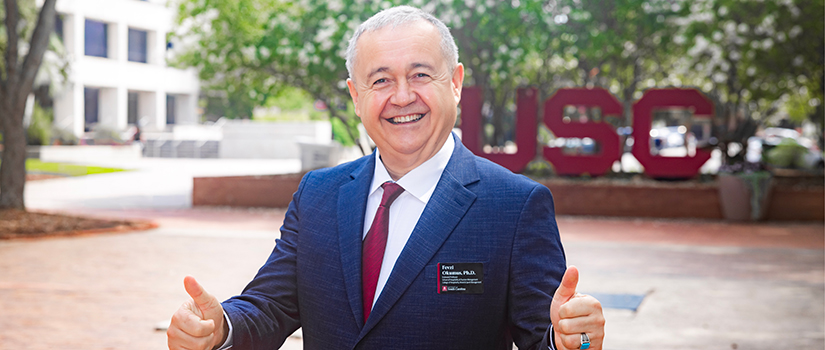
When Fevzi Okumus looks at the University of South Carolina’s School of Hospitality and Tourism Management, he sees a program ready to soar.
Okumus, who was recently appointed to a two-year term as director of the school, believes that successful academic programs are built through shared vision, innovation, trust, collaboration and continuous improvement.
That mindset has defined a career that spans decades of leadership, research and innovation in hospitality and tourism education. An internationally recognized scholar and the William McFall “Mac” Pearce Endowed Professor, Okumus has authored more than 330 publications and established a global reputation for bridging academic excellence with industry impact.
He serves as editor-in-chief of three academic journals, including two leading Q1 journals in hospitality and tourism. He has been recognized among the top 2% of scientists worldwide in Stanford University's database and has been named a Clarivate Highly Cited Researcher, placing him among the world's most influential scholars in this field in terms of research impact.
Okumus joined USC in 2025 after spending nearly 20 years at the University of Central Florida (UCF). There, he served as the founding chair of the Hospitality Services Department, held the Central Florida Hotel and Lodging Association (CFHLA) Preeminent Chair Professorship, and was awarded the Pegasus Professor designation in 2025, the highest honor bestowed upon a faculty member at UCF. The move to USC was inspired by professional relationships, opportunities for both him and his wife, fellow faculty member Professor Bendegul Okumus, and what he sees as the tremendous potential of USC’s hospitality and tourism program.
“I have many good friends here,” he says. “I saw tremendous potential here. The dean was very supportive, and after considering everything, we decided to join.”
Now, he’s bringing that experience combined with an ambitious vision centered on student success, industry engagement, enrollment growth, innovation and high-quality scholarship to his newest role.
Since arriving in Columbia, Okumus has embraced both the university and the city. He enjoys South Carolina’s four seasons, appreciates the beauty of campus and has found USC students especially impressive.
“I taught a class in the spring semester, and I really enjoyed it,” he says. “Our students are really world-class.”
That enthusiasm for students is at the center of everything he hopes to accomplish.
The School of Hospitality and Tourism Management is already recognized as one of the nation’s leading hospitality and tourism programs, offering undergraduate and graduate degrees supported by world-renowned faculty, experiential learning opportunities and strong industry partnerships. Its mission is to educate global leaders through innovative curriculum, research and community engagement.
For Okumus, the next step is building on that foundation.
“When I look at our faculty, they are world-class,” he says. “When I look at our students, they are amazing. We have great industry support. What we need to do is continue improving everything: our culture, our environment, our programs and our connections.”
One of his highest priorities is growing enrollment at both the undergraduate and graduate levels. But growth, he says, must be paired with innovation and improving the quality of student experience.
A major initiative already underway is the development of a new hospitality and tourism management degree structure that would provide students with more opportunities to specialize in areas aligned with their career goals.
Potential concentrations include club management, event management, global hotel and resort management, travel and tourism management, hospitality real estate asset management, business analytics and international hospitality management.
“These concentrations will give students more options,” Okumus says. “Students can specialize based on their interests while still receiving a strong hospitality and tourism management education.”
Ask Okumus what makes a USC hospitality degree valuable, and his answer goes beyond landing a first job. "We prepare students not only for their first job, but also for the management and leadership roles that follow." he says.
The hospitality and tourism industry remains one of the world’s largest and fastest-growing sectors, offering careers in hotels, restaurants, tourism, events, clubs, resorts, entertainment venues, destination management organizations and more.
Okumus wants graduates to leave with the leadership skills, business knowledge, relevant cutting edge technology skills, industry experience, continuous learning, career planning and resilience building needed to move quickly into supervisory and executive roles.
“The goal is for students to become informed decision-makers, experience designers, great communicators, team builders, managers and leaders," he says.
He emphasizes that hospitality and tourism education develops highly transferable skills, including communication, teamwork, guest experience design, problem-solving and leadership. Combined with growing exposure to emerging technologies, analytics and experiential learning, those skills create opportunities far beyond traditional careers.
One of Okumus’ important ideas involves examining every step of a student’s journey through the program.
From the moment prospective students discover USC to their first internship, graduation and eventual alumni engagement, he wants the school to identify every touchpoint and ask one question: “How can it be better?”
“We will map the entire student experience,” he says. "We want to understand why students choose us, what they experience when they arrive, how they engage with our curriculum and internships, and how we can improve every stage of their educational journey."
The school already provides students with hands-on learning opportunities through facilities such as the McCutchen House restaurant, Marriott Kitchen and Beverage Lab.
Okumus hopes to expand those experiential opportunities while strengthening ties with industry partners.
His vision includes bringing more executives into classrooms, increasing site visits to hospitality businesses and creating even more opportunities for students to learn directly from industry leaders.
Graduate education is another area where Okumus sees exciting possibilities. He plans to explore a fully online, asynchronous master’s degree program designed to make advanced hospitality and tourism education more accessible to working professionals.
One particularly innovative idea would pair faculty members with industry executives as co-instructors in many graduate courses, blending academic expertise with real-world experience.
“We want students learning from both perspectives,” he says. The approach reflects his broader philosophy that hospitality education should always remain closely connected to industry needs.
If there is one area where Okumus believes the school has untapped potential, it is visibility.
“We need to promote our program more,” he says, not through advertising alone, but through the voices of students, alumni and industry partners.
The school boasts successful graduates working throughout the hospitality and tourism industry, yet many prospective students may not fully understand the range of opportunities available through a hospitality degree.
Okumus wants those success stories front and center.
“We have so many successful alumni,” he says. “We need to highlight them and show what our graduates are accomplishing.”
For all his ambitious plans, Okumus is quick to emphasize that lasting progress takes time.
His vision is not about dramatic overnight change. It is about continuous improvement, collaboration and building momentum.
“We already have a very strong platform,” he says. “Our goal is to improve the platform.”
At the heart of that effort is a clear focus.
“Our students are our priority,” he says. “To improve the student experience, we should continue having world-class and dedicated faculty members, strong industry connections and a culture of collaboration.”
Okumus also plans to strengthen the school's leadership in artificial intelligence, analytics, smart hospitality and tourism, and emerging technologies. He hopes to further expand international partnerships, faculty exchanges, and global experiential learning opportunities.
Equally important, Okumus is committed to fostering a strong culture of research excellence and collaboration within the school and college. He plans to support all research-active faculty members in increasing high-quality publications in top-tier journals and securing more grants and contracts through interdisciplinary research and collaboration.
Another key priority is expanding external funding opportunities through strategic partnerships across disciplines and with industry. In addition, Okumus aims to strengthen doctoral education by enhancing interdisciplinary research opportunities, expanding international collaborations, and promoting faculty mentoring to support the development of the next generation of hospitality and tourism scholars and leaders.
Ultimately, Okumus envisions positioning the University of South Carolina's School of Hospitality and Tourism Management among the top five hospitality and tourism programs globally through excellence in teaching, research, industry engagement, innovation, and student success.
It’s a bold vision rooted in optimism, opportunity and growth.