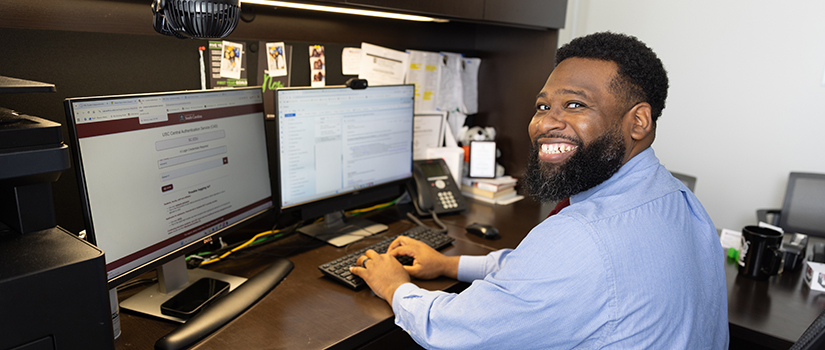
For some people, artificial intelligence is still about futuristic possibilities. For College of Hospitality, Retail and Sport Management advisor Martiez Moore, it is very much the present, and an invaluable tool to use in creating more time for meaningful conversations with students.
That student-centered approach recently earned Moore the USC Institutional Academic Advising Award for Outstanding Advising Initiative, recognizing his innovative use of AI to improve advising while enhancing the student experience.
Rather than viewing AI as a replacement for human interaction, Moore sees it as a way to remove routine administrative work so advisors can focus on what matters most.
"My big takeaway," Moore said after attending a Teaching and Learning with AI conference, "was this whole concept of cognitive offloading."
That concept has become the foundation of his work.
Academic advisors juggle a wide range of responsibilities, from documenting appointments to answering repetitive questions and helping students navigate university processes. Moore began asking a simple question: “Which tasks require human judgment, and which ones could be automated?”
"I've been trying to think, what are those routine things that take up mental space that don't require a lot of judgment and can be automated for advisors to focus more on students?" he explains.
The result has been a series of AI-assisted workflows that streamline common advising tasks while improving consistency and accessibility for students.
One example involves creating personalized follow-up resources. When students ask how to complete a university form or navigate an online process, Moore demonstrates the steps during the appointment and then uses a tool called Guide to create a visual walkthrough they can reference later.
"If you forget what we did, then just reference this," he tells students.
Instead of repeating the same instructions multiple times, students leave with a resource they can revisit whenever they need it.
Moore is quick to point out that he is not a technology specialist or someone with years of AI training.
"No specialized training," he says, adding that most of his knowledge came from university workshops, professional development opportunities and conference sessions, combined with plenty of personal experimentation.
Like many AI users, Moore discovered that success often comes through trial and error.
He spent about a month refining a custom GPT that summarizes advising appointments in the format his office uses for documentation. While Microsoft Copilot could generate summaries, the formatting didn't match the team's preferred style, so Moore created a customized solution that did.
After testing it himself and confirming it saved time, he shared it with colleagues, who adapted it to fit their own advising styles.
"They don't do it exactly the way I would do it, which is the whole point," Moore says. "It can adapt to whoever's needs."
That willingness to experiment and then share what works has helped create a culture of innovation within the HRSM advising team.
One of the most important aspects of Moore's approach is that he views AI as an evolving tool rather than a finished product.
The custom GPT that once streamlined appointment summaries has already become less necessary as Microsoft Copilot introduced new customization features.
Instead of clinging to an older solution, Moore simply adapted.
"We only used it for a semester," he says. "Now everything can be done in Copilot."
His philosophy is simple: stay curious and keep refining.
That mindset has led to additional projects, including automating responses to common questions from graduating seniors. Students often ask when to apply for graduation, the difference between graduating and participating in an early commencement ceremony.
Moore created a system in which students complete a form, and Power Automate and Copilot generate responses tailored to their answers. Those whose questions are fully addressed receive the information they need immediately, while students who need more personalized guidance can still schedule an appointment or stop by during drop-in advising hours.
The technology doesn't eliminate advisor-student interaction. Instead, it ensures those interactions happen when they provide the greatest value.
Moore's work reflects a broader philosophy that AI should enhance, not replace, the human side of higher education.
Every automation he has developed serves the same goal: reducing repetitive administrative work so advisors can spend more time listening, mentoring and helping students navigate important academic decisions.
His experience also demonstrates that meaningful AI innovation doesn't require advanced technical expertise. It starts with identifying everyday challenges, remaining open to learning and being willing to experiment.
By combining professional development opportunities with his own curiosity, Moore has transformed routine advising processes into more efficient, student-friendly systems.
That innovative spirit is precisely what the College of HRSM encourages and the USC Institutional Academic Advising Award for Outstanding Advising Initiative celebrates.
As artificial intelligence continues to reshape higher education, Moore's example offers an encouraging reminder that the most impactful innovations are often the simplest ones, those that give people time to do what only people can do.
For Moore, AI isn't about replacing advisors. It's about giving them more opportunities to be present for the students who need them most.