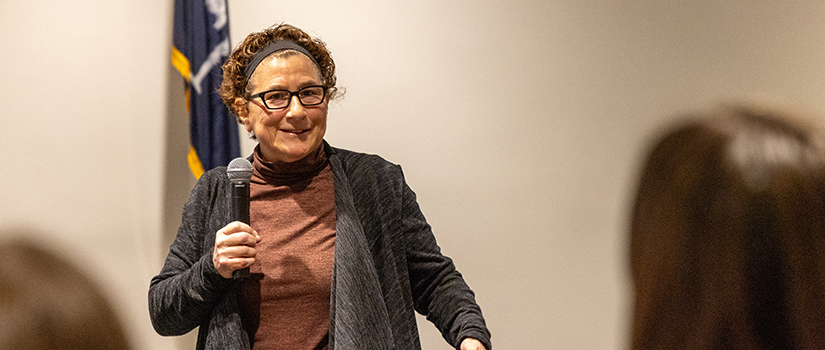
There are moments in every person’s life that make all the difference, turning points that shape an entire future. For Michelle Delloso, one came in the summer of 1987. Almost 40 years later, she still vividly remembers the day her first visit to the University of South Carolina changed everything.
She arrived in Columbia as a talented softball recruit from Quakertown, Pennsylvania who wanted a career in the business side of sports, unsure of where either dream could ultimately take her. Women’s professional sports opportunities were scarce. Softball was far from the public eye. And the idea that a woman could build a long-term career in the business of sport still felt radical. The ceilings still seemed made of something far harder to break than glass.
Then came the recruiting pitch. Gamecocks softball coach Joyce Compton knew Delloso hoped to go to one of the sport’s traditional powers on the West Coast. Compton told Delloso that at South Carolina she could be a key to taking the team to the College World Series, which was a dream of the young woman’s.
I was trained here what to ask for. That’s how I was able to become kind of a trailblazer and a pioneer. This is the university that built a program that nobody had built to this level. And I had, I believe, one of the best experiences one can have as a student-athlete here at the University of South Carolina.
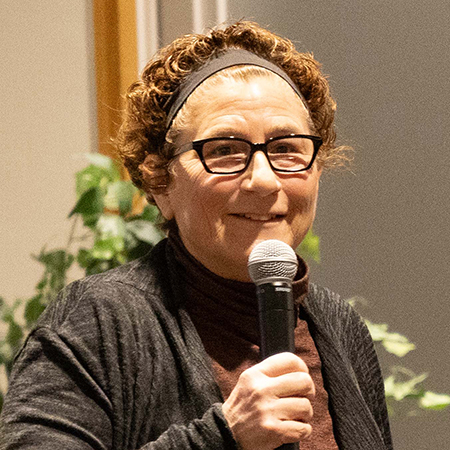
On the academic side, South Carolina was launching a new program that year, then known as “sport administration,” one of the first of its kind in the country. For Delloso, it was the unveiling of a path she never knew existed.
“It changed my life,” Delloso recalls. “I knew at age 12 I wanted to go work in sport in addition to playing, and both of those opportunities were not quite out there yet. Coming here with both the softball experience and then the department, graduating with a degree in sport administration really propelled me into the field.”
Thirty-five years after graduating from what is now the David and Nicole Tepper Department of Sport and Entertainment Management, Delloso’s career reads like a roadmap of modern women’s sports history:
- She was a three-time All-American softball player for the Gamecocks, led them to the College World Series in 1989, and was inducted into the National Softball Association Hall of Fame in 2004.
- She played professional baseball with the pioneering Colorado Silver Bullets baseball team.
- She signed endorsement deals with Nike and Louisville Slugger at a time when female athletes rarely did, becoming the first softball player to have her name on a Louisville Slugger bat.
- Off the field, she helped shape the business of softball through leadership roles with major athletic brands.
Most important of all, she became what she once needed herself: proof for young women that they belong in sports: not only on the field, but also in the boardroom, the marketing department and the executive suite.
“I was trained here what to ask for,” Delloso says of her education at South Carolina. “That’s how I was able to become kind of a trailblazer and a pioneer.”
Delloso’s story is a triumphant one, but a hero’s journey is never smooth and easy. Her road began with baseball.
Growing up in the 1970s, she played with boys because organized opportunities for girls barely existed. She loved the game and competed relentlessly, but at age 12 she was told she could no longer continue playing. The message was clear: there were limits on what girls were allowed to do in sports.
Others would have accepted it. For Delloso, the rejection became fuel.
She found a chance to play high school softball and developed into one of Pennsylvania’s top athletes. Meanwhile, South Carolina was building something ambitious on and off the field.
While Compton recruited stars like Delloso, the university’s new sport administration program, founded by the late Professor Guy Lewis, sought to treat sports as a serious academic and business discipline rather than simply an extension of physical education. That distinction mattered to Delloso.
“At the time everything was PE-based,” she says. “Nobody was thinking sport as a microcosm for society and teaching us tort liability and business partnerships.”
The combination of top-level athletics and innovative academics might have been created just for her.
“It started for me with that love and conviction for having it better and making it better than I had it. That starts with access and opportunity,” she says. “I know my story was lightning in a bottle. How many athletes are recruited late and end up going to play at a university that has a program that they're going to love even though they didn't even know it existed?”
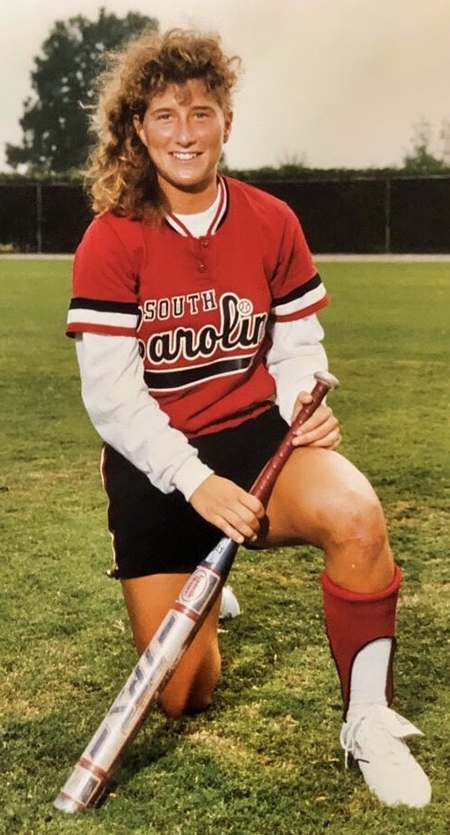
Delloso starred immediately for the Gamecocks, becoming one of the most accomplished players in program history. From 1988 to 1991, she earned four letters, three All-America honors and four all-region selections while helping lead South Carolina to the 1989 Women’s College World Series.
She remains one of the toughest hitters to strike out in Gamecock history, fanning only 13 times in 784 career at-bats.
For all that, Delloso insists her education was just as important as her athletic success.
Unlike many athletes of her era, she entered college already thinking beyond competition. She wanted to understand the mechanics of sports marketing, sponsorships and athlete branding long before those concepts became common discussion points in women’s athletics.
South Carolina gave her that vocabulary. Delloso speaks emotionally about Lewis, who she describes as the first mentor to help her envision a future beyond the playing field.
“He really kind of took my hand on navigating the world outside of softball,” she says.
That guidance shaped not only her career, but her philosophy of leadership.
“I’m a big believer in giving back tenfold what was given to me,” she adds.
One lesson from college proved especially pivotal: internships matter.
Delloso embraced the program’s emphasis on experiential learning, taking internships that exposed her to the growing sports marketing industry. One opportunity led her to Colorado, where she worked for a sports marketing company organizing softball tournaments for very little money.
“I think it was $100 a month,” she recalls with a laugh.
But despite the lack of financial rewards, that internship changed everything. There, she met executives from Louisville Slugger and Nike, connections that would launch her into a groundbreaking professional career. At a time when women athletes received little corporate attention, Delloso became one of the first softball players to land significant endorsements.
Before joining the Colorado Silver Bullets, she had already signed with Louisville Slugger and had her name placed on a signature bat model.
“It wasn’t even me pitching it,” she says. “It was the company I went to work for saying, ‘Hey, we have this great softball athlete. Why don’t we put it on our bat and sell these bats?’”
Later, she also signed with Nike, another rarity for female athletes in the early 1990s.
Those relationships helped position Delloso at the forefront of a changing industry. They also prepared her for one of the most unusual chapters in women’s sports history.
In 1994, Delloso joined the Silver Bullets, the first all-female professional baseball team since 1954. The team barnstormed across the country, playing men’s teams in Major League Baseball stadiums and challenging deeply rooted assumptions about women in sports. For Delloso, it represented a return to her first love.
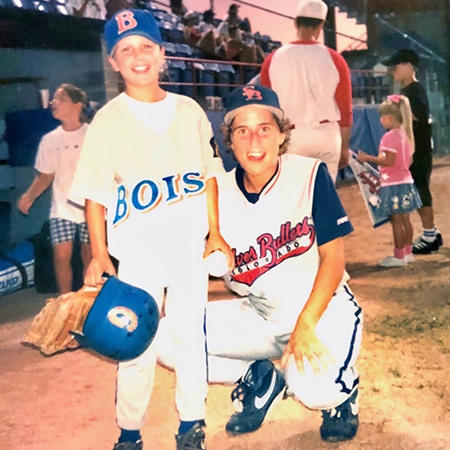
“I grew up playing baseball,” she says. “The Olympics were on the line back then … you couldn’t play professionally and then go play in the Olympics. But I went with my first love, which really was the sport of baseball.”
The experience was both exhilarating and exhausting. Women athletes at the time constantly had to justify their presence. Every game felt like a referendum on whether women belonged in traditionally male sports spaces. Delloso remembers the era as one of perpetual resistance.
“It was always swimming upstream,” she says.
The Silver Bullets were not merely playing baseball; they were forcing audiences to reconsider what female athletes could do.
Delloso became one of the team’s most versatile players, appearing at multiple infield positions and the outfield. But her influence extended beyond the diamond. Armed with the marketing knowledge she developed at South Carolina, she also recognized the broader opportunity.
“I was the voice in the room,” she says. “I was the one saying ‘What if we do this?’”
She leveraged her visibility to participate in Nike events, visit Boys & Girls Clubs and serve as a role model for young athletes who rarely saw women represented in sports marketing campaigns.
That drive to pair athletics with advocacy became the defining thread of her career.
After her playing days, Delloso transitioned fully into the business side of sports, working for Louisville Slugger and later Adidas. She spent years helping grow softball equipment lines, signing athletes and coaches, and building opportunities for future generations of female players.
In many ways, she entered the industry at exactly the right moment.
Women’s sports were beginning to gain momentum, but many structures still needed to be built. Delloso helped shape those structures from inside major companies, pushing for visibility and investment in women athletes before it became fashionable corporate strategy.
“When I see all the opportunities [women in sports have today], it’s very emotional,” she says. “But I’m also very humble because the path was so hard.”
She speaks often about mental health, pressure and sustainability. In her view, the future of women’s sports depends not only on top-level visibility, but on preserving access and joy at the grassroots level.
“We can’t lose that next generation,” she says. “It has to be sustainable, women in sport and opportunities for girls and women in sport.”
That drives much of her work today. Through speaking engagements, mentorship initiatives and programs aimed at empowering girls through sports and outdoor activities, Delloso continues to advocate for confidence, resilience and participation.
Her advice to young women is rooted less in fame than in purpose.
“Find what you love. Protect it. Work hard. And remember why you started,” she says.
Delloso says the program now known as the David and Nicole Tepper Department of Sport and Entertainment Management did more than prepare her for a job. It gave her agency.
The program taught her to think critically about sports as business, culture and opportunity. It taught her to ask questions in rooms where women were often ignored. It taught her that leadership could take many forms. And perhaps most importantly, it taught her the responsibility that comes with opening doors.
“I’ve always made sure that I took on the interns that they wanted me to take on in all of my roles, to help that next generation,” she says.
She arrived at the University of South Carolina as a young woman searching for possibility. She found mentors, opportunity and a vision for the future. She left with her feet set firmly on the road to becoming who she dreamed of being, who she was meant to be.
“This is the university that built a program that nobody had built to this level,” she says. “And I had, I believe, one of the best experiences one can have as a student-athlete here at the University of South Carolina.”