Purpose
To encourage collaboration and innovation through music leadership and emphasize, support, and encourage projects, events, or activities rooted in community service or community engagement to one or more of the following:
- School of Music community
- USC Campus community
- Columbia local community
- South Carolina/Southeastern community
- National/world community
What You Need to Know
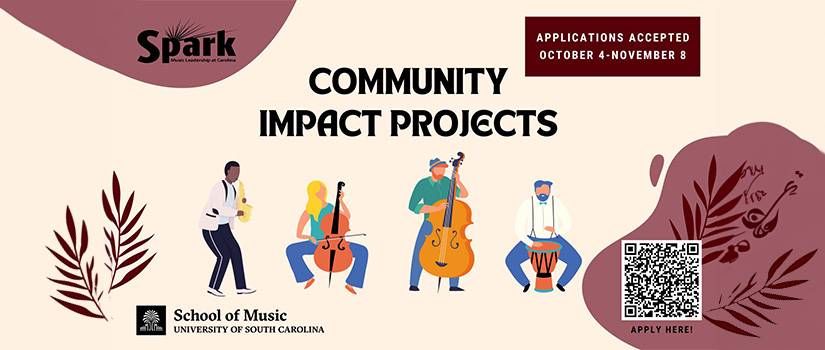
A project proposal must be submitted via Google form by November 8, 2024 with the following details:
-
What community are you seeking to engage and impact?
-
Why are you seeking to engage and impact this community?
-
How will you do this? What are you planning to do?
-
Who will be involved?
-
How will the engagement and impact be measured?
-
Where will the project take place? (may be multiple locations or change as the project develops)
-
Potential Partnerships or Collaboration (if collaborating)
-
Project timeline (what are the steps involved and when do they happen?)
-
Budget w/request for initial funding- up to $250 (What are your projected expenses?)
-
Documentation (How are you capturing your project? Video, pictures, documents, etc.?)
Finalists will be notified of their status by mid-November 2024.
If named a finalist: To complete a SCI Project and be entered into judging for scholarships you must complete a Final Project Submission including a 2-4 min. video presentation detailing:
- Project execution
- Community impact
- Reflection on successful aspects & challenges faced
- What might be done differently next time/future iterations?
- Familiarizing students with grant application processes
- Cultivating and recognizing student creativity
- Fostering innovation and experimentation
- Broadening understanding of student success
- Engaging with non-musicians, underserved communities and discovering new audiences
- Exploring professional life skills include communication, community engagement, relationship building, financial awareness, event management
Prizes
Projects will be adjudicated by outside judges based on a rubric with awards ranging from $250 - $1,500.
Deadline
Initial project proposals are to be completed using the online submission process by November 8, 2024 by 5 p.m. Final Project submissions are due March 29, 2025 by 5 p.m.
Past Projects
Creativity in Music projects reflect the diversity of student interests at the School of Music.
- Performances (recitals on and off-campus, chamber music, etc.)
- Student organized studio collaborations
- Educational Events and Creative Presentations
- Community Programming and Interactive Events
- Service or Issue Driven Causes
- Other student-driven events involving musical performance and an audience
- Shupeng Cao: Creative Convergence
- Garrett Fuller: Fuller Forests
- Christine Powell: Perform & Paint
- Molly Thomas: Keys for Kids
Members of the Spark team are available to consult about project design and the application process. If you have questions or would like to meet with someone, email spark@mozart.sc.edu.
Applications are to be completed using the online submission process. Click here for form.
Late proposals or project summaries will not be accepted.