Born in California but raised in Connecticut, Anna Chupak truly had a bicoastal upbringing. She remembers playing on the shoreline of her historic
little town until sunset – and always being interested in health as a career path.
Unsure how that path would look, Chupak took a position at the Yale Alzheimer’s Disease
Research Unit after graduating with a neuroscience degree from the University of Vermont.
“That really ended up being a turning point for me,” she says.
I’m interested in research that can help inform more equitable policies and practices,
so that all older adults have a better chance at healthy aging.
Anna Chupak
Over a three-year period – which included the height of the pandemic – Chupak coordinated
eight clinical research trials focused on Alzheimer’s disease treatment, neuroimaging,
genetics and healthy aging. Through interacting with the 500+ participants and their
caregivers, she discovered she was passionate about both research and the people it
served.
“I started to see how many challenges they faced beyond just the disease itself, especially
when it came to navigating the health care system,” Chupak says. “That’s when I started
thinking more about the bigger picture, such as how systems, access and prevention
all shape health outcomes.”
She began looking at graduate programs, and USC’s Ph.D. in Health Promotion, Education, and Behavior program stood out to her both for its national rankings and its flexibility. Chupak
valued the ability to shape her own research path while counting on strong support
from advisors – something she didn’t see in other programs.
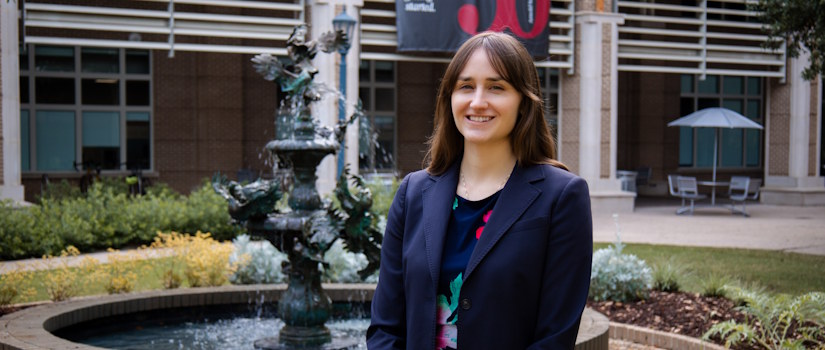
Anna Chupak graduates in August with a Ph.D. in Health Promotion, Education, and Behavior.
After arriving at the Arnold School in 2022, Chupak immersed herself in research with
HPEB professors Caroline Rudisill and Andrew Kaczynski. With Rudisill, a health economist, Chupak explored the role of health systems, community
programming, referral networks and support services, and health behaviors and health
care perceptions on population health. An expert on the built environment, Kaczynski
introduced Chupak to analyzing community-level infrastructure (e.g., walkability,
access to recreational spaces, safe transportation) and its impact on the health of
local residents.
During the summers, the Norman J. Arnold Fellow interned at the Rutgers Institute
for Health, Health Care Policy and Aging Research and the National Institute on Aging’s
Laboratory of Epidemiology & Populations Sciences. She also analyzed Medicaid data
for the SC Department of Health and Human Services.
“I am really grateful to Drs. Rudisill and Kaczynski for giving me the flexibility
to explore different research interests, supporting me in pursuing opportunities both
within and outside of USC, and consistently challenging me to grow,” Chupak says.
“Just as importantly, they’ve created a supportive environment where I feel encouraged
to ask questions, take risks, and develop my own voice as a researcher. Their mentorship
has played a huge role in shaping not only my academic path, but also my confidence
in what I’m capable of doing moving forward.”
For Chupak, that next step will likely involve researching cognitive aging, dementia,
and health disparities using a population-level lens. She’s particularly interested
in understanding how social and structural factors, like access to care, socioeconomic
status, and broader systemic inequities, shape cognitive health as people age.
“Ultimately, I’m interested in research that can help inform more equitable policies
and practices, so that all older adults have a better chance at healthy aging,” she
says.
Chupak graduates in August with numerous honors, including her department’s Christopher
Peter Aluah Outstanding Doctoral Student Award, the Graduate Student Scholarship in
Aging, the Olga I. Ogoussan Doctoral Research Award, the Butterfoss Community-Based
Research Fellowship, and the Excellence in Access and Collective Engagement in Research
Award.
“My degree has shaped me not only as a researcher, but also as a more confident and
independent thinker,” Chupak says. “I’ve gained experience leading research projects
from start to finish–from conducting literature reviews to analyzing data to publishing
and disseminating findings.”
Looking back, she appreciates the supportive community she encountered at the Arnold
School – particularly since her neuroscience background gave her a bit of imposter
syndrome when she initially joined a school of public health.
“But I quickly realized that both faculty and peers were incredibly encouraging,”
Chupak says. “I truly felt like people were rooting for my success, which helped me
grow in confidence.”
She’ll also miss the energy and spirit that accompany a big football university as
well as the capital city’s many festivals and outdoor spots like Saluda Riverwalk
and Congaree National Park.
“I would encourage students to explore opportunities in public health beyond their
program, especially when it comes to potential career paths as it’s really helpful
to get a sense early on of how your interests translate into real-world work,” says
Chupak, whose advice also includes practical tips such as attending conferences, keeping
an updated CV or resume and staying on top of funding deadlines. “And don’t forget
to prioritize your life outside of your program. Making time for hobbies, rest, and
relationships really matters; it helps you stay grounded and avoid burnout.”