A study abroad trip changed everything for Eandra Goldsmith. The Anderson, South Carolina native was studying language and international health
at Clemson University when she traveled to Seville, Spain, where she interned in two
different health care settings.
The first, a Red Cross Hospital, introduced Goldsmith to a warm and caring approach
to health care that made families feel welcome and free to voice their concerns. It
made the college senior want to bring this same energy to the U.S. health care system
in her own future work.
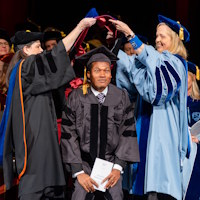
Eandra Goldsmith graduates in August with a M.S. in Speech-Language Pathology.
The second internship took place at a neurological rehabilitation center where Goldsmith
worked alongside a speech therapist – treating patients across the lifespan who were
facing a variety of challenges.
“During the six weeks I was there, I saw the patients make immense progress and how
relieved and grateful the families were for the speech therapist’s help,” she says.
“I decided then that I wanted to bring that same care, joy and love to patients with
communication and swallowing disorders.”
After graduating in 2016, Goldsmith joined the health care workforce in the Upstate
– first managing patient intake and processing at Prisma Health and then as a Home
Health Coordinator with Interim Healthcare. During this time, she completed a second
bachelor's degree – a B.A. in Speech-Language Pathology (SLP) from Columbia College
– which enabled her to take on an SLP Assistant position with Anderson School District
5.
When looking at graduate programs, Goldsmith had significant coursework and experience
in the field, but she also had to consider factors such as proximity, family responsibilities,
fulltime work, and cost. The Distance Education pathway offered by the Master of Science program in the Arnold School’s Department of Communication Sciences and Disorders (COMD) checked all of the boxes, and reviews from previous students confirmed her
decision.
In addition to the coursework curriculum, the program provided Goldsmith with nearly
400 hours of clinical training beyond what she was already amassing at her day job.
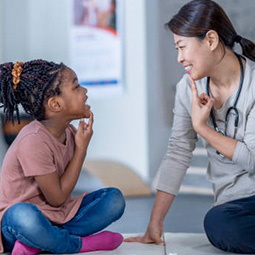
She worked with an array of pediatric and adult populations in university, skilled
nursing and private practice settings – developing interests in articulation, phonology,
and feeding and swallowing.
My cohort played an invaluable role in my graduate school experience. They understood
exactly what I was going through, provided encouragement during difficult times, and
shared strategies that helped us all to successfully navigate program requirements.
Eandra Goldsmith
Throughout the program, Goldsmith felt fully included by both the USC Graduate School
and her department, which bridged the gap she expected to feel as a distance student.
She found mentors in COMD faculty Crystal Murphree-Holden, Beth Barnes, and Juliana Miller.
“They have been my biggest supporters during this program,” Goldsmith says. “They
have guided me from beginning to end, supported me through my pregnancy and childbirth,
and answered all of my questions when I’ve needed support during a placement.”
She also made strong connections with members of her cohort, which she says can make
a tremendous difference throughout the program.
“My cohort played an invaluable role in my graduate school experience,” Goldsmith
says. “They understood exactly what I was going through, provided encouragement during
difficult times, and shared strategies that helped us all to successfully navigate
program requirements.”
After graduating in August with her department’s MS-Distance Education Outstanding
Student Award, Goldsmith plans to work as a school-based SLP while also doing part-time
work in a medical setting, such as a skilled nursing facility. She believes her program
and clinical placements have given her the skills she needs to succeed and grow in
both environments.
“When pursuing a career in speech-language pathology, there may be times when the
journey feels challenging where the coursework, practicums, internships, and other
program requirements can sometimes feel overwhelming,” Goldsmith says of her part-time,
distance education experience in the hopes of guiding future students. “Late nights
and early mornings may become part of your routine, but only for a season. The three-
to four-year journey is well worth the sacrifices you are making now. This is the
career you have worked so hard for, and you are now in the process of making that
goal a reality.”