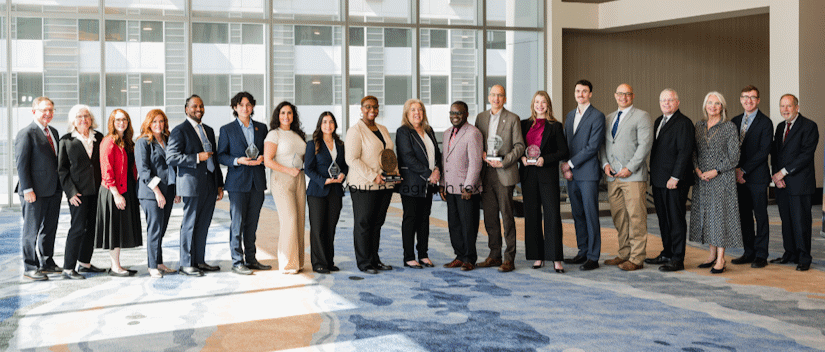
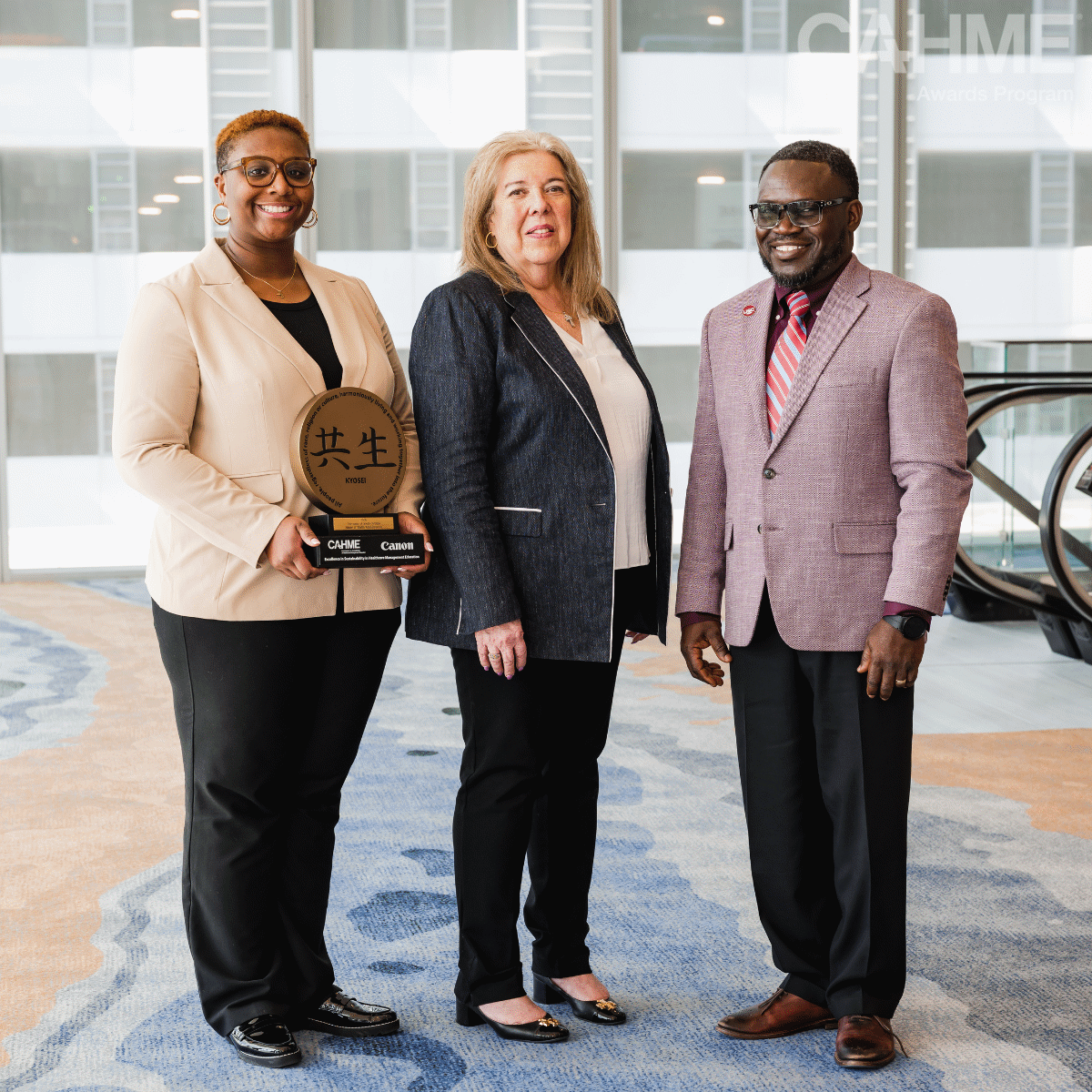
The Commission on Accreditation of Healthcare Management and Education (CAHME) has
selected the Department of Health Services Policy and Management’s (HSPM) Master of Health Administration (MHA) program to receive the Canon Award for Excellence in Sustainability in Healthcare
Management Education and Practice. Established in 2017, this honor was created to
recognize accredited programs that intentionally incorporate sustainability (e.g.,
environmental, social, and economic) into healthcare management education.
“Our MHA program prepares students to become mission-driven leaders across a range
of healthcare settings, from hospitals and clinics to insurers and public agencies,”
says HSPM assistant professor Nabil Natafgi, who has overseen the program off and on since 2019 until recently handing the reins
over to Zahi Jurdi. “Rooted in community, diversity and integrity, the USC MHA Program fosters lifelong
learning, student-centered leadership, and impactful professional development to advance
equitable and ethical health system transformation.”
Accredited by CAHME since 1991, the Arnold School’s MHA program offers both full-time
traditional and weekend executive formats. Students engage in paid, two-year graduate
assistantships in healthcare organizations before culminating their experiential education
with a residency project. As an additional enhancement to applied learning, two-thirds
of the program’s instructors are nationally recognized experts who are active practitioners
in the field. One hundred percent of students attain employment after graduation.
Adopting Canon’s Kyosei philosophy (i.e., harmonious living and working across cultures
through a deeply embedded sustainability vision), the program incorporates this approach
across the curriculum (including environmental, social, and governance frameworks,
emissions balancing, systems thinking and enhanced decision-making capacity), alumni
engagement, and experiential learning.
The award, which was bestowed during a ceremony in Houston, also came with a $5,000
grant. The department is using it to expand the environmental, social and governance
sustainability efforts and training to bolster the curriculum, enhance the Carbon
Emissions Learning Lab (CELL), and support new interprofessional sustainability case
competitions and workshops. The MHA faculty are also developing more student-led projects
in partnership with local health systems to measure and improve environmental performance
(e.g., reducing healthcare waste, decarbonization strategies).
“Our approach integrates cultural humility, environmental responsibility, accessibility
and equity into every phase of student development,” Natafgi says. “With this additional
funding, we aim to create a replicable, practice-based sustainability learning model
that extends beyond the MHA program to benefit the broader Arnold School of Public
Health and the USC health system. These efforts align directly with Canon’s vision
of Kyosei and will build leadership capacity for advancing sustainability in healthcare
organizations and communities.”
Students, alumni and collaborators share their experiences, which demonstrate the
MHA program’s commitment to sustainability:
Throughout the program, we participated in several CELL simulations which offered
a dynamic and hands-on opportunity to experience the complexities of sustainably running
a healthcare organization, as well as balancing operational efficiency with ethical
leadership and fiscal responsibility. That exercise fundamentally shaped my understanding
of how sustainable decision-making contributes to resilient healthcare systems.
Taryn Senger, 2026 MHA Graduate
As both a proud alumnus and a long-time adjunct faculty member, I have had the privilege
of witnessing the transformation of our program into a national leader in embedding
sustainability within health management education. As a professional with over 30
years of experience across healthcare operations, HR transformation, and strategic
change leadership, I can confidently say that the USC MHA program is preparing its
graduates to lead responsibly in a rapidly evolving healthcare landscape. The integration
of sustainability is not superficial—it is embedded in how students are taught to
think, act, and lead.
Ed Bell (MHA '93), Faculty Affiliate
The MHA program has shown students and alumni alike just how crucial sustainability
can be for not just the healthcare environment, but the environment we live and breathe
in as well. There is a clear commitment to sustainability and even greater commitment
to ensuring students understand how much of a key role sustainability is in our future.
Ryan Carr, 2026 MHA Graduate
The USC MHA program fosters the development of high-caliber, forward-thinking healthcare
leaders through experiential learning, rigorous academic training, and deep engagement
with the healthcare community. My more than three decades in healthcare leadership
have affirmed for me that sustainable success in healthcare requires more than operational
excellence; it demands vision, collaboration, and a commitment to both values and
results. The USC MHA program is deeply committed to cultivating these same attributes
in its students.
Jay Hamm (MHA ’00), Vice President of Operations at Lexington Medical Center
I have witnessed firsthand how this program develops healthcare leaders who are not
only competent and compassionate, but also globally minded, equity-focused, and committed
to sustainable, systems-level transformation. USC’s MHA program has equipped me with
the tools, the confidence, and the community to pursue a career grounded in service,
access, and leadership. I have complete confidence that this program will continue
to help everyone but also inspire and give the opportunity to others who are non-traditional
learners like me to find their voice and identity, and make them feel empowered.
Martha Selmon, MHA Executive Track Student
I continue to apply the principles I learned through the program: leveraging financial
data to promote operational sustainability, supporting clients in implementing value-based
strategies, and aligning fiscal stewardship with social responsibility. The MHA program’s
holistic approach—integrating environmental, economic, and ethical sustainability—has
profoundly influenced how I define success in healthcare leadership.
Ruta Patel, (MHA ’25), Healthcare Consultant at Finance, Forvis Mazars US
The MHA Program’s efforts to embed sustainability into classroom case studies, experiential
learning, and healthcare leadership training help bridge the gap between academic
theory and institutional practice. Students exposed to real-world sustainability challenges
in healthcare settings are better positioned to lead organizations that balance ecological
stewardship, social responsibility, and financial viability.
Larry Cook, Director for the USC Office of Sustainability
Challenge the conventional. Create the exceptional. No Limits.