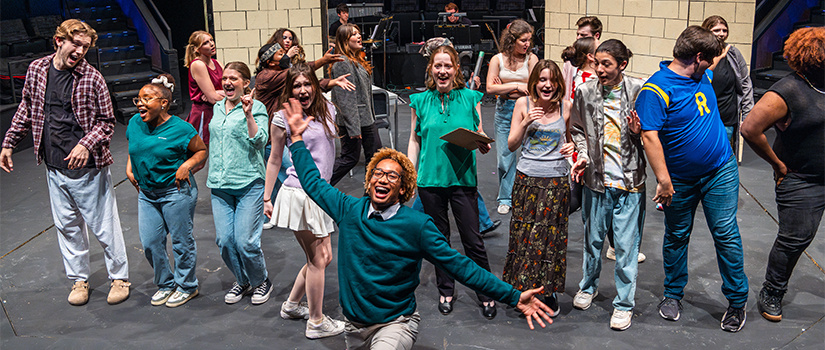
The musical by Tony award-winning composer Mark Hollman (Urinetown) and lyricist/bookwriters Kia Beth Kofron and Cooper Kofron was workshopped at the University of South Carolina earlier this year and will be performed April 28 and 29 at Longstreet Theatre.
“While the idea of joining a new musical was daunting at first, it was so exciting to watch the creative team in action and to jump into the changes that were made throughout the week of workshopping,” Alexander says. “I definitely feel that the process made me a stronger musician and improved my adaptability as a performer.”
Musical Theatre concentration coordinator and stage director Michelle Haché says she saw incredible growth in the students during the workshopping process, a method that readies a musical for production through rehearsals, revisions and rewrites.
“We are excited to be a part of the journey of this musical, knowing the USC School of Music will always be a part of its history,” Haché says.
The production of Rocky Mountain High also marks the first time a musical theatre performance will take place in one of the campus theatre spaces. Previously, all productions were in the School of Music Recital Hall.
The opportunity to perform at Longstreet Theatre excites senior Lily Smith from Atlanta. She says, “Adapting to changes in score and script has been challenging, but it has also stretched us as performers and provided us with an experience that none of us will forget.”
Senior Taylor McCullough notes that when a cast works on a musical that’s already published, there are previous recordings and other resources for reference. While she calls the process exhausting, she is grateful for the learning opportunity with Haché, Hollman, the production team and her fellow students.
“With workshopping an entirely new musical, there is nothing to help you except what your team gives you and what you as a professional performer can bring to the table,” McCullough says. “It has been such a rewarding experience because I get to be in a position that is very close, if not the very same as it would be in a professional theatre or Broadway production.”
One thing that drew me to USC was having the opportunity to study what I love underneath the larger umbrella of the School of Music. The concentration has given me the flexibility to study and practice several different genres of music, from classical to contemporary, which I truly feel has given me the tools to succeed as a well-rounded performer.
— Sarah Alexander, senior
Building a diverse concentration
Alexander and McCullough are among the first graduates with a musical theatre concentration, which was developed by School of Music voice faculty in 2019 and 2020 and was then added to School of Music programming in 2021 as Haché joined the faculty as coordinator.
“We’re hitting a new golden age of musical theatre, and the interest was extremely high in our concentration when we started it,” she says.
Haché focuses on building a diverse repertoire and providing holistic training, including business skills and industry knowledge, to ensure students can succeed in their field. The concentration includes 18 credit hours in classes in the Department of Theatre and Dance.
The seeds for the Music Theatre concentration were planted at least 20 years ago when students, potential students and faculty expressed interest in offering it in the curriculum, says Dean Tayloe Harding. Collaboration with the Department of Theatre and Dance to incorporate music students into courses they would require in movement and acting stalled.
That changed in the spring and summer of 2020 as the pandemic was raging, Harding says. The School of Music invested in a faculty position to teach musical theatre voice and administer the study, a staff accompanist, and some production funding.
“We were able to begin not a full bachelor’s degree major in musical theatre, but a concentration in that discipline as part of the Bachelor of Arts degree,” he says. “At the same time, the School of Music obtained support from the Department of Theatre and Dance to require a few of the latter’s classes in a new musical theatre concentration.”
The concentration was launched in August 2021 with a few students and has since grown to 16-18 students and has added an adjunct faculty member. An influx of students is expected this fall after a record number of auditions.
Students come from a variety of backgrounds and interests, ranging from classical to contemporary musical theatre, pop, rock, R&B, gospel and crossover.
“Whatever their background is or their knowledge of musical theatre, it's fun being able to say, ‘Let's start with what you know and what you love, and let's bring that over into the other time periods and styles of musical theatre,’” Haché says.
Alexander, who is from Sumter, South Carolina, transferred to USC her sophomore year and says it has been exciting to be a part of a concentration that is growing rapidly. She has been involved in multiple productions and showcases at USC, each providing unique opportunities.
“One thing that drew me to USC was having the opportunity to study what I love underneath the larger umbrella of the School of Music,” she says. “The concentration has given me the flexibility to study and practice several different genres of music, from classical to contemporary, which I truly feel has given me the tools to succeed as a well-rounded performer.”
As she has built the musical theatre concentration, Haché says one of her favorite things is also creating a family with a supportive and collaborative environment.
“We spend time together outside of classes and rehearsals, and I can confidently say that I have made lifelong friends through the concentration,” Alexander says. “I feel secure knowing that the relationships I’ve built in my time at USC will continue to support me as I continue on towards the next step.”
McCullough, who is from Kingstree, South Carolina, loves musical theatre because it is a form of art that allows every person’s story to be told and heard.
“It allows everyone to be their unique self. You don’t have to pretend to be someone you’re not,” says McCullough, a Music Theatre major with a Music Industry Studies minor. “Before coming to college, I always tried to make myself small and try to fit in, but Mrs. Haché showed me the world of musical theatre as well as what I can be in that world and the worlds I can create of my own.”
Haché explains that musical theatre has historically served as a mirror to the world, reflecting societal changes and addressing issues like racism and women's rights. The form also has evolved to become inclusive of various musical styles, offering opportunities for singers of all voice types.
McCullough has been in nearly all of the Musical Theatre productions since 2021.
“My repertoire from each USC production has been different, but all sharing a similar theme of dealing with different life situations while coming of age,” she says. “Each character I’ve played and song I’ve sung, I’ve learned something more about myself and the uniqueness of what I can bring to a character.”
I tell the students, ‘Whatever your dreams are, whatever your other passions are, let me know so that I can create opportunities for you. If somebody is interested in directing, I'll assign them as an assistant director in one of our shows. It is important that we create the opportunities for them to diversify their education to succeed in this industry.
– Michelle Haché, USC Musical Theatre concentration coordinator
Experiential learning and community outreach
Haché adds that students are fortunate to be starting their careers at a time when musical theatre is experiencing high popularity. Students in the first graduating class are pursuing diverse opportunities in musical theatre and related fields, arts administration, and continuing education.
For example, Alexander is planning to pursue a master’s in Vocal Performance/Music Theatre and an Advanced Certificate in Vocal Pedagogy at NYU Steinhardt with a goal to work as a voice instructor in a collegiate musical theatre program and as a performer.
“The School of Music has presented me with so many incredible opportunities to explore all of my specific interests and gain experience in several different areas throughout my time here. I’ve also had the opportunity to learn from some incredible mentors, and I am so grateful for those relationships,” she says.
In addition to class instruction, musical theatre students are involved in all aspects of production, including assistant directing, set building, costuming and social media promotion.
“I tell the students, ‘Whatever your dreams are, whatever your other passions are, let me know so that I can create opportunities for you,’” Haché says. “If somebody is interested in directing, I'll assign them as an assistant director in one of our shows. It is important that we create the opportunities for them to diversify their education to succeed in this industry.”
She added that a student designed the set for Rocky Mountain High, and a pizza party was in the works for the cast to help build it.
Smith, a Public Relations major, is one of the students who has taken on the role of assistant director for a production. She has been involved in four showcases and two musicals, including Rocky Mountain High.
“Experiential learning is a huge part of what we do in USC Musical Theatre, and Professor Haché gives us plenty of opportunities to explore our professional development,” Smith says. “I was nervous to begin the production of Rocky Mountain High, but after the first day of the workshop in January, we all realized just how fun and educational it would be.
Smith also promotes the Music Theatre concentration on social media, including a viral video of students performing “You Will Be Found” from Dear Evan Hansen in their costumes at a Halloween party. The video garnered 2.3 million views and increased followers to 12,500.
“We want people on campus and in Columbia to know who we are and what we bring to the table,” Smith says. “I’ve greatly enjoyed using my creativity to promote the impactful work that USC Musical Theatre does every semester. The viral video in the fall semester was a unique and fun experience for us.”
Haché emphasizes the importance of social media presence for the visibility of the concentration, not only to target audiences but also as a recruiting tool for potential students. She says the viral success of the “You Will Be Found” video brought global recognition to their concentration and gives Smith an impressive addition to her professional portfolio.
Students also learn the value of community outreach and collaboration through internships and partnerships, such as the generous offer from Trustus Theatre to loan costumes for Rocky Mountain High, which helped reduce costs and enhance the production quality.
In addition, Haché is artistic director of the USC Summer Musical Theatre Intensive, which provides immersive training and college audition coaching. The intensive has been successful as a recruitment tool and has produced revenue that can be reinvested into the Musical Theatre concentration, she says.
USC faculty are joined by Broadway professionals to lead two student cohorts. In one cohort, middle and high school students participate in a weeklong intensive, polishing their skills in voice, dance and acting. The second cohort is comprised of college-bound high school juniors and seniors who want to build, perfect and record their college audition packages and pre-screens.
Alexander, who has been a counselor and the administrative/teaching assistant for the summer intensive, says it has become her favorite week of the year.
“It is such a joy to connect with the students and witness their growth throughout the week, and I love getting to observe and learn from the incredible faculty,” she says. “It is what initially inspired me to go into pedagogy with the ultimate goal teaching.”
Adapting for the future
The Musical Theatre curriculum aims to instill a mindset of continuous learning in students, encouraging them to evolve with the industry to stay relevant and contribute to its future growth.
“We must keep our finger on the pulse of the industry – where the jobs and opportunities are for our students. We have to make sure that when we send our students out into the world, they are marketable and multifaceted,” Haché says.
Harding adds, “As the School of Music celebrates its centennial, the work of the students and faculty in the concentration are important contributors to the School of Music's growth and relevance.”
McCullough, who hopes to secure an artists and repertoire internship after graduation, also plans to audition for professional musicals.
“The School of Music has not only taught me irrepressible skills in vocal technique and professionalism, but also the importance of building and sustaining a welcoming community,” she says. “Working hard on personal growth is only half the battle, creating a community where you can work with others is crucial to building impactful projects.”