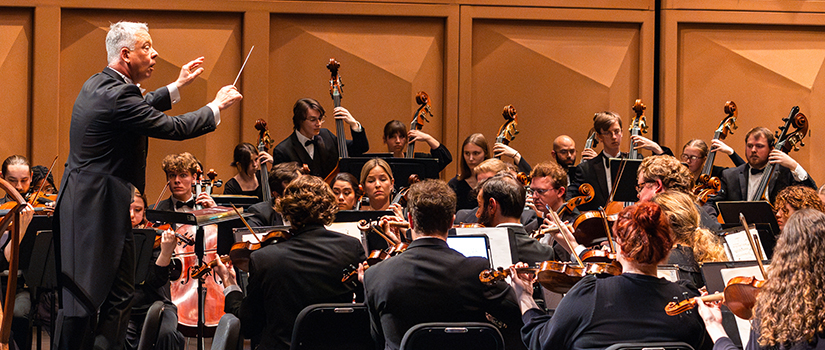
In my professional life, I have been able to do the two things I love most: teach amazing students and conduct some of the greatest music ever written. I feel enormously grateful.
— Scott Weiss, Sarah Bolick Smith Distinguished Professor of Music / Director of Orchestras
Among the season’s six concerts is Mahler’s Symphony No. 2, “Resurrection,” on April 22, featuring mezzo-soprano and USC vocal professor Rachel Calloway, soprano Tina Milhorn Stallard and the Choirs of Carolina — a work Weiss has waited decades to conduct.
“Since I was 15 years old, I have had a deeply personal connection to Mahler’s Second Symphony,” Weiss says. “It holds a very special place in my musical soul, and I have been waiting until I felt worthy to conduct it.”
Calloway, who has collaborated with Weiss and the USC and Aiken symphonies, calls him “a generous collaborator, always striving for cohesive and organic musical expression.”
From the USC Symphony Orchestra to the Aiken Symphony and South Carolina Ballet, Weiss’ legacy can be heard in the music he has conducted. Its deepest resonance, however, may be found in the musicians he has taught and the artistic culture he leaves behind.
“Scott has built something enduring at USC. His artistry has elevated our orchestra, but his greatest legacy is reflected in the musicians he has taught and inspired,” says Tayloe Harding, dean of the USC School of Music. “They leave USC understanding that great music-making requires not only excellence, but curiosity and generosity.”
That same generosity is at the heart of Weiss’ approach to teaching.
“Working with university students every day reminds you to be humble, to be flexible and to be kind,” Weiss says. “Teaching is about giving, not receiving. It’s not about me; it’s about the students.”
After more than three decades as a music professor, Weiss says his students have shaped him, too: “I am certain that 37 years of working with music students has made me into a better person and musician.”
USC Symphony alumna Julia Jacobsen says Weiss prepared students for more than the concert stage.
“He treated the USC Symphony like it was a professional orchestra in all aspects. He set the best possible example for the rest of us in terms of how we should approach our own music careers. In my five years as a professional, he continues to stand out as one of my favorite conductors to work with,” she says. “Professionalism is not something that is taught very often in music schools, but he embedded it within the operations of the orchestra and taught me the skills needed to succeed in the classical music profession in addition to being able to play at a high level.”
DMA candidate Edvan Moraes, assistant conductor of both the USC Symphony Orchestra and Aiken Symphony, has experienced Weiss’ mentorship from the podium.
“As he usually says, ‘We should look like the music,’” Moraes says. “Some of his traits as a teacher and as a human being are his generosity, hard work, communication skills and organizational abilities.”
“In my professional life, I have been able to do the two things I love most: teach amazing students and conduct some of the greatest music ever written,” Weiss says. “I feel enormously grateful.”
Click here to learn more about the USC Symphony Orchestra’s 2026-27 season.