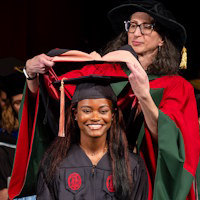
Victoria Adebiyi graduates with a Ph.D. in Health Promotion, Education, and Behavior (HPEB) this month after completing her global health dissertation project. She’s
currently working on two manuscripts that describe what she learned during a mixed-methods
study conducted in Nigeria.
Victoria Adebiyi has completed a Ph.D. in Health Promotion, Education, and Behavior.
With funding from the Nestlé Foundation and support from advisors both at the University
of South Carolina and the University of Ibadan, Nigeria, Adebiyi and her two research
assistants interviewed employed mothers of infants in urban Nigeria to better understand
their decision-making process related to whether they continued breastfeeding exclusively
after returning to work following maternity leave.
The research team also examined influences on the decision-making process of postpartum
mothers. For example, they examined the role that members of social networks (e.g.,
family members, friends) can play in mothers’ decisions around infant feeding.
“The World Health Organization recommends giving infants breast milk only – exclusive
breastfeeding for the first six months,” Adebiyi says. “Exposing infants to exclusive
breastfeeding is an important foundation for promoting adequate growth and brain development
for the children and preventing chronic diseases in adulthood. Formally employed mothers,
however, often struggle to continue exclusively breastfeeding their children, especially
after returning to work, partly due to inadequate maternity provisions and support
at the workplace.”
The project builds on more than a decade of public health nutrition experience that
began when Adebiyi was an undergraduate student at the University of Ibadan. She then
completed a hospital-based internship to become a registered dietitian – an experience
that fueled her passion for finding solutions to preventable diet-related chronic
diseases.
A scholarship from the Mastercard Foundation brought Adebiyi to the United States
where she studied public health nutrition as part of a master of public health program
at the University of California, Berkeley. When looking for researchers involved in
global health nutrition, she met HPEB faculty Leila Larson and Edward Frongillo and made her move to the Arnold School.
By believing in me, valuing my ideas, giving constructive feedback, and pushing me
to think broadly and critically, my advisors have prepared me to be a critical thinker
and researcher who will make valuable contributions to the field of global health.
I am taking these deeply impactful experiences with me as I graduate.
“The rigorous training I acquired under the supervision of my advisors, securing a
grant and leading my dissertation research in addition to the intensive class work
during this doctoral program have all equipped me with the skills I need for my future
work,” says Adebiyi, who plans to continue her work in a research institute. “My goal
is to contribute to our understanding of nutritional and health behaviors of populations
and to support the design, implementation and evaluation of evidence-based interventions
that will make a meaningful positive impact on population health.”
She is particularly grateful for the role of Larson and Frongillo in her professional
development.
“I have especially enjoyed the mentorship, guidance, and immense support from my advisors,”
Adebiyi says. “By believing in me, valuing my ideas, giving constructive feedback,
and pushing me to think broadly and critically, my advisors have prepared me to be
a critical thinker and researcher who will make valuable contributions to the field
of global health. I am taking these deeply impactful experiences with me as I graduate.”