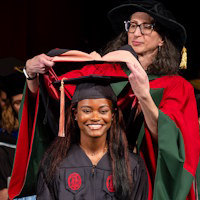
USC Presidential Fellow Keren Herrán graduates this month, and she’s ready to change the world. The global health researcher
gained a breadth and depth of international research experience during her Ph.D. in Health Promotion, Education, and Behavior (HPEB) program, and she will soon be lending her food insecurity and social connections
to the nonprofit sector.
Keren Herrán graduates this month with a Ph.D. in Health Promotion, Education, and
Behavior.
“The supportive environment and camaraderie, both from faculty and among doctoral
students within the HPEB program, have been critical as I explore next steps in my
career,” Herrán says. “Within the program, we celebrate each other’s accomplishments
and milestones as if they are our own and we share interview advice and job leads
with one another. I am grateful for Dr. Daniela Friedman’s years of leadership as former department chair in fostering the HPEB culture of
kindness, excellence and mutual support.”
Herrán joined the Arnold School in 2021, shortly after completing her bachelor’s degree
at the University of Maryland, Baltimore County focusing on global health and environmental
factors. Over the past four years, she has deepened her knowledge of how these areas
intersect through coursework focused on the social determinants of health, humanitarian
health, and qualitative and quantitative research methods.
She’s applied these lessons to her graduate research experiences – working with San
Francisco University of Quito and Brown University faculty to explore strategies for
decreasing adolescent pregnancy (publication here) and her advisor, Edward Frongillo, in collaborating with the National Center for Farmworker Health, where she also
spent a summer taking a deep dive into data collection as an intern (see what they
learned in this recent Frontiers publication).
“Dr. Frongillo’s mentorship has prepared me for the academic and nonprofit sector
by sharpening my critical thinking, writing and presentation skills,” Herrán says.
“I am thankful that what began as an email exchange with Dr. Frongillo my junior year
of college blossomed into years of impactful research training under his tutelage.
He has embraced my interest in exploring nonprofit research experiences and has inspired
me and countless other students with his remarkable career.”
The supportive environment and camaraderie, both from faculty and among doctoral students
within the HPEB program, have been critical as I explore next steps in my career.
Within the program, we celebrate each other’s accomplishments and milestones as if
they are our own and we share interview advice and job leads with one another.
Keren Herrán
Herrán’s doctoral program culminated with her dissertation project, which examined
Food insecurity and Social Connection of Nicaraguan refugees and asylum seekers in
Costa Rica. The semester she spent in Costa Rica collecting data for this project
was the perfect capstone to her previous international experiences as a student (Ghana,
Panama, Honduras, Nicaragua, Belize, Italy, Ecuador) before she moves forward to lead
new work as an independent researcher. Herrán is committed to making these types of
experiences available to future students as well.
In addition to conducting research in the nonprofit sector, Herrán plans to pursue
adjunct faculty roles where she can lead study abroad public health courses. Her three
years as an HPEB teaching assistant, completion of USC’s Integrative and Experiential
Learning and Preparing Future Faculty certificates, and mentorship experience in her
department and with the university’s First-Generation Center have all helped prepare her for this role.
Herrán graduates with six peer-reviewed publications to her name and several others
in preparation. Her dissertation publications will focus on understanding how Nicaraguan
refugees and asylum seekers experience and foster social connection in Costa Rica
and how social connections influence their food access.